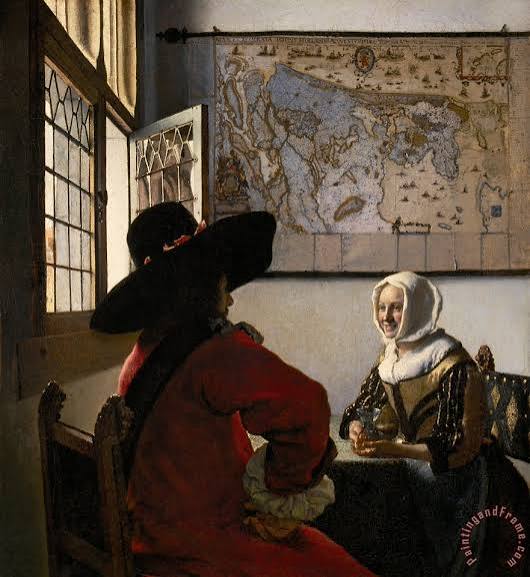
In the 1660s, Johannes Vermeer painted The Milkmaid with such precision that the bread on the table looks like it was captured by a lens, not a brush. Across the Dutch Republic, Rembrandt van Rijn was pulling prints from copper plates that seemed to breathe with light and shadow. Both artists worked in the same golden century, yet they used radically different tools to achieve their effects—one may have traced light itself, the other invented new ways to carve it.
This is the story of how two Dutch masters embraced technology—the camera obscura and the etching needle—and in doing so, changed the course of art forever.
A World Rebuilt on Trade and Observation
The Dutch Golden Age (c. 1588–1672) wasn’t just a time of tulips and trade. After breaking free from Spanish rule, the Dutch Republic became a bustling hub of commerce, science, and cultural experimentation. Protestant iconoclasm had stripped churches of religious imagery, freeing artists to explore the secular world—domestic interiors, portraits, landscapes, and still lifes.
A wealthy merchant class emerged, eager to decorate their homes with paintings that reflected their lives. This demand pushed artists to specialize and innovate. Nowhere was this more evident than in Delft, where the microscope was being pioneered by Antonie van Leeuwenhoek, and where Vermeer would quietly transform how artists saw the world.
Vermeer and the Camera Obscura: Tracing Light
Johannes Vermeer produced only about 34 to 37 paintings, a tiny output for an artist of his era. Each canvas—like The Music Lesson or Girl with a Pearl Earring—reveals an almost obsessive attention to light and geometry.
Art historian Philip Steadman, in his 2001 book Vermeer’s Camera, argues that Vermeer used a camera obscura to achieve this realism. The device, a darkened box with a lens that projects an image onto a surface, was known since antiquity but became more portable and precise in the 17th century.
The Evidence Inside the Paintings
Look closely at The Milkmaid or View of Delft. You’ll notice halation—glowing highlights where light blooms around edges, like the glint on a metal pitcher. There are also pointillés, tiny dots of light that appear on bread crusts or map edges, mimicking the way a lens renders out-of-focus specular highlights.
Steadman took this further. He reconstructed Vermeer’s studio from the paintings themselves, finding that dimensions like the floor tiles and window placements were consistent across multiple works. He then showed that this room, with its specific size and window layout, could have functioned as a giant camera obscura. The artist could have sat in the back, projected the scene onto his canvas, and traced the outlines.
The perspective in The Music Lesson converges with mathematical exactness—a level of precision that suggests tracing from a projected image rather than freehand drawing. Steadman’s reconstruction found that the vanishing point in several paintings aligns with where a camera obscura would have been positioned.
The Pushback
Here’s the catch: no inventory or document mentions Vermeer owning a camera obscura, and no preparatory sketches survive. Walter Liedtke, a former curator at the Metropolitan Museum of Art, argues that Vermeer’s realism came from careful observation and training, not mechanical aid.
But even skeptics admit the optical effects are there. Whether Vermeer traced projections or internalized optical principles through practice, his paintings display a lens-like understanding of light that was decades ahead of its time.
Rembrandt’s Etching Revolution: From Craft to Art
While Vermeer worked in the quiet of Delft, Rembrandt van Rijn was building a career in Amsterdam as a painter, draftsman, and printmaker. He left behind roughly 290 etchings—the largest body of graphic work by any major artist. And he transformed etching from a reproductive craft into a medium of artistic expression.
Etching works like this: you coat a copper plate with wax, draw through the wax with a needle to expose the metal, then bathe the plate in acid. The acid bites into the exposed lines, which can then be inked and printed. Earlier artists like Dürer had experimented with it, but it was often seen as inferior to engraving, where lines are cut directly into metal.
Drypoint and the Burr
Rembrandt’s key innovation was drypoint. In this technique, you draw directly on the plate with a needle, which throws up a rough edge of metal called a burr. When inked, this burr holds extra ink, producing rich, velvety lines. Rembrandt exploited this to create dramatic chiaroscuro, deep blacks that seemed to swallow light.
Multiple States and Experimentation
Rembrandt didn’t treat a finished plate as final. He constantly reworked his plates, printing multiple versions called “states.” The Three Crosses (1653) exists in at least five distinct states. In one, Christ is central; in another, he’s moved; in others, figures appear or vanish as Rembrandt scratched out or added lines.
He also experimented with different papers—including Japanese paper and vellum—and different inking techniques. He used sugar-lift and sulfur to create tonal variations, achieving effects that mimicked painting.
The Impact of Prints
His etchings circulated across Europe, making his art accessible to far more people than paintings could reach. They influenced generations of printmakers, from Goya to Picasso. Where Vermeer was a private genius, Rembrandt’s prints made him a public one.
Two Masters, Two Technologies, One Golden Age
Vermeer and Rembrandt represent two poles of the same revolution. Vermeer, if Steadman is right, used a mechanical aid to achieve a realism that still astonishes. Rembrandt used his hands and a needle to create an expressive intensity that no camera could capture.
Their works embody the Dutch Golden Age’s spirit of empirical inquiry and technical mastery—a time when artists didn’t just paint, they experimented with the latest tools, from lenses to acids. And in doing so, they not only created masterpieces but also expanded the definition of what art could be.
The question of whether Vermeer used a camera obscura may never be settled with certainty. But the debate itself shows how deeply his paintings engage with the optical science of his day. And Rembrandt’s etchings prove that technology isn’t a shortcut—it’s a material to be mastered. Together, they remind us that artistic genius often works hand in hand with the tools of its time.
Summary
- Vermeer likely used a camera obscura to trace compositions, as indicated by optical effects like halation and pointillés, and the geometric precision of his interiors.
- Rembrandt transformed etching into a fine art by using drypoint, multiple states, and varied papers to achieve painterly, expressive prints.
- The Dutch Golden Age’s scientific culture—from microscopes to lenses—provided fertile ground for these innovations.
- The debate over Vermeer’s tools underscores how technology can influence, but not replace, artistic vision.
- Rembrandt’s etchings made his art widely accessible, influencing generations of artists across Europe.
FAQ
Q: Did Vermeer actually use a camera obscura?
A: There is no documentary proof, but art historian Philip Steadman’s reconstruction of Vermeer’s studio, combined with optical effects in his paintings, makes a strong circumstantial case. Some scholars remain skeptical, arguing his realism came from observation alone.
Q: What is drypoint and why was it important in Rembrandt’s etchings?
A: Drypoint is a technique where the artist draws directly on a copper plate with a needle, creating a raised burr that holds ink. Rembrandt used it to produce rich, dark lines that added dramatic contrast to his prints.
Q: How many etchings did Rembrandt produce?
A: Rembrandt created about 290 etchings, the largest body of graphic work by any major artist. He constantly reworked his plates, creating multiple states that show his creative process.
Q: What is the significance of The Three Crosses?
A: The Three Crosses is famous for its radical changes across at least five states, where Rembrandt altered the composition dramatically, showing his willingness to reinvent a work even after it was printed.
Q: Why did the Dutch Golden Age produce such technical innovation in art?
A: The Dutch Republic’s prosperity, scientific curiosity, and a secular market for art encouraged artists to experiment with new techniques and tools, from optical devices to printmaking methods.
Leave a Reply