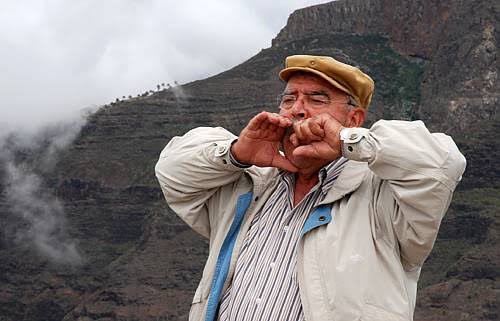
On the rugged island of La Gomera, where deep ravines slice the land into natural fortresses, a conversation can travel three kilometers without a phone line or a shout. It rides on a whistle, cutting through the silence with two tones and a handful of interruptions that somehow carry whole sentences in Spanish. This is Silbo Gomero, a whistled form of speech that has outlived its practical need and found a second life as a symbol of identity.
For centuries, this was the island’s version of a text message: shepherds on one ridge warning of danger, farmers coordinating harvests across valleys, neighbors sharing news without walking hours. Then roads came, telephones arrived, and Silbo nearly vanished. Today, it is a UNESCO-protected treasure, taught in every primary school on the island, and studied by neuroscientists as a window into how the brain processes language itself.
A Language Born from Geography
La Gomera is one of the smallest Canary Islands, but its terrain is brutally vertical. Barrancos—steep, narrow ravines—cut the island into isolated pockets where foot travel could take hours over treacherous paths. In this landscape, a voice carried only a few hundred meters, but a well-aimed whistle could travel up to five kilometers, bouncing off canyon walls.
The indigenous Guanche people, who arrived from North Africa centuries before the Spanish conquest, likely developed whistling as a practical tool. After the Spanish took over in the 15th century, the practice adapted: instead of whistling in Guanche, speakers began whistling in Spanish, transforming the spoken language into a series of pitch contours that could traverse the ravines.
Silbo Gomero is not a separate language—it is Spanish re-encoded into whistled tones. Vowels and consonants are reduced to just a few distinct pitch patterns: two vowel qualities and four to five consonant contrasts. The result sounds like a bird’s song to the untrained ear, but to a fluent whistler, it carries the full meaning of spoken Spanish.
The Mechanics: How Does Whistling Carry Language?
To understand Silbo, imagine stripping Spanish down to its bare essentials. Spoken Spanish has five vowels and around twenty consonants; Silbo reduces these to a simpler system. Vowels are distinguished by pitch level—high, low, or falling. Consonants are marked by interruptions or pitch breaks. For example, a continuous whistle might represent a vowel, while a sharp cut signals a consonant like ‘p’ or ‘t’.
Crucially, Silbo is not a code where each word has a fixed whistle. Instead, it re-encodes the phonology of Spanish. Listeners decode the whistled signal using context and redundancy, just as they would with mumbled speech or a noisy phone line. This is why Silbo can be learned as a natural language skill rather than memorized as a secret cipher.
In 2005, researchers led by Manuel Carreiras published a landmark study in Nature showing that Silbo Gomero activates the same left-hemisphere language areas of the brain as spoken Spanish. When fluent whistlers listened to Silbo, their brains processed it as language, not as music or ambient noise. This finding reshaped scientific understanding of what counts as language—proving that vocal cords are not essential for linguistic processing.
The Decline: Roads, Telephones, and Shame
Silbo Gomero thrived for centuries because it was essential. But in the mid-20th century, the island began to modernize. Roads connected previously isolated villages, making foot travel less necessary. Telephones arrived, allowing real-time conversation without stepping outside. And tourism began to reshape the economy, drawing younger generations away from the rural livelihoods of shepherding and farming that had sustained whistling.
Just as importantly, Silbo became stigmatized. Younger islanders associated it with an older, poorer way of life. Whistling in public was seen as rustic or backward, and many parents stopped teaching it to their children. By the 1970s, Silbo Gomero was on the brink of extinction, with only a handful of elderly speakers still using it regularly.
The Revival: Schools and UNESCO
The turnaround began in the 1980s, when a group of educators and linguists—most notably Isidro Ortiz—argued that Silbo was not a folkloric relic but a valuable cultural asset. They lobbied the regional government to introduce Silbo into the school curriculum, and in 1999, it became a mandatory subject in all primary schools on La Gomera.
This was a radical experiment: teaching a whistled form of speech as a second language to children who had grown up with telephones and paved roads. The program aimed not just to preserve Silbo but to give it a new generation of speakers. Today, over 3,000 students have gone through the Silbo curriculum, and estimates suggest that between 20,000 and 30,000 residents now have some level of understanding, though fluent, active whistlers remain in the low thousands.
UNESCO recognition added another layer of protection. In 2005, Silbo Gomero was proclaimed a Masterpiece of the Oral and Intangible Heritage of Humanity, and in 2009, it was inscribed on the Representative List. This global acknowledgment shifted local perception: what had once been a source of embarrassment became a source of pride. The Spanish government and the Canary Islands’ regional authorities now grant Silbo legal protection, and it is officially classified as an intangible cultural heritage asset.
What Silbo Teaches Us About Language and Identity
Silbo Gomero is one of around seventy documented whistled languages worldwide—from the whistled Turkish of Kuşköy to the Mazatec whistled speech in Mexico—but it is the most studied and best understood. Its survival offers a glimpse into how language adapts to extreme environments and how communities can actively reclaim a fading tradition.
For linguists, Silbo is a natural experiment in language universals. It shows that the human brain can process linguistic information through channels other than the voice, as long as the structural elements of language are preserved. For the people of La Gomera, Silbo is a link to their Guanche ancestors and to a rural past that modernization erased. It is a reminder that even in an age of instant global communication, a whistle across a canyon can still say something that a phone call cannot.
Despite its revival, Silbo remains vulnerable. Linguists note that the number of truly fluent whistlers is small, and the school program teaches a standardized version that may differ from the traditional dialects once spoken in different valleys. The challenge now is not just to keep Silbo alive in classrooms but to ensure it is used in daily life, not just performed as a cultural show.
The Future: A Whistle in the Digital Age
In 2024, Silbo Gomero faces a new set of pressures and opportunities. Tourism brings thousands of visitors each year, and Silbo has become a popular attraction, with demonstrations in San Sebastián de La Gomera and other towns. Some worry that this commodification could reduce Silbo to a folkloric performance, stripped of its original practicality.
But there are also signs of adaptation. Social media and video platforms have allowed young whistlers to share their skills with a global audience, and researchers have used smartphones to document and analyze the acoustic properties of Silbo in unprecedented detail. The island’s schools continue to teach Silbo to each new cohort, and the government has invested in community workshops and events.
Whether Silbo Gomero will survive the next century depends on whether it can evolve from a necessary tool into a chosen one. As one local teacher put it, “We don’t need to whistle to communicate anymore, but we choose to whistle to remember who we are.” In that choice lies the real hope for this forgotten language.
Silbo Gomero is more than a quirky remnant of a pre-technological past. It is proof that human communication can take astonishing forms when pushed by necessity—and that a community can deliberately rescue a language from the brink of silence. As long as there are children on La Gomera learning to whistle their names across a ravine, the oldest voice of the island will keep echoing.
Summary
- Silbo Gomero is a whistled form of Spanish used on La Gomera island, capable of traveling up to 5 km.
- It encodes Spanish phonology into pitch patterns and interruptions; not a separate language.
- In 2005, Nature research proved it activates brain language areas, not just auditory regions.
- Decline in mid-20th century due to roads, phones, and stigma; revived through school programs since 1999.
- UNESCO recognized it in 2009; now a cultural identity symbol, though still vulnerable.
FAQ
Q: Is Silbo Gomero a unique language?
A: No, it is a whistled adaptation of Spanish, reducing the language to a few pitch contours and interruptions. It is one of about 70 documented whistled languages worldwide.
Q: How far can a Silbo whistle be heard?
A: Under optimal conditions, a Silbo whistle can be understood up to 3–5 kilometers away, far beyond the range of a shout.
Q: Why is Silbo Gomero taught in schools?
A: To revive a dying practice, Silbo was made a mandatory subject in all La Gomera primary schools in 1999, teaching children the whistled language as a second language.
Q: What did the Nature study find about Silbo?
A: In 2005, researchers showed that fluent whistlers process Silbo in the same brain areas as spoken language, proving it is a true linguistic system, not just a code or music.
Q: Is Silbo Gomero in danger of dying out again?
A: While official protection and school programs have boosted numbers, fluent active whistlers remain few, making it still vulnerable despite a strong revival.
Leave a Reply