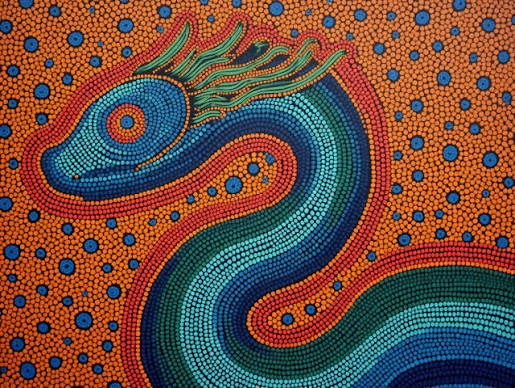
In the rugged landscapes of Arnhem Land, rock art panels depict a colossal snake with a kangaroo head, its body arching like a rainbow across the stone. These paintings are at least 6,000 years old, and some estimates push them to 10,000 years. They are the oldest surviving images of a being that has shaped Aboriginal Australian culture for millennia: the Rainbow Serpent.
This is not just a story of creation. It is a living mythology that explains the land, enforces law, and encodes ecological wisdom. From the monsoon-soaked north to the arid southwest, the Rainbow Serpent appears in the Dreaming stories of dozens of language groups, each with its own name and nuance. Its enduring presence in art, ceremony, and contemporary culture makes it one of the most significant ancestral beings in human history.
A Being of Many Names, One Essence
The Rainbow Serpent is known by many names across Australia. The Yolngu of Arnhem Land call it Yurlunggur; the Noongar of the southwest call it Wagyl; the Gunwinggu know it as Ngalyod; in northern Queensland it is Kunia. Each name reflects a local understanding, yet the core identity is remarkably consistent: a giant serpent that shaped the earth during the Dreaming.
The Dreaming, or Dreamtime, is not a distant past but a continuous, cyclical reality. Ancestral beings like the Rainbow Serpent moved across a featureless land, creating rivers, mountains, and waterholes through their actions. The serpent’s sinuous path carved the landscape, and its body became the rainbow that bridges sky and earth. This duality—creator and destroyer—is central to its power. It brings life-giving rain but also floods; it guards sacred sites but punishes transgressors.
The Oldest Myth in the World?
The antiquity of the Rainbow Serpent is staggering. Rock art in Arnhem Land depicting serpentine figures dates back at least 6,000 years, with some experts arguing for 10,000 years. This makes it one of the oldest continuous mythological traditions on Earth. Some researchers speculate the myth could be far older, potentially tracing to the first human settlement of Australia around 50,000–65,000 years ago, though direct evidence for the specific motif is missing.
What is clear is the geographical spread. The Rainbow Serpent appears in myths across most of mainland Australia, from the Kimberley to Cape York and down to the southwest. Its absence in Tasmania is telling: the land bridge connecting the island to the mainland was submerged around 10,000 years ago, likely before the myth became widespread. This geographic and temporal reach underscores its deep roots.
Regional Variations: A Serpent for Every Landscape
Arnhem Land: Yurlunggur and the Monsoon
For the Yolngu people, Yurlunggur is tied to the monsoon season. The serpent’s rising brings the rains that replenish waterholes and initiate new growth. Yurlunggur is central to initiation ceremonies, and its image is painstakingly painted on bark in intricate patterns. These artworks are not mere decoration; they are visual records of ancestral power and law.
Southwest Western Australia: Wagyl and the Swan River
The Noongar people tell of Wagyl, a serpent who slithered across the land, carving the Swan River and the Darling Scarp. Today, Wagyl is still revered as the guardian of water sources in the Perth region. Its presence is a reminder that the landscape is alive with ancestral significance, and that water—a scarce resource—must be protected.
Queensland: Reefs and Rivers
In coastal Queensland, the Rainbow Serpent is credited with creating parts of the Great Barrier Reef. Inland, it formed river systems. These stories link the serpent to both the sea and the land, showing how a single being can account for diverse geological features.
The Serpent as Lawgiver and Guardian
The Rainbow Serpent is not a passive creator. It is a moral authority. It punishes those who break taboos, disrespect elders, or misuse sacred knowledge. This role is reinforced in ceremonies where the serpent’s story is reenacted, reminding participants of the consequences of straying from cultural norms.
Its guardianship extends to sacred sites, especially waterholes, which are considered living entities. The serpent is believed to reside in these places, and disturbing them can bring misfortune. This belief system has practical implications: it enforces sustainable use of water and land, and it maintains respect for ancestral territories.
A Living Symbol in Contemporary Australia
The Rainbow Serpent has transcended its mythological roots to become a powerful symbol of Aboriginal identity and resilience. It appears in modern art, literature, and public murals, bridging ancient traditions with contemporary expression. The “Rainbow Serpent Festival” in Victoria, now renamed the Wanderer Festival, once bore its name, though it faced criticism for cultural appropriation—a reminder that the serpent’s power is not to be taken lightly.
In education, the myth is used to teach Aboriginal culture in schools, ensuring that new generations understand its significance. It also appears in environmental discussions, where the serpent’s connection to water and seasons resonates with current ecological concerns.
Why the Rainbow Serpent Matters Today
The Rainbow Serpent is more than an ancient tale. It is a framework for understanding the world. It encodes knowledge about water sources, seasonal rains, and animal behavior—practical wisdom that has sustained Aboriginal peoples for thousands of years. It connects people to their land in a profound way, making the landscape a living document of ancestral action.
In a time of environmental crisis, the serpent’s role as a guardian of water is particularly poignant. It reminds us that the Earth’s resources are sacred and must be respected. The Rainbow Serpent is not a relic; it is a living presence that continues to shape culture, law, and identity.
The Rainbow Serpent is a testament to the depth and sophistication of Aboriginal Australian culture. It is a creator, a destroyer, a lawgiver, and a guardian. For tens of thousands of years, it has been a source of meaning and guidance. Its image, carved into rock thousands of years ago, still speaks to us today. The serpent’s story is not just about the past; it is about how we relate to the land, to each other, and to the forces that shape our world.
Summary
- The Rainbow Serpent is a central ancestral being in Aboriginal Australian mythology, known by many names across different language groups.
- It is associated with creation, destruction, rain, water, and fertility, and is depicted as a giant serpent.
- Rock art of the Rainbow Serpent dates back at least 6,000 years, making it one of the oldest mythological traditions.
- The myth varies regionally, with specific stories tied to local landscapes and seasons.
- The serpent serves as a lawgiver and guardian of sacred sites, encoding ecological knowledge and reinforcing social norms.
- Today, it remains a symbol of Aboriginal identity and cultural resilience.
FAQ
Q: What is the Rainbow Serpent?
A: The Rainbow Serpent is a major ancestral being in Aboriginal Australian mythology. It is a giant serpent that is believed to have created rivers, mountains, and waterholes during the Dreaming, and is associated with rain, fertility, and the rainbow.
Q: How old is the Rainbow Serpent myth?
A: The myth is ancient. Rock art depicting serpent-like figures in Arnhem Land has been dated to at least 6,000 years old, with some estimates up to 10,000 years. Some researchers believe it could be even older, possibly dating back to the first human settlement of Australia.
Q: Where is the Rainbow Serpent found in Australia?
A: The Rainbow Serpent appears in myths across most of mainland Australia, including the Kimberley, Arnhem Land, Queensland, and southwest Western Australia. It is notably absent from Tasmania, likely because the land bridge was submerged before the myth spread.
Q: What is the cultural significance of the Rainbow Serpent?
A: The Rainbow Serpent is a lawgiver that punishes those who break cultural rules. It is also a guardian of sacred sites, especially waterholes, and encodes ecological knowledge about water and seasons. It features prominently in art, ceremony, and contemporary Aboriginal identity.
Q: How is the Rainbow Serpent represented in modern times?
A: The Rainbow Serpent appears in contemporary Aboriginal art, literature, and public murals. It is used in education to teach about Aboriginal culture and has become a symbol of cultural resilience. However, its name has also been used in events that faced criticism for cultural appropriation.
Leave a Reply