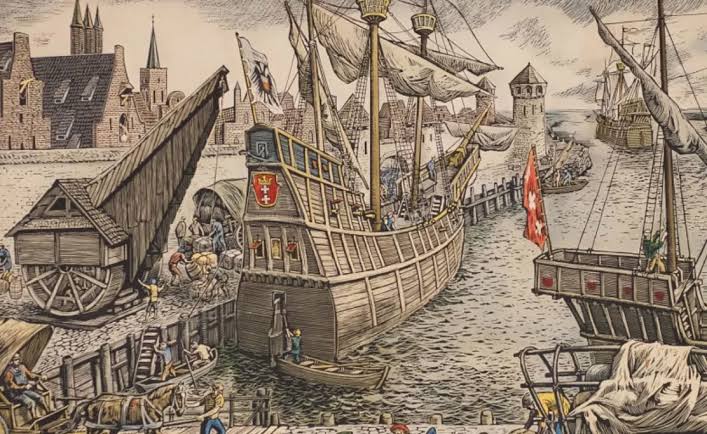
In the 14th century, a merchant from Lübeck could sail to Novgorod, sell Flemish cloth, buy Russian furs, and return home without ever worrying about border checks, currency exchange, or whether a foreign court would enforce his contracts. That was the miracle of the Hanseatic League a commercial network that spanned over 4,000 kilometers and dominated Northern European trade for 300 years, all without an army, a flag, or a central government.
The League was not a state. It was a voluntary, polycentric network of more than 200 towns and merchant guilds that pooled resources for mutual defense and profit. Its innovations from extraterritorial trading posts to collective embargoes—laid the groundwork for modern trade, and its rise and fall offer lessons that still resonate in today’s global economy.
The Problem: A Feudal Patchwork of Chaos
Europe in the High Middle Ages was a mess of feudal fiefdoms, each with its own laws, tariffs, and currency. A merchant traveling from Cologne to London had to navigate dozens of tolls, risk banditry on land and piracy at sea, and hope that a foreign ruler would honor a contract signed in another jurisdiction. There was no central authority to standardize weights and measures or enforce agreements. Trade was a gamble, and most merchants stayed close to home.
The Hanseatic League solved this problem not by building an empire, but by building a network. Its members—towns like Lübeck, Hamburg, and Bremen—agreed to protect each other’s merchants, standardize trade practices, and present a united front to foreign powers. The League’s first formal act was a mutual protection treaty between Lübeck and Hamburg in 1241, but by the 1350s, it had grown into a confederation that could challenge kings.
The Kontor: A Free-Trade Zone in a Foreign Capital
The League’s most enduring innovation was the kontor system. These were self-governing merchant enclaves established in foreign cities, operating under extraterritorial privileges granted by local rulers. The four principal kontors were in Bergen, Novgorod, Bruges, and London—each specializing in key commodities. The London Steelyard, for instance, was a walled compound with warehouses, offices, residences, and its own court. It functioned as a free-trade zone within a foreign capital, governed by Hanseatic law, not English law.
Kontors were more than just trading posts. They served as chambers of commerce, consulates, and arbitration courts rolled into one. Young merchants were sent there as apprentices, learning the ropes of international commerce, languages, and law on the job. This was the medieval equivalent of a multinational corporation’s overseas branch, complete with its own legal jurisdiction.
The kontor system gave Hanseatic merchants a competitive edge. They could operate in foreign markets with the same legal protections they enjoyed at home, reducing the risk of fraud or expropriation. This extraterritoriality was a radical departure from the norm, and it laid the groundwork for the consular system and international trade law that we know today.
The League’s Playbook: Embargoes, Blockades, and Leverage
The Hanseatic League had no standing army, but it wielded formidable power through economic leverage. Its most potent weapon was the Verhansung, a trade embargo that excluded a city or region from the League’s network. When the League imposed an embargo on a rival—be it a recalcitrant prince or a competing merchant group—it cut off their access to essential goods like salt, herring, and grain. The threat of exclusion was often enough to bring opponents to the negotiating table.
The League also used military force when necessary, but always in a coordinated, strategic manner. During the Confederation of Cologne (1367–1370), a coalition of Hanseatic cities and their allies went to war with Denmark over trading rights in the Baltic. The resulting Treaty of Stralsund gave the League unprecedented control over the herring trade and the Sound, the strait connecting the North Sea to the Baltic. This was not conquest in the traditional sense; it was the enforcement of commercial privileges through collective action.
This playbook—economic coercion backed by the threat of force—would later be adopted by the Dutch East India Company and the British Empire. The League proved that a network of cities could project power more effectively than many a king.
A Network, Not an Empire: The League’s Governance
The League was notoriously decentralized. It had no formal constitution until its later years, no permanent bureaucracy, and no single leader. Instead, decisions were made at irregular Hansetage (diets), where delegates from member cities gathered to vote on matters of common concern. Attendance was voluntary, and resolutions were not always binding, yet the League held together for centuries.
This polycentric structure was both its strength and its weakness. It allowed for flexibility and local autonomy, but it also made the League slow to respond to challenges. As the political landscape of Europe shifted in the 15th and 16th centuries—with the rise of powerful nation-states and the discovery of new trade routes—the League’s loose confederation struggled to adapt. Its internal discord and inability to enforce discipline among members led to its gradual decline.
The Golden Age and the Decline
The League’s golden age ran from roughly 1375 to 1450. During this period, it held a near-monopoly on Baltic trade, moving grain, timber, furs, and herring across a vast network that stretched from London to Novgorod. The wealth generated by this trade fueled the urbanization of Northern Europe and the rise of a merchant middle class that was distinct from both the feudal nobility and the peasantry.
But the seeds of decline were already sown. The League had always been a defensive alliance, and its power rested on the willingness of its members to cooperate. As the Dutch and English developed their own merchant fleets and began to challenge Hanseatic dominance, the League’s internal divisions became more pronounced. The discovery of the Americas and the shift of trade routes to the Atlantic further marginalized the Baltic trade.
By the late 16th century, the League was a shadow of its former self. The final Hansetag was held in 1669, with only nine cities in attendance. Lübeck, Hamburg, and Bremen continued to call themselves Hanseatic cities, and they still do today—a testament to the League’s enduring legacy.
The Legacy: How the Hanseatic League Shaped Modern Trade
The Hanseatic League may have dissolved, but its innovations live on. The kontor system evolved into the modern concepts of the free-trade zone and the consulate. The League’s use of embargoes and economic sanctions became a standard tool of international relations. Its preference for standardized weights, measures, and accounting practices facilitated the growth of commerce in an era before double-entry bookkeeping and formal banking.
More importantly, the League demonstrated that trade could flourish without central authority. It was a bottom-up, cooperative enterprise that proved the power of voluntary networks. In an age of global supply chains and digital marketplaces, the Hanseatic League’s model of decentralized, self-governing commerce feels remarkably prescient.
The Hanseatic League was not the first merchant association, but it was the first to achieve such scale and sophistication. It invented the playbook for modern trade, and its lessons—about the importance of trust, legal certainty, and collective action—remain as relevant today as they were in the 14th century.
The Hanseatic League was a merchant adventurer’s dream: a network that made trade safer, faster, and more profitable across a third of a continent. It thrived for three centuries because it solved a problem that still plagues global commerce—how to build trust in a fragmented world. Its story is a reminder that trade is not just about goods and money, but about the institutions and networks that make exchange possible. And as we navigate the complexities of modern globalization, we can still learn from the league of cities that invented modern trade.
Summary
- The Hanseatic League was a commercial and defensive confederation of merchant guilds and towns, active from the mid-12th to the 17th century, with over 200 member towns at its peak.
- It solved the problem of feudal fragmentation by creating a voluntary, polycentric network that provided security, standardization, and legal protections for merchants.
- The kontor system—self-governing trading posts in foreign cities—was a forerunner to modern free-trade zones and consulates.
- The League wielded power through economic leverage, including embargoes and blockades, rather than standing armies, and its governance was decentralized, with decisions made at irregular diets.
- Its decline came from internal divisions and external competition (Dutch and English), but its innovations shaped modern trade practices, and Lübeck, Hamburg, and Bremen still bear the Hanseatic title.
FAQ
Q: What does ‘Hanse’ mean?
A: ‘Hanse’ comes from the Middle Low German word for ‘company’ or ‘guild,’ reflecting the League’s origins as an association of merchant guilds.
Q: Was the Hanseatic League a state or an empire?
A: Neither. It was a voluntary, polycentric network of cities and merchant guilds that cooperated for mutual defense and commercial advantage, without a central government or standing army.
Q: What were the main trading posts of the League?
A: The four principal kontors were in Bergen (fish), Novgorod (furs and wax), Bruges (cloth and luxury goods), and London (wool and cloth).
Q: How did the League enforce its rules without an army?
A: It used economic leverage, such as embargoes (Verhansung) and blockades, to pressure rivals and members alike. It also occasionally formed ad hoc military coalitions, as in the war against Denmark.
Q: What caused the League’s decline?
A: The rise of Dutch and English competition, shifting trade routes to the Atlantic, internal discord, and the growing power of nation-states all contributed to the League’s decline. The final diet was held in 1669 with only nine cities attending.
Leave a Reply