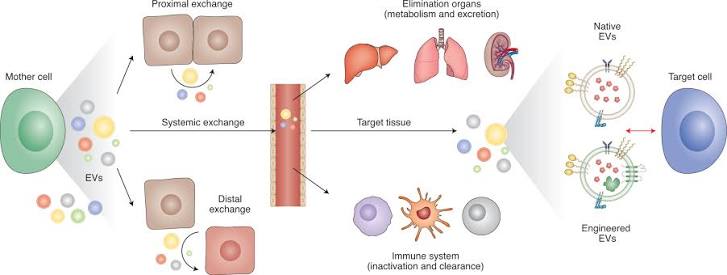
Every cell in your body releases tiny bubbles called exosomes. For decades, scientists dismissed them as cellular waste. Now, these nanoparticles are being repurposed as delivery vehicles for drugs, RNA therapies, and other treatments potentially reaching targets that conventional carriers cannot.
Exosomes range from 30 to 150 nanometers in diameter, about one-thousandth the width of a human hair. They are produced by nearly all cell types and circulate in blood, urine, saliva, and even breast milk. Their natural role is to shuttle proteins, lipids, and genetic material between cells, effectively serving as the body’s own communication system.
What makes exosomes attractive for drug delivery is their biocompatibility, low toxicity, and ability to cross biological barriers like the blood-brain barrier. Unlike synthetic nanoparticles, exosomes are recognized as ‘self’ by the immune system, reducing the risk of rejection. However, significant challenges remain in manufacturing, standardization, and regulatory approval. This article explains how exosome drug delivery works, its current status, and what hurdles must be overcome before it becomes a mainstream medical tool.
How Exosomes Are Made and What They Carry
Exosomes are formed through the endosomal pathway. Inside cells, inward budding of endosomal membranes creates multivesicular bodies (MVBs) filled with small vesicles. When an MVB fuses with the cell’s outer membrane, these vesicles are released into the extracellular space as exosomes.
The composition of exosomes reflects their cell of origin. They carry a variety of molecules:
- Proteins: Including tetraspanins (CD9, CD63, CD81) that are commonly used as markers, and integrins that may influence tissue targeting.
- Lipids: A lipid bilayer that protects the cargo from enzymes in the bloodstream.
- Nucleic acids: mRNA, microRNA, and other non-coding RNAs that can alter gene expression in recipient cells.
Because they are natural carriers, exosomes can deliver therapeutic payloads—such as small interfering RNA (siRNA), messenger RNA (mRNA), proteins, or small-molecule drugs—directly to target cells. The lipid bilayer shields the cargo from degradation, while surface proteins help the exosome bind to specific cell types.
Why Exosomes Could Outperform Synthetic Nanoparticles
Current drug delivery systems, like lipid nanoparticles (LNPs) used in mRNA COVID-19 vaccines, have limitations. LNPs tend to accumulate in the liver, can trigger immune responses, and have poor targeting to tissues outside the liver. Exosomes offer several potential advantages:
- Biocompatibility: Since they are naturally derived, exosomes are less likely to be attacked by the immune system.
- Targeting: Surface proteins can be engineered to recognize specific cells, such as cancer cells, improving precision and reducing side effects.
- Blood-brain barrier penetration: Some exosomes can cross the blood-brain barrier, which is a major obstacle for delivering drugs to the brain.
- Low toxicity: Preclinical studies generally show favorable safety profiles, with fewer off-target effects.
These properties have sparked a boom in exosome research, moving from basic biology to therapeutic applications.
Current Status: Clinical Trials and Commercial Efforts
As of 2025, dozens of clinical trials are registered worldwide testing exosome-based therapies. Examples include:
- Exosomes loaded with curcumin for colorectal cancer
- Mesenchymal stem cell (MSC)-derived exosomes for ischemic stroke
- Exosomes carrying KRAS-G12D siRNA for pancreatic cancer
Despite this activity, no exosome-based drug has received full FDA approval. Most candidates are in Phase I or II trials, which primarily test safety and preliminary efficacy. Several companies are leading the effort:
- Codiak BioSciences: Develops engineered exosomes with specific surface modifications.
- Evox Therapeutics: Focuses on exosome-based delivery for rare diseases.
- ExoCoBio: Works on exosome-based cosmetics and therapeutics.
- Aruna Bio: Targets neurological disorders with exosome carriers.
These companies are investing heavily in scaling up production and overcoming manufacturing hurdles.
The Challenges: Manufacturing, Loading, and Regulation
Despite the promise, exosome drug delivery faces significant obstacles:
Scalability
Producing exosomes in large, consistent batches is difficult. Yields from cell culture are low, and the process is expensive. Researchers are exploring bioreactors and continuous production methods, but standardization remains a challenge.
Isolation and Purification
Separating exosomes from other extracellular components is tricky. Common methods include ultracentrifugation, size-exclusion chromatography, and tangential flow filtration. Each has trade-offs between purity, yield, and integrity. Contaminants like protein aggregates can reduce effectiveness and cause immune reactions.
Loading Efficiency
Getting therapeutic cargo into exosomes is not straightforward. Techniques like electroporation, sonication, and incubation have variable success, especially for hydrophilic molecules. Some researchers engineer producer cells to package the drug during exosome formation, which can improve loading but complicates the manufacturing process.
Regulatory Ambiguity
Regulatory agencies like the FDA and EMA have not yet defined a clear framework for exosome-based products. Are they a drug, a biologic, or a medical device? This ambiguity slows approval and confuses developers. The lack of universal characterization standards—despite MISEV guidelines for research—makes quality control difficult.
The Road Ahead: Balancing Hype and Evidence
Proponents argue that exosomes represent the next generation of drug delivery, combining the precision of biologics with the versatility of nanocarriers. Engineered exosomes show remarkable efficacy in animal models of Parkinson’s, Alzheimer’s, and various cancers. However, critics point to reproducibility issues and the gap between animal studies and human results. Many published studies lack rigorous controls, and the field has been accused of overhyping early findings.
To move forward, researchers need to:
- Develop standardized methods for exosome production and characterization.
- Conduct larger, well-controlled clinical trials.
- Work with regulators to establish clear guidelines.
If these challenges are met, exosome drug delivery could become a powerful tool for precision medicine, offering targeted treatments with fewer side effects than current approaches.
Exosome drug delivery is at an exciting but precarious stage. The underlying biology is compelling, and early trials show promise. Yet, the path to clinical adoption is long and fraught with technical and regulatory hurdles. As research advances and manufacturing improves, exosomes may indeed become a mainstay of precision medicine. For now, they remain a promising frontier—one that requires careful scientific rigor to translate from bench to bedside.
Summary
- Exosomes are natural nanoparticles (30–150 nm) that carry proteins, lipids, and RNA between cells, making them promising drug carriers.
- Advantages over synthetic carriers include biocompatibility, low toxicity, and the ability to cross the blood-brain barrier.
- Dozens of clinical trials are underway, but no exosome-based drug has been approved yet.
- Major challenges include scalable production, efficient cargo loading, and regulatory ambiguity.
- Overcoming these hurdles could lead to targeted therapies with fewer side effects for diseases like cancer and neurological disorders.
FAQ
Q: What are exosomes exactly?
A: Exosomes are tiny extracellular vesicles (30–150 nm) released by nearly all cells. They contain proteins, lipids, mRNA, and microRNA, and act as natural messengers between cells.
Q: How can exosomes be used to deliver drugs?
A: Scientists can load exosomes with therapeutic molecules like siRNA, mRNA, or small-molecule drugs. The exosomes protect the cargo and deliver it to specific cells by exploiting surface proteins that bind to target tissues.
Q: Are there any approved exosome-based drugs?
A: No, as of 2025, no exosome-based therapeutic has received full regulatory approval. Several are in clinical trials (Phase I/II) for conditions like cancer and stroke.
Q: What are the main challenges in developing exosome therapies?
A: Key challenges include scaling up production, isolating pure exosomes, efficiently loading them with drugs, and establishing regulatory standards. Batch-to-batch variability and reproducibility are also concerns.
Q: Can exosomes cross the blood-brain barrier?
A: Some exosomes can cross the blood-brain barrier, which is a significant advantage for treating neurological diseases. This property is being studied in clinical trials for conditions like Alzheimer’s and stroke.
Leave a Reply