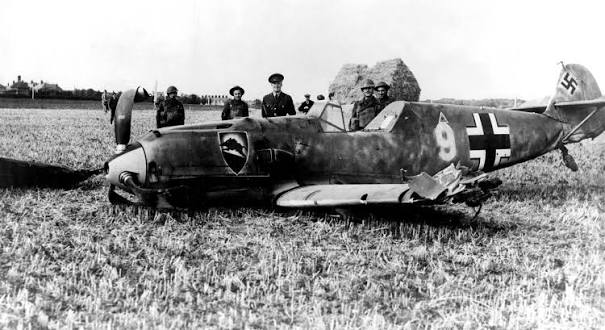
In the summer of 1940, Britain stood alone. France had fallen, the British Expeditionary Force had been evacuated from Dunkirk, and Hitler expected London to sue for peace. Instead, the RAF prepared to fight for its survival. From July to October, the skies over southern England became the stage for a desperate duel that would decide whether Germany could invade at all. This is the story of how a small, integrated air-defense system and a handful of pilots broke the Luftwaffe’s might and changed the course of the war.
The Dowding System: Britain’s Secret Weapon
Air Chief Marshal Hugh Dowding, the head of Fighter Command, had spent years building something the Luftwaffe didn’t fully understand: a centralized air-defense network. Chain Home radar stations along the coast could detect enemy aircraft up to 120 miles away. The Observer Corps tracked planes that flew too low for radar. Filter rooms sorted the data, and operations rooms used radio-telephony to guide squadrons precisely to their targets.
This system meant RAF pilots didn’t have to waste fuel on standing patrols. They could stay on the ground until the radar showed a raid forming, then be vectored into position. It was efficient, flexible, and—crucially—it conserved both aircraft and pilots’ energy. By contrast, the Luftwaffe flew long missions over hostile territory, their fighters often operating at the very edge of their range.
The Pilots: A Multinational Few
The RAF’s pilots were a mixed lot. Many were British, but a significant number came from Poland and Czechoslovakia—men who had fled their occupied homelands and were burning to fight. There were also New Zealanders, Canadians, Australians, South Africans, Belgians, and even a handful of Americans who had joined the RAF before the United States entered the war.
These men flew two main fighters. The Supermarine Spitfire was fast and agile, a match for the Messerschmitt Bf 109. The Hawker Hurricane was slower but tougher and more stable—a workhorse that could take punishment and dish it out. Together, they formed the backbone of Fighter Command.
By August, the RAF was losing pilots faster than it could train them. The average pilot’s life expectancy in combat was measured in weeks. Yet they kept taking off, day after day, to meet the waves of German bombers and fighters.
The Battle Shifts to the Airfields
Hitler’s Directive No. 17, issued on 1 August, authorized an intensified air offensive. On 13 August—Adlertag, or “Eagle Day”—the Luftwaffe launched its main assault on RAF airfields. For weeks, German bombers and fighters pounded the bases in southeast England. The goal was to destroy the RAF on the ground and in the air, clearing the way for Operation Sea Lion, the planned invasion.
It was a close-run thing. By early September, Fighter Command was reeling. Airfields were cratered, radar stations were occasionally hit, and pilots were exhausted. But the Luftwaffe had made critical errors. It failed to systematically destroy the radar chain—the very eyes of the Dowding System. And Göring, the Luftwaffe chief, kept interfering with fighter tactics, ordering Bf 109s to fly closer escort to the bombers, which reduced their endurance and made them less effective in dogfights.
The Fatal Switch to London
Then, on 7 September, the Luftwaffe made its biggest mistake. Instead of continuing to hit the airfields, it shifted to mass daylight bombing of London. The switch was partly a response to a British raid on Berlin and partly an attempt to break civilian morale. But it gave the RAF a reprieve.
Air Vice-Marshal Keith Park, commanding No. 11 Group, which bore the brunt of the battle, used the lull to rebuild his squadrons. Aircraft production was now exceeding losses—about 470 new fighters rolled off the lines in September, versus roughly 440 lost. But pilot numbers remained dangerously thin.
The Turning Point: 15 September
On 15 September 1940, the Luftwaffe launched its biggest daylight raid yet on London. Over 1,000 aircraft crossed the Channel. The RAF was waiting. In a series of sharp engagements, the fighters broke up the raid, shooting down dozens of German aircraft. The Luftwaffe lost 56 planes that day; the RAF lost 28. It was a decisive defeat.
Two days later, on 17 September, Hitler postponed Operation Sea Lion indefinitely. The invasion was never attempted. The battle officially ended on 31 October, with the Luftwaffe largely abandoning daylight operations.
Why the RAF Won
The RAF’s victory was not inevitable. It rested on three pillars: the Dowding System’s efficiency, British industrial resilience, and German strategic blunders. The Luftwaffe’s intelligence repeatedly overestimated the damage it had inflicted, reporting Fighter Command as nearly destroyed when it was still flying. Göring’s decision to switch to London gave the RAF just enough breathing room to recover. And the Luftwaffe’s failure to destroy the radar chain meant the RAF could always know where the enemy was.
But ultimately, it was the pilots—the Few—who made the difference. They flew relentless sorties, often several per day, against superior numbers. They were outnumbered, but they were not outthought. The Dowding System ensured they were in the right place at the right time, and their aircraft were equal to anything the Germans could send against them.
By the end of the battle, the RAF had lost about 1,547 aircraft and 544 pilots killed. The Luftwaffe lost nearly 1,900 aircraft and over 2,500 aircrew. The Luftwaffe could not replace its losses at the same rate. The RAF could.
The Legacy
Winston Churchill immortalized the pilots in a single phrase: “Never in the field of human conflict was so much owed by so many to so few.” The Battle of Britain was the first major Allied victory of the war. It showed that Hitler could be stopped, that Germany was not invincible. It kept Britain in the war as a base for the liberation of Europe, and it gave hope to occupied nations.
For the German side, the battle was a strategic failure. The Luftwaffe had been blunted, and the invasion never came. The war would drag on for another five years, but the skies over Britain had taught the world that a determined defense, built on intelligence and resilience, could defeat even the most formidable air power.
The Battle of Britain was not just a battle between aircraft; it was a battle between systems. The Dowding System proved that integrated air defense could turn the tide, and the pilots who flew those Spitfires and Hurricanes became the embodiment of resistance. Their victory in the autumn of 1940 was a turning point that shaped the outcome of World War II, ensuring that Britain would remain a beacon of defiance in a darkened Europe.
Summary
- The Battle of Britain (10 July – 31 October 1940) was a decisive RAF victory that prevented a German invasion.
- The Dowding System—radar, Observer Corps, and centralized command—gave the RAF a tactical edge.
- The Luftwaffe made critical errors: failing to destroy radar, switching to bombing London, and underestimating RAF strength.
- The RAF lost 1,547 aircraft and 544 pilots; the Luftwaffe lost 1,887 aircraft and over 2,500 aircrew.
- The victory kept Britain in the war and marked the first major Allied defeat of Nazi Germany.
FAQ
Q: Why did the Luftwaffe switch from attacking airfields to bombing London?
A: Partly in response to a British raid on Berlin and partly to break British morale. It was a strategic blunder because it gave Fighter Command time to recover.
Q: What was the Dowding System?
A: It was an integrated air-defense network using radar, Observer Corps, filter rooms, and radio-telephony to guide fighters precisely, conserving resources and improving effectiveness.
Q: How did aircraft production compare between the RAF and Luftwaffe?
A: British production exceeded losses, with about 470 new fighters in September 1940 versus 440 lost. The Luftwaffe could not replace its losses at the same rate.
Q: Who were ‘The Few’?
A: The pilots of RAF Fighter Command, including British and Commonwealth pilots, as well as Poles, Czechs, Belgians, French, and Americans. Churchill’s phrase immortalized them.
Q: When did Hitler postpone the invasion?
A: On 17 September 1940, two days after the RAF’s decisive victory on 15 September, Hitler postponed Operation Sea Lion indefinitely.
Leave a Reply