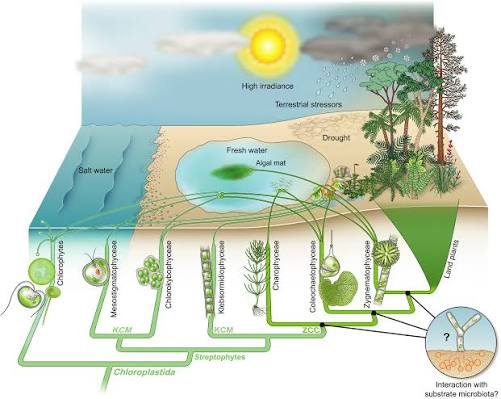
When we think of the Anthropocene, we often picture doom: melting glaciers, bleached corals, and forests reduced to tinder. But beneath this apparent chaos, a quieter, more hopeful story is unfolding. Plants—the very foundation of terrestrial life—are not just passively suffering under climate change; they are evolving at breakneck speed. From urban weeds that have altered their seed size in just a few generations to alpine flowers hybridizing into new species, the human-altered planet is becoming a crucible of evolution.
This isn’t to downplay the crisis. Many species are struggling, and extinctions are real. But the narrative of inevitable decline overlooks the remarkable adaptive capacity of flora. As Fred Pearce argues in his book Despite it All, the Anthropocene is not merely destroying nature—it is also turbocharging evolution itself. The catch? Our conservation strategies, often fixated on preserving ‘pristine’ ecosystems, may be hindering this adaptive surge. To truly help plants survive, we may need to rethink what ‘conservation’ means in an age of rapid change.
The Hidden Resilience of Plants
Plants are masters of adaptation, far more flexible than we often give them credit for. Unlike animals, which can move to escape unfavorable conditions, plants are rooted in place—so they must evolve or die. Under the intense selection pressures of climate change—drought, heat, shifting seasons—many species are responding with astonishing speed.
Take the case of Crepis sancta, a daisy relative that grows in the cracks of city sidewalks. In urban environments, where seeds that land on concrete are doomed, this plant has evolved to produce heavier seeds that are more likely to fall into the soil nearby. This shift occurred in just a few generations—a blink of an eye in evolutionary terms. Similar stories abound: flowering times are advancing as plants track earlier springs, and some species are altering their leaf shapes and root depths to cope with changing water availability.
These changes are driven by several mechanisms. Phenotypic plasticity allows plants to adjust their physical traits within a single generation, without any genetic change. Epigenetic modifications can switch genes on or off in response to stress, and these changes can be passed to offspring. And when environmental pressures are strong, rapid genetic selection can favor individuals with advantageous mutations, leading to evolutionary shifts in just a few years.
Hybridization: Nature’s Innovation Engine
One of the most exciting—and controversial—aspects of Anthropocene evolution is hybridization. As climate zones shift, species that were once geographically isolated are now coming into contact. When they interbreed, they can produce hybrid offspring with novel trait combinations. In alpine regions, for example, warming temperatures are pushing species upslope, causing them to overlap and hybridize. Some of these hybrids may be better suited to the new conditions than either parent species.
Hybridization is not just a curiosity; it’s a powerful engine of innovation. It can introduce new genetic diversity, allowing populations to adapt more quickly to changing environments. In some cases, hybrids can even become new species, a process known as hybrid speciation. This is happening in real time, as plants like sunflowers and certain grasses form hybrid swarms in disturbed habitats. Pearce argues that we should see this not as a threat to ‘pure’ species, but as nature’s way of creating resilience.
The Migration Lag and the Role of Human Transport
Climate models suggest that many plants will need to migrate at rates of 1–10 kilometers per year to track their preferred climate conditions. Most plants can’t move that fast on their own—their seeds are dispersed by wind, water, or animals, often over short distances. This ‘migration lag’ is a major concern for conservationists. But humans are inadvertently helping. We transport seeds across continents in our shoes, on our vehicles, and in agricultural shipments. While this has led to problematic invasions, it also means that some species are finding new homes faster than they could naturally.
In the Anthropocene, human-altered landscapes—cities, highways, farmlands—are not just barriers; they can be corridors for movement. Urban heat islands, for instance, mimic the conditions of warmer climates, allowing species to ‘pre-adapt’ to future warming. Industrial sites, with their contaminated soils and extreme conditions, are becoming laboratories for evolution, selecting for plants that can tolerate heavy metals or drought. These ‘novel ecosystems’ are not ecological wastelands; they are crucibles of adaptation.
Rethinking Conservation for a Changing World
Our traditional conservation framework is rooted in a backward-looking ideal: restore ecosystems to a pre-human ‘baseline’ and keep them there. This has led to a focus on preserving ‘native’ species and eradicating ‘invasives.’ But in a rapidly changing world, this static approach is increasingly untenable. Pearce argues that we should shift our focus from preserving species assemblages to protecting evolutionary processes—gene flow, hybridization, and adaptation.
This means welcoming ‘alien’ species if they contribute to ecosystem resilience. It means allowing ecosystems to change and reorganize, rather than trying to freeze them in time. It means managing for function and adaptability, not just for historical fidelity. This is a radical shift, but it may be the only way to ensure that plants—and the ecosystems they support—can survive the coming decades.
Of course, this doesn’t mean we should abandon efforts to protect endangered species or restore degraded habitats. But we must recognize that the goalposts have moved. Conservation in the Anthropocene is not about turning back the clock; it’s about helping nature navigate the chaos. As Pearce puts it, ‘The apparent chaos of the Anthropocene is turbocharging evolution itself.’ Our job is to get out of the way—and sometimes, to lend a helping hand.
The Anthropocene is a time of upheaval, but it is also a time of extraordinary biological creativity. Plants are not passive victims; they are active agents of their own survival, evolving in ways that defy our expectations. The question is whether we will let them. By embracing a new conservation ethic—one that values adaptability over purity, and process over stasis—we can support the evolutionary surge that is already underway. The future of our flora may depend less on protecting what was, and more on nurturing what could be.
Summary
- Plants are evolving rapidly in response to climate change, with genetic changes occurring in just a few generations.
- Mechanisms include phenotypic plasticity, epigenetic changes, and rapid natural selection.
- Hybridization between previously isolated species is creating new lineages with novel traits.
- Human-altered landscapes, such as cities and farms, are becoming hotspots of evolution.
- Conservation must shift from preserving static ecosystems to protecting evolutionary processes.
FAQ
Q: How fast can plants evolve?
A: Under strong selection pressure, some plants can undergo significant genetic changes in as little as a few generations—often just a few years. For example, urban populations of Crepis sancta evolved heavier seeds within about 12 generations.
Q: What is a ‘novel ecosystem’?
A: A novel ecosystem is one that has no historical analogue, resulting from human activity—such as the combination of species and environmental conditions found in cities or industrial sites. These ecosystems are often dismissed as degraded, but they can be hotbeds of adaptation.
Q: Are invasive species always bad?
A: Not necessarily. While some invasives cause harm, others can enhance ecosystem resilience by filling niches or providing resources. In the Anthropocene, we may need to judge species by their functional role rather than their origin.
Q: Can hybridization lead to new species?
A: Yes, hybridization can sometimes produce offspring that are reproductively isolated from both parent species, effectively creating a new species. This is happening in real time in some alpine and disturbed habitats.
Q: What can individuals do to help plants adapt?
A: Support conservation efforts that focus on connectivity and habitat diversity, plant native species that are adapted to future conditions, and reduce your carbon footprint to slow the pace of climate change.
Leave a Reply