Every time an AI agent chats with you, it reads the entire conversation history. That text costs money literally. With API pricing per token, a long-running agent session can rack up dollars in input fees before it ever produces a useful output. But money isn’t the only issue. The model’s attention mechanism slows down as context grows, and quality degrades. This is why context management how an agent stores, retrieves, and forgets information is not a minor implementation detail. It’s a core architectural decision that affects cost, speed, and success.
The problem is exploding as autonomous agents become common. Coding assistants, research bots, and customer-service agents operate for hours or days, accumulating tool outputs, file contents, and reasoning steps. Even with massive 200K-token windows, agents exhaust context quickly. The paper Agentic Context Management: Memory and Cost as Architecture Problems (arXiv:2607.21503) argues that memory and cost are coupled: every token stored in context has a direct price and a latency cost. Therefore, designing memory is not just about capability—it’s about economics.
Context Bloat: The Hidden Tax on AI Agents
Imagine an AI agent tasked with researching a topic for you. It starts by scraping dozens of web pages, saving snippets, and taking notes. Each step adds to the conversation history. After an hour, the context might contain 100,000 tokens—roughly the length of a short novel. Every subsequent request to the model must process all those tokens, even if only the last few are relevant. That’s the context bloat problem.
With API pricing, input tokens typically cost more than output tokens. For a long-running agent, input dominates. A single session can easily cost tens of dollars if left unchecked. But cost isn’t the only penalty. Attention mechanisms scale with context length, so response times slow down. And research shows that models struggle to use information buried in the middle of long contexts—the ‘lost in the middle’ effect. Even a 1M-token window doesn’t solve this; it just makes the problem more expensive and slower.
Memory Is More Than Storage
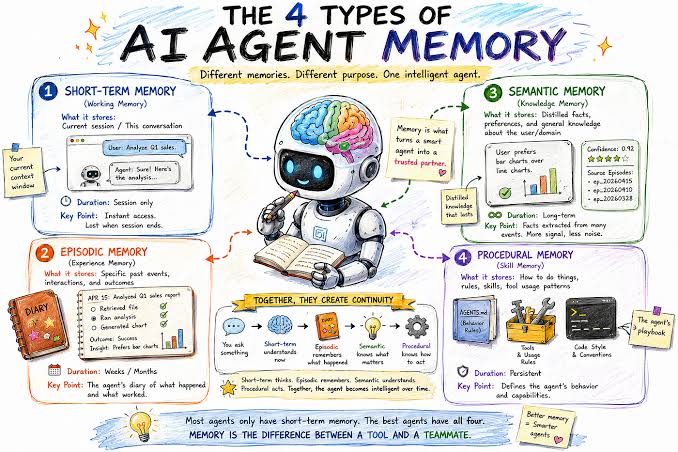
A common misconception is that memory is just a database. But in agentic AI, memory refers to what you feed into the model at inference time. Storing data on disk is cheap—putting it into context is not. The paper emphasizes this distinction. A vector database full of facts is useless unless the agent retrieves the right facts and includes them in the prompt. That act of inclusion is where cost and latency hit.
Think of it like a librarian. Storing books in a warehouse is easy. But bringing every book to the reading room for every visitor is absurd. The librarian must decide which books to fetch, which to summarize, and which to leave in the stacks. That decision is the architecture.
The Cost-Performance Trade-off
Context management strategies fall into a few broad categories, each with strengths and weaknesses:
- Sliding windows: Keep only the last N messages. Simple, but the agent forgets early context. If the user mentioned a constraint at the start, it’s gone.
- Summarization: Periodically compress history into a summary. Saves tokens, but summaries lose detail. A critical nuance might vanish.
- Retrieval-augmented generation (RAG): Store all data externally, retrieve relevant snippets on demand. Powerful, but retrieval can miss the right snippet. If the query is ambiguous, the agent might fetch the wrong information.
- Hierarchical memory: Combine summaries and raw details, like a pyramid. The agent uses the summary for big-picture reasoning and drills into details when needed. This is closer to human memory.
None of these is universally best. The optimal strategy depends on the task. For a customer-service bot, a sliding window might suffice—the last few messages contain the issue. For a research assistant, hierarchical memory with retrieval is better. The paper likely proposes a taxonomy to help engineers choose and combine strategies.
Why Bigger Context Windows Won’t Save You
Some argue that context management is a temporary problem—that as models get cheaper and windows get bigger, we won’t need to manage memory. The paper counters this by pointing to fundamental limits. Even with unlimited context length, the cost per token and attention complexity grow. A 1M-token context might cost $10 per call, making it impractical for high-frequency agents. Moreover, attention quality degrades with length, as shown by the ‘lost in the middle’ phenomenon. So management remains necessary.
Think of context as RAM, not disk. You can never have enough RAM; you always need to manage what’s loaded. The same logic applies to agent context.
The Economic Imperative
For startups and enterprises, context management directly hits the bottom line. A poorly designed memory system can make an agent economically unviable at scale. If each task costs $1 in tokens, a million tasks cost a million dollars. Cutting that to $0.10 through smart memory policies is a game-changer.
Cost-aware memory policies are a design lever. For example, ‘forget cheaply, retrieve expensively’—drop low-value details early, and only spend tokens on retrieval when necessary. This is like a company that archives old emails instead of keeping them in the inbox.
The paper argues that memory design is a cost-optimization problem. Engineers should measure token cost per task, not just task success rate. A strategy that saves 50% tokens but reduces success by 5% might be worth it—or not, depending on the application.
Security and Privacy: The Hidden Angle
Storing more context increases the blast radius of data leaks. If an agent handles sensitive customer data, keeping every detail in memory is a liability. Context management as a privacy feature—minimization—reduces risk. The paper likely touches on this: forgetting is not just a performance tool, but a security feature.
The Cognitive Science Analogy
Human memory isn’t perfect, and that’s a feature. We forget details to focus on what matters. Agents that remember everything are not smarter; they are slower and more confused. The paper draws on cognitive science—working memory vs. long-term memory, forgetting curves—to argue that selective amnesia is valuable. An agent that forgets irrelevant details can focus on the task at hand.
Practical Takeaways for Engineers
If you’re building an agent, the paper’s message translates to concrete steps:
- Measure token cost per task—not just accuracy. Include context management in your metrics.
- Choose strategies based on task type—not just what’s trendy. A sliding window might be fine for short sessions; a hybrid retrieval-summarization approach for long-horizon tasks.
- Design memory with failure in mind—what happens when retrieval misses? The agent should recover gracefully.
- Consider privacy from the start—minimize stored context to reduce breach impact.
Conclusion
Context management is not a plugin you bolt on; it’s an architectural pillar. The paper Agentic Context Management makes a strong case that memory and cost are intertwined. As agents become more autonomous and handle longer tasks, the ability to manage context will separate successful systems from bankrupt ones. The next time you see an agent struggle with a long conversation, remember: it’s not the model’s fault—it’s the architecture’s.
Context management is the unsung hero of agentic AI. It’s not glamorous, but it’s essential. The paper’s core insight—that memory is a cost problem—should change how you build. Start measuring token costs, experiment with hybrid memory strategies, and design for forgetting. Your cloud bill and your users will thank you.
Summary
- Context management is an architectural concern, not an implementation detail: memory and cost are directly coupled.
- Every token in context costs money and slows down the model; even huge context windows don’t solve the economic or quality issues.
- Common strategies (sliding windows, summarization, RAG, hierarchical memory) each have trade-offs; no one-size-fits-all solution.
- Cost-aware memory policies (e.g., ‘forget cheaply, retrieve expensively’) are essential for making agents economically viable at scale.
- Context management also serves as a privacy feature, minimizing data blast radius—forgetting is a security tool.
FAQ
Q: What is context bloat in AI agents?
A: Context bloat happens when an agent accumulates conversation history, tool outputs, and intermediate reasoning, making the input to the model huge. This increases cost and latency, and degrades performance.
Q: Why can’t we just use a bigger context window?
A: Bigger windows don’t solve the cost problem—input tokens still cost money, and attention slows down. Also, models lose track of information in the middle of long contexts, so quality suffers.
Q: What are the main context management strategies?
A: Sliding windows (keep recent messages), summarization (compress history), retrieval-augmented generation (store externally, fetch relevant snippets), and hierarchical memory (combine summaries with details). Each has trade-offs.
Q: How does context management affect cost?
A: Since API pricing is per token, reducing the input tokens per call directly reduces cost. Efficient memory strategies can cut costs significantly, making agents viable at scale.
Q: Is context management a privacy issue?
A: Yes—storing more data increases the impact of a leak. Minimizing what’s kept in context is a privacy feature, in addition to improving performance.
Leave a Reply