The Pacific Ocean spans more than one-third of Earth’s surface, yet its islands—scattered across thousands of kilometers of open water—gave rise to some of the world’s most distinctive cultures. From the towering moai of Easter Island to the stone currency of Yap, isolation didn’t just shape these societies; it became the canvas on which they painted their identities.
But isolation was never absolute. The same ocean that separated also connected, enabling daring voyages and complex exchanges. This article explores how geography—distance, resources, and climate—molded the cultures of Melanesia, Micronesia, and Polynesia, and how these peoples turned isolation into a crucible of innovation.
The Geography of Isolation
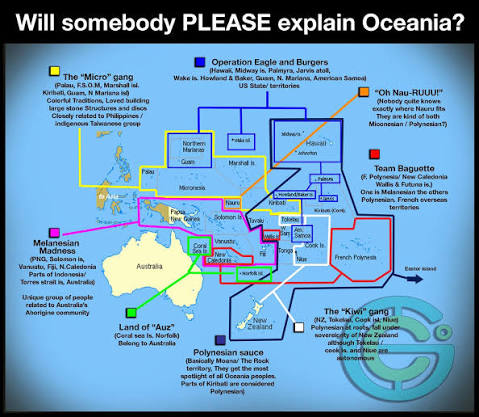
The Pacific Islands are not a monolith. They divide into three main cultural-geographic regions: Melanesia (Papua New Guinea, Vanuatu, Fiji), Micronesia (Palau, Guam, Marshall Islands), and Polynesia (Hawaii, Samoa, Tonga, Easter Island, New Zealand). Each region’s geography dictated its history.
Consider Easter Island (Rapa Nui). It sits about 3,700 kilometers from mainland Chile and roughly 2,000 kilometers from the nearest inhabited island, Pitcairn. That’s a staggering distance—equivalent to flying from New York to Los Angeles and back, with no land in between. Such extreme isolation meant that settlers had to be entirely self-sufficient.
Yet not all islands were equally isolated. The islands of Near Oceania—New Guinea and the Bismarck Archipelago—were reachable by short sea crossings and were settled as early as 40,000–50,000 years ago. In contrast, Remote Oceania, including Vanuatu and Fiji, required deliberate, long-distance voyages, only achieved around 1500–1000 BCE by the Lapita people. The far corners of Polynesia—Hawaii, Easter Island, New Zealand—were the last to be reached, between 800 and 1300 CE.
Language: A Mirror of Fragmentation
Isolation leaves its mark on language. Papua New Guinea alone hosts over 800 living languages—roughly 12% of the world’s total. This linguistic diversity is a direct result of rugged terrain and fragmented island communities, where valleys and reefs created natural barriers. The Austronesian language family, which spread across the Pacific, includes over 1,200 languages, making it one of the largest in the world.
But language also reveals connection. The Austronesian languages spoken from Madagascar to Hawaii share roots, tracing back to a migration from Taiwan around 3000–4000 BCE. Genetic studies show that these Austronesian speakers intermingled with indigenous Papuan populations in Near Oceania before pushing into Remote Oceania—a blend of cultures that still echoes today.
Mastery of the Sea
Isolation didn’t mean immobility. Polynesian wayfinders navigated vast stretches of ocean using stars, ocean swells, and bird behavior. They read the wind and waves as a map, enabling voyages of thousands of kilometers. The revival of this knowledge, beginning with the Hōkūleʻa voyage in 1976, demonstrated that these skills were not lost—only dormant.
Long-distance voyaging also enabled trade. The Yapese, in Micronesia, traveled hundreds of kilometers to Palau to quarry limestone, fashioning it into giant Rai stones—some over three meters tall. These stones served as currency, their value tied not just to size but to the peril of the voyage and the lives lost in retrieval. The stones were too heavy to move, so ownership was communal knowledge—a system that worked because the community was small and relationships were face-to-face.
Subsistence and Society
Island environments demanded adaptation. Taro cultivation, fishing, and aquaculture—like the Hawaiian fishponds—provided sustenance. These practices weren’t just food production; they shaped social organization. In Hawaii, a caste-like system emerged with strict hierarchies, while in Melanesia, ‘big-man’ systems emphasized achieved status through generosity and feasting.
The Lapita culture, named for its distinctive pottery, introduced domesticated animals (pigs, dogs, chickens) and crops (taro, yams, breadfruit) to Remote Oceania. This ‘portable economy’ allowed settlers to survive on islands with limited native resources. Over time, each island developed its own version of this heritage, leading to the diversity we see today.
Case Study: Easter Island’s Rise and Fall
Easter Island is often cited as a cautionary tale of ecological collapse. The classic story: inhabitants deforested the island, leading to societal breakdown. But recent research complicates this narrative. Evidence suggests the population may have been smaller and more resilient than once thought, and that the arrival of Europeans—bringing disease and slave raids—was the primary cause of the collapse.
The moai statues, carved from volcanic tuff, stand as symbols of a society that invested heavily in monumental architecture. The effort required to carve and transport these statues—some weighing over 80 tons—implies a well-organized, hierarchical society. Yet the purpose of the moai remains debated: were they ancestor representations, status symbols, or something else? The island’s isolation meant that its culture developed without external influence for centuries, making it a unique lens into human adaptation.
Colonial Interruption and Revival
European contact, beginning with Magellan in 1521, disrupted Pacific cultures. Diseases, firearms, and introduced animals like rats and goats caused population collapses. Colonial powers imposed boundaries that ignored indigenous cultural lines—the 1884 Berlin Conference partitioned New Guinea without consulting its people.
Despite this, many Pacific nations regained independence in the mid-20th century: Samoa in 1962, Fiji in 1970, Vanuatu in 1980. Others remain territories, like French Polynesia and American Samoa. Today, climate change poses a new threat, with rising seas endangering low-lying atolls like Kiribati and Tuvalu.
Yet there’s a cultural renaissance underway. Traditional navigation is being taught anew, as with the Hōkūleʻa. Hawaiian immersion schools are revitalizing the language. In Vanuatu, the land dive on Pentecost Island—a precursor to bungee jumping—continues as both ritual and tourist attraction. These revivals show that while geography shaped these cultures, it didn’t confine them.
The Debate: Determinism vs. Agency
Scholars have long debated whether geography determines culture or merely constrains it. On resource-scarce islands, strict hierarchies often emerged—perhaps because competition was intense. But Polynesians also maintained long-distance exchange networks, suggesting they were not passive victims of isolation. The Rai stones of Yap required voyages of over 400 kilometers, proving that even ‘isolated’ islands were connected.
Recent scholarship emphasizes human agency. The Lapita people didn’t just cope with new environments; they actively transformed them, introducing crops and animals. The ‘ecocide’ narrative for Easter Island is being replaced by a more nuanced story of resilience and adaptation. Isolation may have shaped these cultures, but it didn’t dictate their fate.
The Pacific Islands show that isolation isn’t a simple term. It can foster linguistic fragmentation, as in Papua New Guinea, or enable long-distance voyaging, as in Polynesia. Geography set the stage, but people wrote the script—through navigation, trade, and cultural adaptation. As climate change reshapes these islands, their histories of resilience offer lessons for the world.
Summary
- The Pacific is vast: Easter Island is 3,700 km from Chile and 2,000 km from the nearest inhabited island.
- Papua New Guinea hosts over 800 languages, reflecting extreme geographic fragmentation.
- Polynesians used sophisticated wayfinding to navigate thousands of kilometers of open ocean.
- The Lapita culture (c. 1500–1000 BCE) spread domesticated plants and animals across Remote Oceania.
- Easter Island’s collapse is now debated; European contact may have been the primary cause.
- Cultural revival movements are reclaiming traditional navigation and languages across the Pacific.
FAQ
Q: How did Polynesians navigate without instruments?
A: They used wayfinding techniques based on stars, ocean swells, bird behavior, and wind patterns, passed down through oral tradition.
Q: Why does Papua New Guinea have so many languages?
A: The rugged terrain and island fragmentation created isolated communities, leading to linguistic divergence. Over 800 languages are spoken there.
Q: What are the Rai stones of Yap?
A: Large limestone discs used as currency, quarried in Palau and transported by canoe. Their value came from the difficulty of the voyage and the skill involved.
Q: Is the Easter Island collapse a myth?
A: Recent research suggests the population was more resilient than once thought, and that European contact (disease, slave raids) was a major factor in the decline.
Q: How are Pacific cultures reviving today?
A: Through initiatives like the Hōkūleʻa voyage, Hawaiian immersion schools, and the continuation of rituals like the Vanuatu land dive.
Leave a Reply