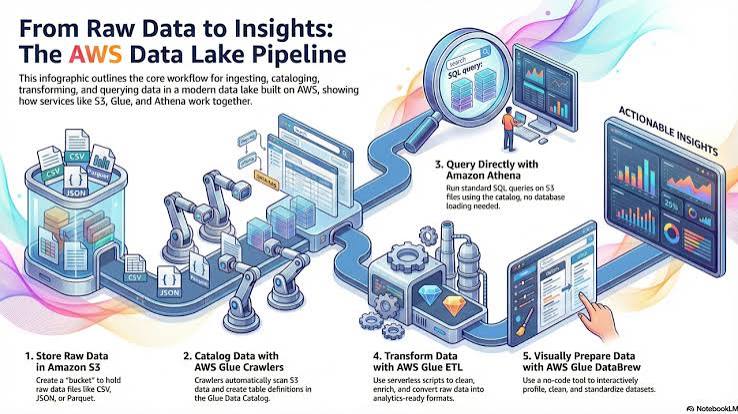
Every enterprise is sitting on a goldmine of data but most of it is buried under decades of legacy infrastructure, inconsistent definitions, and missing lineage. When you try to feed that mess into an AI model, you get garbage out. In fact, Gartner estimates that 70-80% of enterprise AI projects fail or underperform due to poor data quality. That’s not a technology problem; it’s a data problem.
Data modernization is the process of transforming your legacy data stack the pipelines, storage, and governance so that your data is accessible, high-quality, and structured for AI. It’s not about buying a new tool; it’s about rethinking how data flows through your organization. This guide will walk you through the core components, the maturity model, and the practical steps to get your data AI-ready without the hype.
Why Data Modernization Matters Now
Generative AI has put a spotlight on data quality. LLMs and RAG systems are only as good as the data they retrieve and train on. If your customer data is duplicated across three systems with different definitions of “active customer,” your AI will produce inconsistent answers. IBM estimates that poor data quality costs US businesses roughly $3.1 trillion annually and that was before AI made it worse.
Regulatory pressure adds urgency. GDPR, the EU AI Act, and sector-specific rules like HIPAA and SOX require auditable, lineage-tracked data. If you can’t trace a model’s output back to its source data, you’re at risk. And competitors are already using clean, unified data to get faster time-to-insight and better model accuracy.
The Legacy Problem
Most enterprises run on 20-30 year-old data stacks: on-premise Oracle or SQL Server databases, mainframes, and siloed data marts. Data is duplicated, inconsistent, and lacks lineage. For example, finance defines “revenue” one way, sales another, and AI models trained on both will produce contradictory forecasts. Legacy systems also can’t handle the volume, velocity, or variety required for AI training or real-time inference.
The evolution of the data stack shows the path forward:
– 2010s: Cloud data warehouses (Snowflake, BigQuery) solved storage and compute scaling but only handled structured data.
– Late 2010s: Data lakes (S3, ADLS) allowed storing unstructured data but became “data swamps” without governance.
– 2020s: Lakehouse architecture combined warehouse reliability with lake flexibility, using open formats like Iceberg, Delta, and Hudi.
– 2023-present: The GenAI wave forced a shift from “analytics-first” to “AI-first” data strategies. Now you need data for model training, fine-tuning, and RAG—not just dashboards.
The Core Components of Modernization
Modernization isn’t a single purchase; it’s a set of coordinated changes across your data stack. Here are the six pillars:
1. Data Ingestion: From Batch to Real-Time
Legacy ETL runs nightly batches, which is fine for reports but too slow for AI applications like fraud detection or customer support chatbots. Moving to real-time streaming with tools like Kafka or Flink lets you feed models continuously. This is a foundational shift: AI systems need fresh data to stay relevant.
2. Storage: The Lakehouse Shift
Instead of separate warehouses and lakes, a lakehouse stores all your data—structured, semi-structured, and unstructured—in open table formats like Delta Lake or Iceberg. This gives you the reliability of a warehouse with the flexibility of a lake. Databricks, Snowflake, and AWS all support lakehouse architectures, making it the de facto standard.
3. Data Quality & Observability
Automated profiling and anomaly detection catch issues before they poison your AI. Tools like Great Expectations, Monte Carlo, and Soda continuously monitor data for schema changes, null rates, and distribution shifts. You can’t fix what you don’t measure.
4. Governance & Lineage
Centralized catalogs like DataHub, OpenMetadata, or Collibra provide a single source of truth for data assets. Column-level lineage lets you trace any data point back to its origin—essential for compliance and debugging AI outputs. If a model hallucinates a fact, you need to know which source table it came from.
5. Semantic Layer
A semantic layer (dbt, LookML) defines consistent business metrics. Instead of each team having its own “customer count,” you have one canonical definition. AI models then interpret data uniformly, reducing confusion and errors.
6. Vectorization for RAG
Retrieval-Augmented Generation (RAG) is a common way to ground LLMs in your own data. It involves converting unstructured text into embeddings and storing them in a vector database like Pinecone, Weaviate, or pgvector. This is a new skill for most data teams, and it comes with its own challenges—chunking strategies, embedding model selection, and hybrid search (combining vector and keyword search).
The AI-Ready Data Maturity Model
Think of data modernization as climbing a ladder:
- Level 1 – Siloed: Data lives in isolated systems, no central governance. Most orgs start here.
- Level 2 – Centralized: Data is in a warehouse or lake, but quality issues persist.
- Level 3 – Governed: Lineage, quality checks, and access controls are in place.
- Level 4 – AI-Ready: Data is semantically consistent, versioned, and accessible to AI pipelines with automated observability.
Most enterprises are stuck at Level 1 or 2. The goal is to reach Level 3 and 4, where AI can actually run reliably.
Different Paths: Migrate vs. Modernize
There’s an ongoing debate: should you lift-and-shift your existing systems to the cloud, or re-platform with new architectures? Lift-and-shift is faster and cheaper upfront but often perpetuates old problems. Modernizing—rearchitecting your data pipelines and storage—yields long-term benefits but takes more time and investment.
Another debate is data mesh vs. centralized platform. Data mesh decentralizes data ownership to domain teams, which is attractive in theory but hard to execute. A centralized platform team gives you consistency but can become a bottleneck. The right answer depends on your organization’s size and culture.
The Real Cost and ROI
Let’s be honest: modernization is expensive. Large enterprises often spend $5M to $50M+ and take 12-24 months. The ROI is indirect—better data enables AI use cases like customer support automation, fraud detection, and supply chain optimization that deliver measurable savings. The risk is “modernization theater”: buying new tools without changing your data culture or processes. Avoid that trap by focusing on outcomes, not just tooling.
Governance and Compliance in the AI Era
AI models amplify data risks. Bias can creep in from skewed training data. Privacy leaks can occur if PII ends up in prompts. And stale data can cause hallucinations. Modernization must include data access controls for AI—for example, applying row-level security to RAG retrieval so users only see data they’re allowed to see. The EU AI Act, effective 2025-2026, imposes stricter data governance requirements for high-risk AI systems, making this non-negotiable.
Organizational and Cultural Shifts
Finally, data modernization is as much about people as technology. Data engineers and analysts often have conflicting priorities with AI/ML teams: analytics wants stable, aggregated data; ML wants raw, granular data for training. Breaking down these silos requires cross-functional collaboration and a shared understanding of data as a product.
Getting Started: A Practical Roadmap
If you’re ready to start, here’s a high-level path:
- Assess your current state: Map your data sources, identify quality issues, and measure your maturity level.
- Define AI use cases: Start with one or two high-value AI applications—like a customer support chatbot or fraud detection—and work backward to the data they need.
- Modernize incrementally: Don’t boil the ocean. Start with a single domain or data product, implement the lakehouse, lineage, and quality checks, and then expand.
- Invest in the semantic layer early: Consistent definitions are the foundation for AI trust.
- Build observability from day one: You can’t manage what you don’t monitor.
Data modernization is a journey, not a destination. But the payoff is real: AI that actually works, insights you can trust, and a competitive edge in a world where data is the new oil.
Data modernization for AI isn’t a one-time project; it’s a continuous discipline. By moving from siloed, messy data to a governed, AI-ready platform, you can turn your data from a liability into an asset. The key is to start small, focus on outcomes, and build a culture that values data quality as much as model performance.
Summary
- 70-80% of enterprise AI projects fail due to poor data quality (Gartner).
- Data modernization involves transforming ingestion, storage, quality, governance, semantic layer, and vectorization.
- Most enterprises are at maturity Level 1-2; AI-ready is Level 4.
- Costs run $5M-$50M+ and take 12-24 months, but ROI comes from AI use cases.
- Governance and lineage are critical for compliance and to prevent AI risks like bias and privacy leaks.
FAQ
Q: What is the difference between data migration and data modernization?
A: Data migration is moving data from one system to another, often with a lift-and-shift approach. Data modernization involves rearchitecting your data stack—like moving to a lakehouse, implementing real-time streaming, and adding governance—so your data is actually ready for AI.
Q: How long does data modernization take?
A: For large enterprises, it typically takes 12-24 months. Smaller efforts can be faster. The key is to scope it incrementally, starting with a specific use case.
Q: What is a lakehouse and why does it matter for AI?
A: A lakehouse combines the best of data lakes and warehouses: it stores all data (structured and unstructured) in open formats like Delta Lake or Iceberg, with ACID transactions and schema enforcement. This gives AI models access to diverse data types while maintaining reliability.
Q: What is a semantic layer and how does it help AI?
A: A semantic layer defines consistent business metrics and definitions (e.g., “customer” or “revenue”) across your organization. It ensures AI models interpret data uniformly, reducing errors and improving trust.
Q: How does data governance prevent AI hallucinations?
A: Governance with lineage tracks data origin, so you can verify the source of any model output. Access controls also prevent the model from retrieving sensitive or incorrect data. This reduces the risk of hallucination and bias.
Leave a Reply