Imagine software that doesn’t just answer questions but actually gets things done booking your travel, writing code, or negotiating with vendors all on its own. That’s agentic AI, the next big wave in artificial intelligence. For investors, this shift from ‘AI that talks’ to ‘AI that acts’ opens up a fresh set of opportunities, but it also comes with new risks.
This guide breaks down what agentic AI is, why it’s attracting billions in investment, and the concrete ways you can get exposure from buying shares of tech giants to betting on startups. Whether you’re a seasoned investor or just starting to explore AI, you’ll leave with a clear map of the landscape.
What Is Agentic AI, Really?
Agentic AI refers to systems that can autonomously pursue complex goals with minimal human oversight. Unlike generative AI like ChatGPT, which produces content when prompted, agentic AI acts—it can browse the web, write code, book travel, or manage workflows independently. Think of it as the difference between a chef who follows a recipe you give them and a personal assistant who plans the entire meal, shops for ingredients, and cooks it without being asked.
This technical leap became possible because large language models (LLMs) improved enough to handle multi-step reasoning, use tools, and remember context. As a result, agentic AI is moving from research labs into early commercial products. Big players like OpenAI (with Operator and AgentKit), Anthropic (computer use), Google (Project Mariner), and Microsoft (Copilot agents) are all betting on this future.
The Market: Big Numbers, Big Hype
Market forecasts for agentic AI vary widely but are consistently bullish. Some analysts project the market to reach $30–50 billion by 2030, with compound annual growth rates of 40–50%. Others place it higher, at $100+ billion, depending on how broadly you define ‘agentic’ to include infrastructure. Either way, the growth is expected to be explosive.
Enterprise adoption is a key driver. Gartner predicts that by 2028, 33% of enterprise software will include agentic AI, up from less than 1% in 2024. That’s a massive shift. Venture funding reflects the excitement: agentic AI startups raised over $5 billion in 2024, with companies like Sierra, Decagon, Adept, Imbue, and Harvey attracting significant capital.
Why Now? The Stars Are Aligning
Three forces have converged to make agentic AI investable. First, technical maturity: LLMs can now handle the complex reasoning and tool use required for agency. Second, enterprise pain points: businesses are drowning in data but starved for labor, and agents promise to automate knowledge work. Third, the cost curve: inference costs have fallen roughly 10x per year for some models, making agent deployment economically viable.
Think of it like the early days of the internet. For years, companies spent money on websites that were little more than brochures. Then, as infrastructure matured, e-commerce and software-as-a-service (SaaS) exploded. Agentic AI is at that inflection point—the infrastructure is ready, and the use cases are becoming clear.
Investment Vehicle 1: Large-Cap Tech Stocks
The simplest way to invest in agentic AI is through the tech giants that are building or enabling it. These companies have the resources to develop agents, the distribution to deploy them, and the balance sheets to weather setbacks. Key names include:
- Microsoft – integrating agents into its Copilot suite and Azure cloud
- Alphabet (Google) – Project Mariner and its Gemini models
- Amazon – AWS AI services and its investment in Anthropic
- Meta – open-source Llama models and its massive compute infrastructure
- Nvidia – the dominant supplier of AI chips, a critical enabler
- Salesforce – embedding agents into its CRM platform
- ServiceNow – automating workflows with AI agents
These are the ‘picks and shovels’ of the agentic gold rush. Even if specific agents fail, these companies will likely benefit from the broader trend.
Investment Vehicle 2: Pure-Play and Smaller Stocks
For higher risk and higher potential reward, you can look at smaller companies focused specifically on AI. Names like C3.ai, SoundHound AI, and BigBear.ai are often more volatile but offer direct exposure to the agentic AI theme. However, be cautious: many trade at extreme valuations, sometimes 50–100x revenue, with little profitability. The hype can outpace reality, so due diligence is critical.
Investment Vehicle 3: Private Markets and Venture Capital
If you’re an accredited investor, you can invest directly in startups through venture capital funds or angel syndicates. This is where the biggest returns could be, but also the highest risk. Many startups fail, and liquidity can take years. If you’re not accredited, you might still participate through crowdfunding platforms, but tread carefully.
Investment Vehicle 4: AI-Focused ETFs
Exchange-traded funds (ETFs) offer a diversified way to invest in AI. Examples include BOTZ (Global X Robotics & Artificial Intelligence), AIQ (Global X Artificial Intelligence & Technology), and IRBO (iShares Robotics and Artificial Intelligence). These hold baskets of AI-related stocks, spreading risk across many companies. They’re a good option if you want exposure without picking individual winners.
Investment Vehicle 5: Infrastructure Plays
Don’t forget the infrastructure that makes agentic AI possible. Semiconductors like Nvidia, AMD, and TSMC are in high demand. Cloud providers like AWS, Azure, and GCP provide the compute power. Data center REITs like Equinix and Digital Realty own the physical facilities. These companies benefit from the AI boom regardless of which agents win.
The Bull Case: Why Invest?
Proponents argue that agents could automate 20–30% of knowledge work, creating massive enterprise value. Software vendors can shift from per-seat to per-task or per-outcome pricing, potentially increasing revenue per customer. Platforms that aggregate agents—like an ‘app store for agents’—could become dominant infrastructure. Historical precedent suggests that every major tech wave (internet, mobile, cloud) created outsized returns for early investors in the right picks.
The Bear Case: Risks to Watch
Skeptics point out that the gap between demo videos and production-ready reliability remains wide. Many ‘agents’ are still brittle, error-prone, and require human supervision. Valuation concerns are real: some pure-play AI stocks trade at astronomical multiples. LLMs themselves are becoming commoditized; the moat may be in distribution, data, or workflow integration, not the model itself. And security failures—like an agent making unauthorized purchases or leaking data—could erode trust.
Regulatory and Policy Risks
The regulatory landscape is still evolving. The EU AI Act classifies AI systems by risk, and agentic systems may fall under ‘high-risk’ categories, increasing compliance costs. The US approach is lighter-touch so far, with executive orders and agency guidance rather than comprehensive legislation. California and New York have proposed AI safety bills that could affect deployment. A key open question is liability: when an autonomous agent causes harm, who’s responsible—the maker or the user?
How to Start Investing
- Educate yourself: Follow industry publications, read earnings reports, and understand the technology’s capabilities and limitations.
- Diversify: Don’t put all your money in one stock or sector. Use ETFs for broad exposure and individual stocks for targeted bets.
- Assess your risk tolerance: Pure-play stocks are volatile; large-cap tech is more stable; private markets are illiquid.
- Think long-term: Agentic AI is still in its early stages. Be prepared for ups and downs.
- Consult a financial advisor: Especially if you’re considering private markets or complex strategies.
The Bottom Line
Agentic AI represents a significant investment opportunity, but it’s not without risks. By understanding the technology, the market, and the various investment vehicles, you can position yourself to benefit from this emerging wave. Whether you choose the safety of large-cap tech, the thrill of startups, or the diversification of ETFs, the key is to stay informed and invest wisely.
Agentic AI is more than a buzzword—it’s a technological shift with real investment potential. From mega-cap tech to nimble startups, there are countless ways to participate. But as with any wave, the key is to stay grounded. Do your research, diversify your holdings, and keep an eye on both the opportunities and the risks. The future of AI isn’t just about generating text; it’s about getting things done. And for investors, that’s a story worth tuning into.
Summary
- Agentic AI systems act autonomously to complete multi-step tasks, unlike generative AI that only produces content.
- The market is projected to reach $30–100+ billion by 2030, with enterprise adoption expected to jump from under 1% to 33% by 2028.
- Investment options include large-cap tech stocks (Microsoft, Google, Nvidia), pure-play AI stocks (C3.ai, SoundHound), private startups, AI-focused ETFs, and infrastructure plays.
- Bullish factors: productivity gains, recurring revenue models, network effects; bearish factors: overhype, high valuations, commoditization, security risks.
- Regulatory risks vary by region, with the EU AI Act potentially classifying agentic systems as high-risk, and liability questions still unresolved.
FAQ
Q: What is the difference between generative AI and agentic AI?
A: Generative AI produces content in response to prompts (like ChatGPT writing an essay). Agentic AI goes further—it can plan, use tools, and execute tasks autonomously, such as booking a flight or managing a calendar.
Q: Can I invest in agentic AI without picking individual stocks?
A: Yes. AI-focused ETFs like BOTZ, AIQ, and IRBO offer diversified exposure to a basket of AI-related companies, reducing single-stock risk.
Q: Are agentic AI investments risky?
A: Yes. The technology is still evolving, and many agents are not yet production-ready. Some pure-play stocks trade at high valuations, and private startups carry high failure risk.
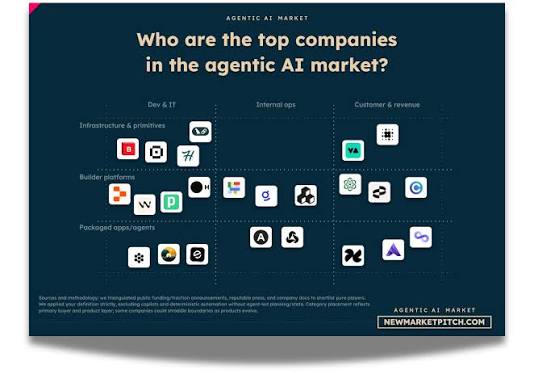
Q: What are the most important companies in agentic AI?
A: Major players include Microsoft, Google, Amazon, and Nvidia, as well as startups like OpenAI, Anthropic, and Sierra. These companies are leading in research, development, and infrastructure.
Q: How can I get exposure to agentic AI as a non-accredited investor?
A: You can invest in public equities, ETFs, or real estate investment trusts (REITs) that own data centers. Crowdfunding platforms may also offer opportunities, but they carry higher risks.