Tag: infrastructure

  • How a 2,177-Kilometer Rail Network Could Reshape Gulf Politics and Global Security


    The Persian Gulf is one of the most strategically vital regions on Earth, yet its internal transportation network is surprisingly fragmented. Nearly all freight and passenger movement relies on sea routes through the Strait of Hormuz a narrow passage that carries about 20% of global oil and on air travel. But a massive infrastructure project, the GCC Railway, aims to change that.

    Spanning 2,177 kilometers and linking all six Gulf Cooperation Council states, the railway has been under construction for over a decade. Once completed, it could fundamentally alter the region’s economic and security calculus, offering a land-based alternative to maritime chokepoints and creating new avenues for trade, diplomacy, and even military logistics.

    The Project: A Long-Awaited Connector

    The GCC Railway was first announced in 2009, during an oil boom that fueled ambitious infrastructure dreams. The plan is to connect Kuwait City, Dammam, Riyadh, Manama (via causeway), Doha, Abu Dhabi, Dubai, and Muscat, integrating with Saudi Arabia’s existing North–South Railway and potentially extending to Jordan, Iraq, and Europe.

    Progress has been uneven. Saudi Arabia already operates freight and high-speed passenger lines, and the UAE’s Etihad Rail is nearly complete domestically. Qatar built a rail network for the 2022 World Cup, while Oman, Kuwait, and Bahrain are still in early stages. The original target of 2021–2025 has slipped, but the pieces are steadily falling into place.

    Why Rail Matters Strategically

    The Hormuz Hedge

    The Strait of Hormuz is the world’s most critical oil chokepoint. Iran has repeatedly threatened to close it in times of tension. For Gulf states, that vulnerability is existential—not just for oil exports but for food imports and general goods. A working rail network could provide an overland alternative, allowing goods to move to Red Sea ports or through Turkey to Europe, bypassing Hormuz entirely.

    This is not a new idea. Gulf states have already built pipelines to reduce reliance on the strait. Rail extends that logic, offering a more flexible and comprehensive land bridge.

    Infrastructure as Leverage

    The Qatar blockade of 2017–2021 showed how land borders can be weaponized. When Saudi Arabia, the UAE, Bahrain, and Egypt cut ties with Qatar, they closed its only land border, forcing Qatar to rely on air and sea routes. Rail connectivity raises a thorny question: could infrastructure be used both as a tool of integration and as a means of pressure? The railway’s design, with its interconnected tracks, inherently raises the stakes of any future political dispute.

    Great Power Competition

    China’s Belt and Road Initiative has already invested heavily in Gulf ports, and Beijing has shown interest in rail links that could extend to Central Asia. Meanwhile, the India–Middle East–Europe Corridor (IMEC), announced at the 2023 G20, proposes a rail-and-shipping route connecting India to Europe via the Gulf and Israel. The GCC Railway could complement or compete with these projects, depending on how it is linked.

    The Abraham Accords have opened discussions about rail connections to Israel via Jordan, though such a link remains politically sensitive. Yet the possibility alone signals how rail could reshape regional alignments.

    Economic Transformation or White Elephant?

    Intra-GCC trade is startlingly low—around 10% of total trade, compared with much higher figures in other regional blocs. Rail is seen as a way to boost non-oil commerce by lowering overland transport costs. The Gulf’s logistics sector is booming, with ports, free zones, and aviation hubs competing for dominance. Rail would complement these modes, offering a cheaper, more reliable option for bulk goods.

    Recent disruptions—the COVID-19 pandemic and Houthi attacks on Red Sea shipping in 2023–2024—have underscored the value of land-based alternatives. Supply chains that rely on a single mode are inherently fragile. Rail adds resilience.

    But the project has faced repeated delays due to budget constraints and oil price volatility. Mega-projects are expensive, and when oil prices drop, governments postpone spending. The railway has been a victim of this cycle since its inception.

    Security and Military Implications

    For military planners, rail offers strategic redundancy. In a crisis, land routes can move troops, equipment, food, and medical supplies without relying on vulnerable sea lanes or contested airspace. Rail could also facilitate joint logistics among GCC states and their Western allies, potentially improving interoperability.

    However, rail infrastructure creates new vulnerabilities. Long stretches of track across open desert are difficult to secure, making them targets for sabotage or attack. Counterterrorism and force protection will become new challenges for Gulf security forces.

    The Road Ahead

    The GCC Railway is more than a transportation project; it is a statement of intent. It represents a desire for deeper regional integration and a hedge against external threats. Completion will require sustained political will and significant investment, but the potential payoff—in trade, security, and geopolitical influence—is immense.

    As the railway inches closer to reality, it will force Gulf states to confront difficult questions about cooperation, competition, and trust. The tracks themselves are neutral, but the politics around them are anything but.

    The GCC Railway embodies both the promise and the peril of infrastructure in a volatile region. It could knit the Gulf together in ways that enhance security and prosperity, or it could become another tool of leverage in future disputes. Either way, its completion will mark a turning point in how the Persian Gulf connects to the world—and to itself.

    Summary

    • The GCC Railway will span 2,177 km, linking all six Gulf states, and is designed to connect with existing national networks and potentially extend to Europe.
    • It offers a land-based alternative to the Strait of Hormuz, reducing vulnerability to Iranian threats.
    • The project faces political and economic hurdles, including delays and the need for sustained investment.
    • Rail could boost intra-GCC trade, which is currently only about 10% of total trade.
    • The network raises security concerns, including the need to protect long stretches of track from sabotage.

    FAQ

    Q: What is the GCC Railway?
    A: A planned 2,177-kilometer rail network connecting all six Gulf Cooperation Council states: Saudi Arabia, UAE, Qatar, Bahrain, Kuwait, and Oman.

    Q: Why is the railway strategically important?
    A: It provides an overland alternative to sea routes through the Strait of Hormuz, which is critical for oil exports and imports, and can enhance supply chain resilience.

    Q: What is the current status of the project?
    A: It is under construction, with national segments at various stages. Saudi Arabia and the UAE have made significant progress, while others are still in early phases.

    Q: How could the railway affect regional politics?
    A: It could deepen integration but also create new leverage points, as seen during the Qatar blockade when land borders were used as political tools.

    Q: What are the main challenges facing the project?
    A: Funding, oil price volatility, and coordinating across different national priorities and political tensions.

  • The Ancient Aqueducts: Engineering Feats That Still Teach Us About Water


    When you turn on a tap, water flows out. It’s easy to take for granted. But two thousand years ago, the Romans achieved something similar—without a single pump or electric motor. They built massive stone channels that carried millions of gallons of water across valleys and through mountains, day and night, for centuries.

    These aqueducts weren’t just ancient wonders. They were solutions to real problems—urban growth, public health, and political power. And their basic principles—gravity, precise gradients, and durable materials—are still relevant today, as modern cities struggle with aging pipes and water scarcity.

    Let’s look at how these structures worked, what made them last so long, and what we can learn from them.

    The First Aqueducts: Not a Roman Invention

    Long before Rome, other civilizations were moving water over long distances. The Assyrians built a stone bridge aqueduct at Jerwan around 691 BCE to supply their capital, Nineveh. The Persians developed qanats—underground tunnels that tapped into aquifers and used gravity to bring water to the surface, sometimes over dozens of kilometers.

    The Greeks also had impressive systems. On the island of Samos, around 530 BCE, engineers dug a tunnel through a mountain to carry water. The Tunnel of Eupalinos is over 1,000 meters long, and it was dug from both ends, meeting in the middle with remarkable accuracy—all without modern surveying tools.

    So when the Romans started building aqueducts in the 4th century BCE, they were building on centuries of prior knowledge. But they took it to a new scale.

    Roman Engineering: Precision and Scale

    Rome’s aqueduct system grew to include 11 major aqueducts, supplying the city with an estimated 1 million cubic meters of water per day. That’s roughly 200 gallons per person per day—comparable to what many developed countries use today. The first, the Aqua Appia, was built in 312 BCE. Later ones like the Aqua Claudia (52 CE) were monumental, running on tall arches that still stand today.

    The Pont du Gard in France is a stunning example. Built around 40–60 CE, it’s a three-tiered bridge that carried water 50 kilometers from springs at Uzès to the city of Nîmes. The Segovia Aqueduct in Spain, built in the 1st or 2nd century CE, functioned into the 20th century—nearly 2,000 years of service.

    But what made these structures so durable? The answer lies in three key engineering principles.

    1. Gravity Does the Work

    Roman aqueducts used no pumps. Water flowed by gravity alone, from a higher source to a lower destination. The engineers maintained a uniform gradient of about 0.5 to 1 meter per kilometer. That’s incredibly gentle—about 0.05% to 0.1% slope. Too steep, and the water would erode the channel. Too flat, and the water would stagnate.

    They achieved this precision using simple tools like the chorobates, a long wooden level, and the groma, for right angles. Surveyors would lay out the route, often over hills and valleys, ensuring the gradient stayed within the narrow range.

    This approach is a masterclass in working with nature rather than against it. Modern systems often rely on pumps and energy-intensive processes. The ancient approach was passive, sustainable, and virtually free to operate.

    2. Materials That Last

    The Romans didn’t have steel or plastic. They used stone, brick, and a revolutionary material: Roman concrete, or opus caementicium. This mix of lime, volcanic ash (pozzolana), and aggregate could set underwater and was incredibly durable. Some Roman concrete structures have lasted over 2,000 years, while modern concrete often degrades within decades.

    The secret? The volcanic ash reacted with lime to form a robust binder that was resistant to seawater and weathering. This innovation allowed them to build sturdy channels, bridges, and even siphons.

    3. Solving the Terrain Problem

    Aqueducts couldn’t always run on a smooth gradient. To cross valleys, Romans used inverted siphons—pipes that went down one side of a valley and up the other, using pressure to push water uphill. This required pipes that could withstand high pressure, often made of lead or clay, and careful engineering to avoid bursting.

    They also built settling basins to remove sediment and distribution tanks (castella) to divide water among different users. These were the ancient equivalent of modern water treatment and distribution systems, though simpler.

    The Political and Social Role of Water

    Aqueducts weren’t just practical; they were symbols of power. Roman emperors funded aqueducts to gain favor with the public. The Baths of Caracalla and other public baths consumed enormous volumes of water—a luxury that demonstrated imperial largesse.

    The maintenance of aqueducts was a serious matter. Frontinus, appointed water commissioner in 97 CE, wrote a detailed manual, De aquaeductu, documenting flow rates, legal disputes, and repair practices. He even complained about people illegally tapping into the system—a problem that sounds familiar to modern utilities.

    This administrative oversight was crucial. Aqueducts required constant maintenance, from clearing sediment to repairing leaks. When the Western Roman Empire fell, that maintenance stopped. Many aqueducts were destroyed or fell into disrepair.

    The Fall and the Lost Knowledge

    By the 5th century CE, Rome’s water system collapsed. The population plummeted from around 1 million to roughly 30,000 in the early medieval period—partly because there was no water. The knowledge of how to build and maintain aqueducts was largely lost in Europe for nearly a millennium.

    Some systems survived in the Byzantine East and the Islamic world, where engineers continued to use and refine these techniques. But in much of Europe, the skills vanished. This shows how fragile infrastructure knowledge can be—a lesson for today’s aging water systems.

    Lessons for Modern Water Management

    What can we learn from these ancient engineers? Here are three key takeaways.

    Lesson 1: Gravity and Passive Systems Save Energy

    Modern water systems rely heavily on pumps, which consume a significant portion of a city’s energy budget. Ancient aqueducts used gravity, which is free and reliable. For many regions, especially in developing countries, gravity-fed systems can be a low-cost, low-maintenance alternative.

    Lesson 2: Durable Materials Matter

    Roman concrete lasted 2,000 years. Modern concrete sometimes fails in 50 years. Researchers are studying Roman concrete to understand its longevity, hoping to create more sustainable materials. But we can also learn from the design principle: build to last, not to replace.

    Lesson 3: Maintenance and Governance Are Essential

    Aqueducts worked because someone was in charge of maintenance. Frontinus’s manual is a reminder that infrastructure requires ongoing care. Today, many cities have water systems that are over a century old and leaking. Proper investment in maintenance, as the Romans did, could extend the life of these systems.

    The Enduring Legacy

    Ancient aqueducts are more than tourist attractions. They are evidence that sophisticated engineering is possible without modern technology. They solved problems we still face: supplying clean water to dense populations, managing scarce resources, and building infrastructure that lasts.

    As we confront climate change and growing urban populations, looking back at these ancient solutions might offer more than nostalgia—it might give us practical ideas for a sustainable future.

    The next time you see an aqueduct ruin, remember that it wasn’t just a bridge—it was a lifeline. The Romans’ ability to move water over long distances with precision and durability is a feat we still struggle to replicate in terms of longevity. Their principles—gravity, simplicity, and robust materials—offer enduring lessons for our own water challenges.

    Summary

    • Ancient aqueducts were built by many civilizations, but the Romans perfected them, supplying Rome with ~1 million cubic meters of water daily.
    • Key engineering principles: gravity-driven flow with a gentle gradient (0.5–1 m per km), durable materials like Roman concrete, and solutions like inverted siphons for crossing valleys.
    • Aqueducts were political symbols and required serious maintenance; Frontinus’s manual shows the importance of governance.
    • After Rome fell, the knowledge was largely lost, leading to a collapse in urban water supply.
    • Modern lessons: prioritize gravity-fed systems to save energy, build with durable materials, and invest in maintenance to extend infrastructure life.

    FAQ

    Q: How did Roman aqueducts work without pumps?
    A: They relied on gravity. The water source was at a higher elevation than the destination, and the aqueduct was built with a very slight downward slope (about 0.5 to 1 meter per kilometer). This gentle gradient kept water flowing without erosion or stagnation.

    Q: What materials did the Romans use to build aqueducts?
    A: They used stone, brick, and a type of concrete called opus caementicium, made from lime, volcanic ash, and aggregate. This concrete was remarkably durable and could set underwater.

    Q: How long did Roman aqueducts last?
    A: Some, like the Segovia Aqueduct, functioned for nearly 2,000 years. Others fell into disrepair after the fall of the Roman Empire, but many structures still stand today.

    Q: Why did the knowledge of aqueduct building disappear?
    A: After the Western Roman Empire collapsed, the political and economic systems that supported maintenance fell apart. Without funding and expertise, aqueducts fell into ruin, and the technical knowledge was lost for centuries.

    Q: What can we learn from ancient aqueducts today?
    A: We can learn to use gravity-driven systems to save energy, to build with durable materials to reduce maintenance and replacement costs, and to invest in proper maintenance and governance to keep our water systems running for generations.

  • Ike’s Hidden Hand: How Dwight Eisenhower Quietly Remade America

    Ike’s Hidden Hand: How Dwight Eisenhower Quietly Remade America

    When Dwight Eisenhower left the White House in January 1961, many Americans saw him as a kindly, golf-loving grandfather who had coasted through eight years. The press nicknamed his presidency the ‘era of happy days,’ and critics joked that the country was run by his chief of staff, Sherman Adams. But behind the folksy smile and the apparent passivity was one of the most calculating and effective presidents in American history.

    Eisenhower didn’t just preside over peace and prosperity. He ended a war, built a 41,000-mile interstate highway system, created NASA, desegregated a high school at gunpoint, and warned the nation against the rise of a ‘military-industrial complex.’ He did it all while making it look easy. As historian Fred Greenstein later put it, Eisenhower ran a ‘hidden-hand presidency’—a style so subtle that it took decades for scholars to recognize its brilliance.

    The Unlikely General

    Ike’s path to the presidency began in Abilene, Kansas, where he was born in 1890 to a poor Mennonite family. The original family name, Eisenhauer, meant ‘iron hewer’—fitting for a man who would later forge an alliance of 12 nations. Eisenhower won an appointment to West Point, where he was an average student but a standout football player until a knee injury ended his athletic career. After graduating in 1915—a class so talented that 59 of its 164 members became generals—Eisenhower spent 20 years in the peacetime army without seeing combat. He trained tank crews in World War I but never deployed. It was his brilliance as a staff officer, not a battlefield commander, that caught the eye of General George Marshall.

    During World War II, Marshall promoted Eisenhower rapidly, first to lead the Allied invasion of North Africa, then Sicily, and finally to serve as Supreme Allied Commander in Europe. On D-Day, June 6, 1944, Eisenhower made the call to launch the invasion despite a stormy forecast, a decision that cost thousands of lives but ultimately won the war. He also had to manage a coalition of towering egos—George Patton, Bernard Montgomery, Charles de Gaulle—with a patience that became his trademark. When Germany surrendered in May 1945, Eisenhower was a five-star general and a national hero.

    The Hidden-Hand Presidency

    After the war, both parties courted Eisenhower. He chose the Republicans and won the 1952 election in a landslide against Adlai Stevenson, with the slogan ‘I Like Ike.’ But many political insiders expected a passive president who would let Congress run the show. Instead, Eisenhower used what historians now call the ‘hidden-hand’ style: he worked deliberately behind the scenes, using intermediaries and plausible deniability to achieve his goals without appearing to pull the strings.

    Consider how he handled Senator Joseph McCarthy. Rather than confront the demagogue directly—which would have elevated McCarthy’s status—Eisenhower quietly worked to undermine him. He urged Republican leaders to censure McCarthy and used his own staff to leak damaging information. By the time McCarthy fell, Eisenhower’s fingerprints were nowhere to be seen.

    The same indirect approach guided his foreign policy. Eisenhower authorized CIA coups in Iran (1953) and Guatemala (1954), toppling governments he saw as Soviet threats. He used back-channel diplomacy with Soviet leaders, even as he publicly maintained a tough anti-communist stance. His ‘New Look’ defense policy emphasized nuclear deterrence over large conventional forces, cutting the Army while building up the Air Force’s nuclear arsenal. Critics called it risky, but Eisenhower argued it was the only way to contain communism without bankrupting the nation.

    The Builder of Modern America

    Eisenhower’s domestic achievements were anything but passive. In 1956, he signed the Federal-Aid Highway Act, creating the Interstate Highway System—the largest public works project in American history. Spanning 41,000 miles, the highways reshaped American life, enabling suburban growth, long-haul trucking, and cross-country road trips. Eisenhower had seen the German autobahn during World War II and recognized its military value; he sold the project to Congress as a national defense need.

    He also responded to the Soviet launch of Sputnik by creating NASA in 1958 and signing the National Defense Education Act, which poured federal money into science and math education. When Arkansas Governor Orval Faubus refused to integrate Little Rock Central High School in 1957, Eisenhower federalized the National Guard and sent in the 101st Airborne Division to escort nine Black students to class—a dramatic assertion of federal authority.

    Eisenhower didn’t just react to events; he shaped them. He balanced the federal budget in three of his eight years, kept inflation low, and managed to end the Korean War within months of taking office. He also signed the Civil Rights Act of 1957, the first civil rights legislation since Reconstruction, even if its enforcement powers were weak.

    The Warning That Defined His Legacy

    On January 17, 1961, three days before leaving office, Eisenhower delivered a farewell address that shocked the nation. He warned of the rise of a ‘military-industrial complex’—a permanent alliance between the defense industry and the armed forces that could threaten American democracy. ‘We must never let the weight of this combination endanger our liberties or democratic processes,’ he said. The speech, written with his own hand, reflected his deep concern that the Cold War had created a permanent war economy.

    At the time, many dismissed it as the ramblings of an old general. But over the decades, the warning has proven prescient. The military-industrial complex has only grown, and Eisenhower’s phrase has become a touchstone for critics of defense spending and foreign intervention. It was a fitting end for a president who had spent his career in uniform but understood its dangers better than most.

    Eisenhower’s post-presidency was quiet. He retired to his farm in Gettysburg, wrote his memoirs, and played golf. He died in 1969 at Walter Reed Army Medical Center in Washington, D.C. But his legacy was already being rewritten. In the 1980s, historians began to reassess his presidency, recognizing the strategic brilliance behind the folksy exterior. Today, Eisenhower is consistently ranked among the top five presidents in American history—a remarkable achievement for a man who made it all look so easy.

    Dwight Eisenhower’s presidency was a masterclass in indirection. He ended a war, built an interstate system, launched NASA, and desegregated a school—all while maintaining an image of passive detachment. His ‘hidden-hand’ style was so effective that it took historians decades to recognize. Eisenhower proved that the most powerful leaders are often the ones who work quietly, behind the scenes, making difficult decisions look effortless. His warning about the military-industrial complex remains as urgent today as it was in 1961.

    Summary

    • Eisenhower was a five-star general who led the D-Day invasion and served as Supreme Allied Commander in Europe during World War II.
    • As president, he ended the Korean War, created the Interstate Highway System, founded NASA, and enforced desegregation at Little Rock Central High School.
    • His ‘hidden-hand’ presidency used indirect methods to achieve his goals, including CIA coups in Iran and Guatemala and covert diplomacy with the Soviet Union.
    • His farewell address warned of the rise of a ‘military-industrial complex,’ a phrase that has become a cornerstone of American political discourse.
    • Historians now rank Eisenhower among the top five U.S. presidents, a dramatic reversal from the earlier view of him as a passive leader.

    FAQ

    Q: Was Eisenhower a Democrat or a Republican?
    A: Eisenhower was a Republican. He was courted by both parties in 1948 but declared himself a Republican and won the 1952 nomination after a bitter primary battle with Senator Robert Taft.

    Q: What was the ‘hidden-hand’ presidency?
    A: Historian Fred Greenstein coined the term to describe Eisenhower’s leadership style. Instead of openly directing policy, Eisenhower worked through staff, intermediaries, and secret operations to achieve his goals while maintaining plausible deniability.

    Q: What was Eisenhower’s most significant domestic achievement?
    A: Many consider the Interstate Highway System his greatest domestic achievement. The Federal-Aid Highway Act of 1956 created 41,000 miles of highways, transforming American travel and commerce.

    Q: How did Eisenhower handle the Little Rock crisis?
    A: When Arkansas Governor Orval Faubus blocked desegregation at Central High School, Eisenhower federalized the Arkansas National Guard and sent in the 101st Airborne Division to protect nine Black students, demonstrating federal authority over state segregation laws.

    Q: Why did Eisenhower warn about the military-industrial complex?
    A: In his farewell address, Eisenhower cautioned that the permanent alliance between the defense industry and the armed forces could threaten democratic processes. He believed the Cold War had created a powerful interest group that could push the country toward unnecessary wars.

  • Why Running AI Models, Not Building Them, Will Drive Data Center Growth

    Why Running AI Models, Not Building Them, Will Drive Data Center Growth

    The Next Generation of AI Data Centers Explained | GMI Cloud

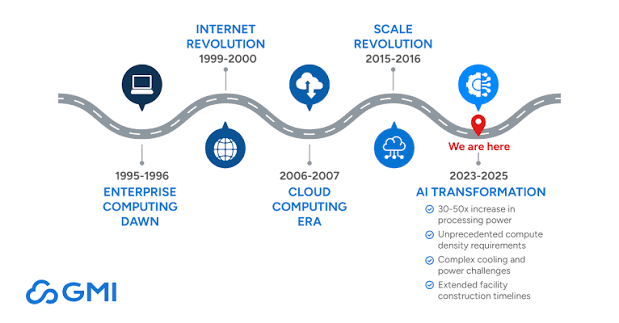
    For the past few years, the biggest data centers on Earth have been built for one purpose: training AI models. These facilities, packed with tens of thousands of GPUs, run for weeks at a time to teach models like GPT-4 how to generate text or images. But that era is ending. By 2026–2028, the industry consensus is that running AI models a process called inference will surpass training as the dominant driver of data center demand. This shift isn’t just a change in workload; it’s a fundamental transformation in how data centers are designed, powered, and located.

    Inference is what happens when you ask ChatGPT a question and get an answer. It’s the always-on, millisecond-sensitive process that powers every AI assistant, recommendation engine, and autonomous agent. Unlike training, which is a massive, one-time burst of compute, inference is a continuous, scaling workload that grows with every new user and every new model. As AI moves from a niche experiment to a mainstream utility, inference is becoming the new cloud workload—and it’s reshaping the data center industry from the ground up.

    The Shift from Training to Inference

    To understand why inference will dominate, you need to know the difference between the two phases of AI compute. Training is like building a rocket: you pour enormous resources into a single, intense project that lasts months. Inference is like launching the rocket every time a user asks a question—it’s the ongoing operation that keeps the service alive.

    Training workloads are batch-processed and can be run in centralized, high-density facilities. They’re tolerant of downtime and latency—if a training run pauses for an hour, no one notices. Inference, on the other hand, is latency-sensitive. When you ask Siri for the weather, you expect an answer in under a second. That means inference servers need to be geographically distributed, closer to the user, to minimize delay.

    NVIDIA has already reported that inference accounts for about 40% of its data center revenue, and it’s growing faster than training. Microsoft, Google, and Amazon are all building out regional edge data centers specifically for inference. The shift is not speculative; it’s happening right now.

    The Numbers Behind the Shift

    The growth projections are staggering. McKinsey estimates that AI-related data center capacity will grow from about 10 gigawatts (GW) in 2024 to 50–60 GW by 2030, with inference driving the majority of that growth. Goldman Sachs projects that data center power demand will increase by 165% by 2030, again with AI inference as the leading contributor.

    What’s driving this? Token generation—the unit of output for AI models—is growing at 3 to 5 times annually across major providers like OpenAI, Anthropic, and Google. As more applications integrate AI, from coding assistants to customer service chatbots, the volume of inference requests skyrockets. And each request consumes compute power, which translates directly to data center demand.

    Why Inference Is Structurally Different

    Inference isn’t just a smaller version of training; it’s a different beast altogether. Training clusters run at near-100% utilization for weeks, making them ideal for a few massive, centralized facilities. Inference, however, has variable utilization—peak during business hours, low at night. That variability requires over-provisioning and new scheduling techniques to handle the load efficiently.

    Hardware is also diverging. Training is dominated by NVIDIA’s H100 and B200 GPUs, but inference is increasingly using specialized chips like Google’s TPU, AWS’s Inferentia, and Groq’s LPU, which are optimized for low latency and high throughput per watt. Software is evolving too, with frameworks like vLLM and TensorRT-LLM that optimize models for inference, sometimes at the cost of making hardware obsolete faster than in the training era.

    The Rise of Agentic AI

    One of the most explosive drivers of inference demand is the shift toward agentic AI—autonomous agents that don’t just answer a single question but perform a series of tasks. Imagine an AI assistant that books a flight, reserves a hotel, and schedules meetings. Each of those steps requires multiple inference calls, multiplying demand by 10 to 100 times per user interaction.

    For example, a simple chatbot might make one inference call per query. An agentic system could make dozens, each with its own latency requirement. This is why companies like OpenAI and Google are investing heavily in agentic frameworks—they know that each agent multiplies the compute needed, and thus the revenue.

    Multimodal Models and Context Windows

    Text-only models were just the beginning. Multimodal models that generate images, audio, and video are far more compute-intensive at inference time. Video generation, for instance, is 100 to 1000 times more expensive per token than text. As these models become mainstream, they’ll add a massive new layer of demand.

    Another factor is the growing size of context windows. Modern models can now process over 1 million tokens in a single request—like reading a whole book before answering a question. The compute needed for inference grows quadratically with context length, meaning that a 1M-token context is not just 10 times more expensive than a 100K-token one; it’s 100 times more. As users demand longer, more nuanced interactions, the cost per request climbs.

    Power and Infrastructure Implications

    Inference workloads have lower power density per rack than training, but they require higher reliability and lower latency. That’s pushing data center design toward regional edge locations. AWS Local Zones and Azure Edge Zones are prime examples—smaller facilities distributed across cities, designed to bring compute closer to users.

    Power procurement is also shifting. Training facilities are the classic “megaprojects”—500 MW or more, built in remote areas with cheap land and power. Inference, by contrast, needs power where people are. That means a distributed portfolio of 50–200 MW sites across many regions. This creates new challenges for grid capacity and reliability, but also opportunities for integration with local renewable energy sources.

    The Economic Logic of Inference

    Training is a capital expense—you build it once and amortize the cost. Inference is a recurring operating expense—you pay per token, per request. That makes it a more predictable revenue stream for cloud providers and a persistent cost for enterprises. The unit economics of inference are improving about 2x per year, but demand is growing faster than efficiency gains. So even as each query becomes cheaper, total spending keeps rising.

    This is why hyperscalers are pouring $200 billion combined into AI infrastructure through 2026, even as skeptics question the near-term returns. They’re betting that inference will become the new cloud workload—the base of a multi-trillion-dollar industry.

    The Skeptic’s View: Is It a Bubble?

    Not everyone is convinced. Some analysts, like Sequoia’s David Cahn, have raised the “$600 billion question”: if inference revenue doesn’t materialize fast enough, the massive capex could be a bubble. If AI adoption plateaus or monetization fails, inference demand could disappoint.

    But the counterpoint is strong: even if consumer AI plateaus, enterprise and government adoption—in coding, healthcare, defense—provides a floor. Companies are already paying for AI copilots that boost productivity, and the ROI is measurable in some sectors. The question isn’t whether inference will grow, but how fast and how sustainably.

    The Energy and Sustainability Angle

    Inference’s distributed nature means power is needed where people live and work, not just in remote deserts. This creates tension with the current data center siting model, which often favors cheap land and abundant power over proximity to users. As cities compete for edge data centers, they’ll need to balance local power demands with sustainability goals.

    The good news is that inference workloads are often more flexible than training—they can be spread out and even shifted between locations based on grid conditions. This opens the door for smart load balancing that can reduce strain on the grid and integrate more renewable energy.

    Looking Ahead

    The era of inference is already here, and it will only accelerate. As AI becomes embedded in every software product, from spreadsheets to medical diagnostics, the demand for running models will dwarf the demand for training them. Data centers will evolve from massive, remote campuses into a web of distributed, edge facilities that bring compute to the user.

    For anyone planning the next decade of infrastructure, the message is clear: the future is not about building the biggest AI model; it’s about running it billions of times a day, reliably, cheaply, and fast. That’s the new reality of data center demand.

    The shift from training to inference is a fundamental change in the data center industry. It’s not just about new hardware or software—it’s about rethinking where data centers are built, how they’re powered, and how they serve the always-on, latency-sensitive demands of AI applications. As inference becomes the primary driver of demand, the winners will be those who can build the most efficient, distributed, and reliable infrastructure.

    Summary

    • Inference is overtaking training as the dominant AI compute workload, with NVIDIA reporting ~40% of data center revenue from inference and growing.
    • Data center capacity is projected to grow from ~10 GW in 2024 to 50–60 GW by 2030, driven largely by inference.
    • Inference is latency-sensitive and requires distributed edge data centers, unlike training’s centralized, batch-processed facilities.
    • Agentic AI and multimodal models multiply inference demand by 10–100x per user interaction.
    • Power procurement shifts from 500MW+ megaprojects to 50–200MW distributed portfolios, closer to users.

    FAQ

    Q: What is the difference between training and inference?
    A: Training is the process of building an AI model, using huge amounts of compute over weeks or months. Inference is the process of running that model to generate outputs, like answering a question or generating an image. Training is a one-time cost, while inference is continuous and scales with usage.

    Q: Why will inference drive more data center demand than training?
    A: Because inference is an always-on workload that grows with every user and every new model. Training, while compute-intensive, is finite and happens less frequently. As AI adoption grows, the number of inference requests multiplies, requiring more data center capacity.

    Q: How does inference affect data center design?
    A: Inference requires low latency, so data centers need to be distributed closer to users. This means more edge data centers in urban areas, with lower power density per rack but higher reliability requirements. It’s a shift from a few massive facilities to many smaller ones.

    Q: What is agentic AI and why does it increase inference demand?
    A: Agentic AI refers to autonomous agents that perform multiple steps to accomplish a task, like booking a trip. Each step involves an inference call, so a single user interaction can trigger 10-100x more compute than a simple chatbot query.

    Q: Is the growth in inference demand a bubble?
    A: Some analysts worry that AI revenue won’t justify the massive investment, but enterprise and government adoption provides a floor. Even if consumer AI plateaus, business use cases like coding and healthcare are expanding, so inference demand is likely to keep growing, though the pace is uncertain.