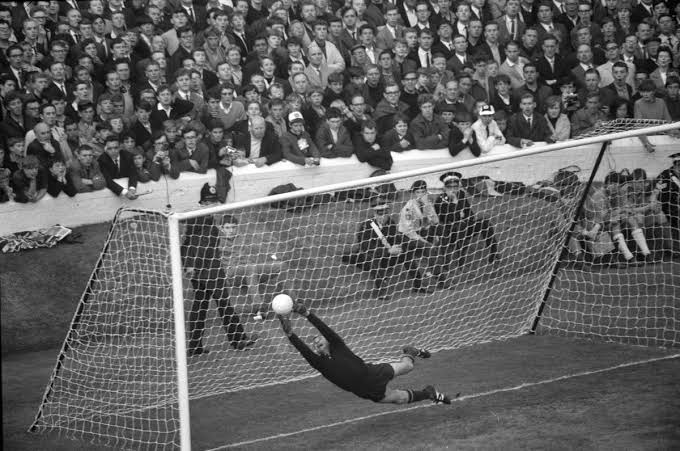
Tag: goalkeeping

  • The Goalkeeper Who Changed the Rules: How Lev Yashin Made the Penalty Area His Kingdom

    The Goalkeeper Who Changed the Rules: How Lev Yashin Made the Penalty Area His Kingdom

    In 1963, a 34-year-old Soviet goalkeeper named Lev Yashin won the Ballon d’Or, the most prestigious individual award in football. No goalkeeper has won it since. To understand why Yashin was not just an exception but a revolutionary, you have to look beyond the trophy and into the penalty area he treated as his personal fiefdom.

    Yashin’s career spanned two decades at Dynamo Moscow, where he made over 300 league appearances, and he became a national hero for the Soviet Union, winning Olympic gold in 1956 and the first European Championship in 1960. But his true legacy lies in how he redefined the goalkeeper’s role—from a static shot-stopper to an active, commanding presence who could change the course of a match with his decisions and his psychology.

    The Black Spider’s Web: A New Kind of Goalkeeper

    In the 1950s and 1960s, goalkeepers were expected to stay on their line. Their job was reactive: make saves, catch crosses, punt the ball upfield. The idea of a goalkeeper as a sweeper, a playmaker, or a psychological weapon was alien. Then came Lev Yashin, dressed head-to-toe in black, earning nicknames like “The Black Spider” and “The Octopus” for his uncanny reach and his habit of covering every inch of his goal.

    But Yashin’s web extended far beyond the goal line. He was the first true sweeper-keeper, routinely charging out of his penalty area to clear through balls, punch crosses away, and act as an extra outfield player. In an era when the back-pass rule didn’t exist—goalkeepers could pick up any ball played back to them—Yashin’s willingness to leave his line was a radical departure. He didn’t just defend his goal; he patrolled the entire penalty area, organizing his defense, claiming crosses with authority, and starting counterattacks with accurate throws.

    His style was so ahead of its time that it took decades for the rest of the world to catch up. Modern sweeper-keepers like Manuel Neuer, Alisson, and Ederson owe a direct debt to Yashin’s pioneering aggression. When Neuer races off his line to clear a through ball, he’s channeling the Black Spider’s spirit. And when a goalkeeper commands his box and shouts orders at his defenders, he’s following a template Yashin set half a century ago.

    The Penalty Psychologist: 150 Saves and Counting

    Yashin’s penalty-saving record is the stuff of legend. Estimates put his career total at over 150 penalties saved—a figure that, if accurate, is unmatched in the modern game. But what made him so good at stopping spot-kicks wasn’t just reflexes; it was psychology.

    Yashin studied penalty takers meticulously. He watched their body language, their run-up, their preferred corners. He was known to delay facing penalties, staring down the taker to unsettle them. He used gamesmanship—shuffling on his line, spreading his arms wide to make himself look bigger, and sometimes even pointing to where he thought the ball would go. This wasn’t random guesswork; it was calculated psychological warfare.

    In an era before video analysis and data-driven penalty metrics, Yashin relied on intuition and observation. Modern goalkeepers now have detailed databases on every taker’s tendencies, but Yashin did it all with his own eyes. He turned penalty shootouts into a duel of wits, and more often than not, he came out on top.

    His approach echoes in today’s game. When a goalkeeper like Emiliano Martínez tries to distract a penalty taker with trash talk or antics, he’s tapping into the same psychological principles Yashin pioneered. The difference is that Yashin did it with a quiet intensity that earned him respect even from the players he denied.

    The Only Ballon d’Or Goalkeeper: A Cold War Icon

    The 1963 Ballon d’Or was a shock. Goalkeepers simply didn’t win the award, which was dominated by outfield players. But Yashin, then 34, finished ahead of Italian midfielder Gianni Rivera and English striker Jimmy Greaves. The award wasn’t just for his shot-stopping; it was for his entire influence on the position.

    Yashin’s success carried political weight. He was a Soviet state hero, a symbol of communist athletic prowess. Yet he was also adored in the West, where his all-black kit and dramatic style made him a cult figure. In an era when Soviet athletes were often portrayed as robotic, Yashin’s flair and sportsmanship—he was known to comfort opponents who missed penalties against him—transcended the Iron Curtain.

    His legacy in Russia is immense. There are statues of him, a stadium named in his honor, and the annual Yashin Award, which was given to the best goalkeeper at the World Cup from 1994 to 2018. But his influence goes beyond trophies and honors. He changed how the world viewed goalkeepers, and his innovations laid the groundwork for the modern game.

    The Rules Caught Up: The Back-Pass Rule and Beyond

    One of the most intriguing aspects of Yashin’s story is how his innovations eventually influenced rule changes. In 1992, FIFA introduced the back-pass rule, which prohibited goalkeepers from handling deliberate passes from teammates. The rule was partly a response to time-wasting tactics, but it also reflected a changing understanding of the goalkeeper’s role—a role Yashin had redefined decades earlier.

    Ironically, Yashin’s sweeping style was made less necessary by the rule change, since goalkeepers could no longer pick up back-passes. But the rule also made sweeping more important in a different way: goalkeepers now had to be skilled with their feet, and the modern sweeper-keeper emerged as a direct consequence. Yashin’s willingness to play as an extra defender foreshadowed this evolution, even if the rules of his time didn’t require it.

    Today, the best goalkeepers are expected to be comfortable with the ball at their feet, capable of playing out from the back and sweeping behind a high defensive line. That expectation would have felt familiar to Yashin, who was doing it in the 1960s with a heavy leather ball and no protective gloves.

    The Octopus’s Legacy: What Modern Goalkeepers Can Learn

    Yashin’s career offers timeless lessons for goalkeepers at every level. First, the mental game matters as much as physical ability. His penalty-saving record was built on study and psychology, not just reflexes. Second, the goalkeeper is not a passive last line of defense but an active participant in the team’s tactics. Yashin’s sweeping and organization were ahead of their time, and they’re now standard practice.

    Third, style matters. Yashin’s all-black kit wasn’t just a fashion choice; it was a statement. It made him stand out, intimidated opponents, and became part of his legend. In a sport where confidence and presence are crucial, Yashin understood that perception is performance.

    Finally, Yashin’s career shows that true innovation often comes from breaking the rules—or at least pushing against their boundaries. He didn’t wait for permission to leave his penalty area; he did it because he saw opportunities that others missed. That mindset is what separates a good goalkeeper from a game-changer.

    As of 2025, no goalkeeper has won the Ballon d’Or since Yashin. The award remains the exclusive domain of outfield players, but Yashin’s place in history is secure. He didn’t just play the position; he reimagined it. And in doing so, he made the penalty area his kingdom—a kingdom that modern goalkeepers still inhabit, whether they know it or not.

    Lev Yashin’s legacy is not measured in trophies alone, though he had plenty. It’s measured in the way goalkeepers play today. Every time a keeper charges off their line, commands their box, or studies a penalty taker’s run-up, they’re following the template Yashin created. He was the Black Spider who wove a web across the penalty area, and the football world is still caught in it.

    Summary

    • Lev Yashin is the only goalkeeper to win the Ballon d’Or (1963), and no goalkeeper has won it since.
    • He pioneered the sweeper-keeper role, routinely leaving his penalty area to intercept passes and organize his defense, decades before modern keepers like Manuel Neuer.
    • Yashin’s estimated 150+ penalty saves were a result of intense psychological study of takers, using body language and gamesmanship to gain an edge.
    • His all-black kit and dramatic style made him a cult figure during the Cold War, transcending political divides.
    • His innovations influenced the evolution of the goalkeeper position, including the eventual 1992 back-pass rule, and his legacy lives on in the modern game.

    FAQ

    Q: How many penalties did Lev Yashin save?
    A: Unofficial counts estimate Yashin saved over 150 penalties during his career, a figure widely cited as unmatched in modern football.

    Q: Why is Lev Yashin considered a pioneer of the sweeper-keeper role?
    A: He routinely left his penalty area to clear through balls, punch crosses, and act as an extra defender, a style that was revolutionary in the 1950s and 1960s and is now standard for many top goalkeepers.

    Q: What was the Yashin Award?
    A: The Yashin Award was given to the best goalkeeper at each FIFA World Cup from 1994 to 2018, named in honor of Lev Yashin. It has since been replaced by the Best FIFA Goalkeeper award.

    Q: Did Lev Yashin win any major international trophies?
    A: Yes, he won Olympic gold in 1956 and the first European Championship in 1960 with the Soviet Union.

    Q: How did Yashin’s style influence the back-pass rule?
    A: While the 1992 back-pass rule was primarily introduced to stop time-wasting, it reflected a changing view of goalkeepers as active players. Yashin’s sweeping style foreshadowed the modern expectation that keepers be skilled with their feet.
  • The Azzurri’s Goalkeeping Paradox: Why Italy’s Defensive Mastery Fails in the Penalty Lottery


    For decades, Italy has been the gold standard for goalkeeping. From Dino Zoff’s 1,168-minute shutout streak to Gianluigi Buffon’s five IFFHS Goalkeeper of the Year awards, the Azzurri have built their footballing identity on defensive perfection. Yet, when matches come down to the cruel randomness of a penalty shootout, Italy has a historically catastrophic record—losing seven of nine major tournament shootouts, including two World Cup finals and a home semifinal.

    This paradox cuts to the heart of Italian football culture. A nation that prides itself on preventing goals seems almost allergic to scoring them when it matters most. But is it a genuine curse, a statistical anomaly, or a deeper psychological and tactical consequence of the catenaccio ethos? The answer is more complex than mere superstition.

    The Glittering Pedigree of Italian Goalkeeping

    Italy’s goalkeeping lineage is unmatched. Gianluigi Buffon, with 176 caps and a 2006 World Cup winners’ medal, stands as the godfather of modern shot-stoppers. Dino Zoff lifted the World Cup in 1982 at age 40, while Walter Zenga’s 518-minute clean-sheet streak at Italia ’90 remains a tournament record. Current custodian Gianluigi Donnarumma, Euro 2020’s Player of the Tournament, represents the next chapter—having already claimed the Yashin Trophy in 2021.

    This dominance extends to individual awards: Italian goalkeepers have claimed the IFFHS World’s Best Goalkeeper honor more times than any other nation, with Buffon winning it five times alone. The roots run deep in the catenaccio system, devised by Helenio Herrera at Inter Milan in the 1960s, which turned defensive solidity into a national obsession. Goalkeepers were the last line of a fortified wall, trained to position, read, and react rather than to theatrically flail.

    The Shootout Curse: A Record of Pain

    Italy’s shootout history reads like a horror reel. The 1990 World Cup semifinal at home against Argentina—Zenga had not conceded all tournament, yet the Azzurri fell in the shootout. 1994: Roberto Baggio skied the decisive penalty over the bar in the final against Brazil. 1998: Luigi Di Biagio hit the crossbar in a quarterfinal exit to France. 2008 and 2016: Spain and Germany ended Italy’s hopes from the spot. Even the 2024 Euro round-of-16 exit to Switzerland came after a goalless 90 minutes, though Italy lost 2-0 in extra time—avoiding a shootout but still succumbing to late collapse.

    Contrast that with the two shootout wins: the Euro 2000 semifinal against the Netherlands—where Italy triumphed 3-1 after a 0-0 draw—and the emotional Euro 2020 final victory over England, where Donnarumma saved two penalties. That’s a win rate of 22% in major tournaments, far below the historical average for elite nations. The absences from the 2018 and 2022 World Cups—both lost in qualifying playoffs—only deepen the sense of a team that freezes when the stakes are highest.

    The Paradox: Elite Defense, Fragile Offense

    Italy’s open-play defense is legendary. The 1,168-minute consecutive shutout streak set between 1972 and 1974 under Zoff remains a world record. In the 1990 World Cup, Italy conceded just twice in six matches before the semifinal—both goals in the shootout itself. Yet this defensive mastery creates a psychological trap: when a shootout arrives, Italy is forced into a contest of attacking precision—exactly what their training and identity de-emphasize.

    Italian youth academies historically prioritized positioning and tactical drilling over penalty technique. The prevailing belief was that penalties were a ‘lottery’, a matter of luck rather than skill. This mindset has been largely debunked by sports science, which now shows that penalty success is highly trainable through techniques like controlled breathing, routine repetition, and studying opponent tendencies. Italy’s until-recently dismissive attitude put them at a disadvantage in high-pressure moments.

    The pattern of missed penalties by star players—Baggio’s skied shot, Di Biagio’s crossbar, Graziano Pellè’s panenka gone wrong in 2016—suggests a cognitive overload. Defensive players are conditioned to react, not to initiate; when asked to step up and take a penalty, the mental shift can be overwhelming. The weight of the ‘Azzurri shirt’ amplifies the pressure, as any error is magnified by a football-crazed nation.

    Statistical Reality vs. Selective Memory

    Critics argue that the ‘curse’ is overblown. Nine shootouts is a small sample size; individual penalty conversion rates are near-average. Italy lost several shootouts to exceptional goalkeeper performances—Sergio Goycochea in 1990, Claudio Taffarel in 1994, and Jens Lehmann’s famous cheat sheet in 2006. In that 2006 final, Italy won the shootout against France, with Buffon saving one penalty—a fact often overlooked.

    Moreover, Italy’s record in shootouts at youth level and in club competitions (e.g., Juventus and AC Milan in European finals) is mixed but not dire. The narrative of a ‘curse’ gained traction because losses occurred in high-profile moments—World Cup finals, semifinals, and European Championship quarterfinals—creating a confirmation bias. Yet the 2020 Euro win under Donnarumma hints at a shift. Donnarumma’s height and reach make him a formidable penalty-saver, and his performance in the final was a masterclass in psychological warfare, including mind games with England’s players.

    Tactical Evolution: The Catenaccio Legacy

    Italy’s defensive dominance may be inherently linked to shootout vulnerability. Catenaccio emphasizes low-scoring, grind-it-out matches where a single goal can decide the tie. When such games reach shootouts, Italian attackers are often fatigued after 120 minutes of defensive work, and their offensive rhythm is cold. In contrast, teams like Brazil or Germany, which play more open, attacking football, have more practice in high-scoring scenarios.

    Additionally, Italian penalty-takers historically lacked a reliable ‘cold’ penalty specialist. The absence of a designated taker—someone who thrives on pressure—is notable. In Euro 2020, Jorginho, a midfielder with a distinctive stutter-step run, was the first-choice taker; his miss in the final could have been fatal, but Donnarumma’s saves rescued the team. Modern Italy, under Roberto Mancini and now Luciano Spalletti, has prioritized penalty practice, and veterans like Donnarumma and Barella are part of a new generation that studies opponents meticulously—a positive sign for the future.

    The Psychological Weight of the Azzurri

    The psychological angle cannot be dismissed. Italian football culture places an immense burden on national team players, especially in shootouts. The fear of becoming the next Baggio—a hero turned scapegoat—can induce anxiety. Psychologists point to ‘choking under pressure’ as a real phenomenon; when players overthink the mechanics of a penalty, performance suffers. The ‘pressione azzurra’ is unique because Italy’s identity is so deeply tied to defensive perfection; failing from the spot feels like a betrayal of that ethos.

    Yet there are counter-examples. Donnarumma appears immune to pressure—his penalty saves in the Euro 2020 final were calm and calculated. The next generation, having grown up with sports psychology and data analysis, may finally break the curse. The 2026 World Cup could be the stage where Italy exorcises its demons, provided they qualify—a task that has proven unexpectedly difficult of late.

    Italy’s shootout struggles are not a supernatural curse but a consequence of their own defensive identity. The very qualities that make them the world’s greatest goalkeeping nation—positioning, reaction, and a focus on preventing goals—leave them ill-prepared for the attacking lottery of penalties. However, the Euro 2020 triumph and the emergence of players like Donnarumma suggest a cultural shift. As Italy integrates modern penalty science and psychological training, the Azzurri may finally convert their defensive mastery into shootout success. Until then, the curse remains a haunting reminder that in football, even the best defenses must eventually face the spot-kick test.

    Summary

    • Italy has the richest goalkeeping history, with legends like Zoff, Buffon, and Donnarumma, yet loses 7 of 9 major tournament shootouts.
    • The defensive catenaccio system creates a psychological paradox: elite shot-stopping but underdeveloped penalty-taking skills.
    • Historical losses (1990, 1994, 1998) and missed World Cup qualifications (2018, 2022) amplify the ‘curse’ narrative, but small sample size and opponent goalkeeper brilliance are factors.
    • Italy’s Euro 2020 win, spearheaded by Donnarumma, signals a possible breaking of the curse through modern training and psychological preparation.
    • The curse is more tactical and cultural than supernatural—Italy’s defensive identity leaves them vulnerable in penalty shootouts.

    FAQ

    Q: Why is Italy considered the greatest goalkeeping nation?
    A: Italy has produced a remarkable lineage of elite goalkeepers—Dino Zoff, Walter Zenga, Gianluca Buffon, and Gianluigi Donnarumma—who have won numerous individual awards and set records, including Buffon’s five IFFHS World’s Best Goalkeeper titles.

    Q: How many major tournament shootouts has Italy lost?
    A: As of 2024, Italy has lost 7 of 9 shootouts in World Cups and European Championships, with notable defeats in the 1990 semifinal, 1994 final, and 2016 quarterfinal.

    Q: Is Italy’s ‘curse’ statistically significant?
    A: No. Nine shootouts is a small sample, and Italy’s individual penalty conversion rates are near average. Many losses were decided by exceptional opposing goalkeeper performances, such as Sergio Goycochea in 1990.

    Q: How does Italy’s defensive style affect their shootout performance?
    A: Italy’s catenaccio system emphasizes defensive organization and low-scoring matches, leaving attackers with less practice in high-pressure offensive scenarios. Additionally, historical training de-emphasized penalty practice, viewing it as ‘luck’ rather than skill.

    Q: Has Italy broken the curse recently?
    A: Yes, in the Euro 2020 final, Italy beat England on penalties, with Gianluigi Donnarumma saving two shots. This win, along with modern sports science integration, suggests a cultural shift toward better penalty preparation.

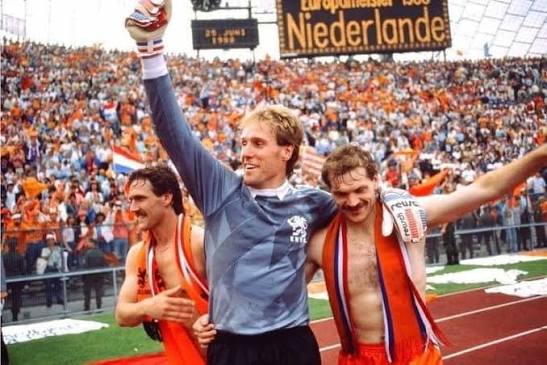
  • The Dutch Goalkeeper Who Became an Outfield Player: Hans van Breukelen and the Birth of the Sweeper-Keeper

    The Dutch Goalkeeper Who Became an Outfield Player: Hans van Breukelen and the Birth of the Sweeper-Keeper

    In the 1988 European Cup final, with the score tied at 0-0 after extra time, PSV Eindhoven goalkeeper Hans van Breukelen faced a penalty shootout against Benfica. He saved two spot-kicks, securing the club’s first and only European Cup. But the most revolutionary thing van Breukelen did that night wasn’t in the shootout it was in the 120 minutes before it, when he repeatedly stepped out of his penalty area to intercept long balls and started attacks with short passes to his defenders. At a time when goalkeepers were expected to stay on their line and boot the ball long, van Breukelen was playing like a fifth defender and first attacker. This was no accident; it was a systematic tactical innovation that would reshape the position forever.

    Van Breukelen’s style, refined under Guus Hiddink at PSV, was a radical departure from the traditional shot-stopper. He was the first goalkeeper to consistently function as a ‘sweeper-keeper’ at the highest level of European club football, and his influence echoes in the modern game’s most celebrated goalkeepers Manuel Neuer, Ederson, and Alisson all trace their lineage directly to him. This is the story of how a Dutchman turned soccer’s most thankless position into the most tactically influential one on the pitch.

    The Goalkeeper as a Liability

    For most of football history, goalkeepers were judged on one thing: keeping the ball out of the net. They stayed on their line, caught crosses, and punted the ball upfield. Any excursion outside the penalty area was considered reckless a goalkeeper caught out of position was a liability, not an asset. This was the orthodox view even in the 1980s, when van Breukelen was turning heads in the Netherlands.

    The back-pass rule, which allowed goalkeepers to handle deliberate back-passes, reinforced this passivity. Goalkeepers were often the target of time-wasting back-passes, but they rarely used the ball to initiate attacks. They were the last line of defense, not the first line of attack.

    Total Football’s Missing Piece

    The Netherlands’ ‘Total Football’ philosophy of the 1970s, pioneered by Rinus Michels and Johan Cruyff, emphasized positional interchange and relentless pressing. But even Cruyff’s Ajax and Netherlands teams used goalkeepers like Jan Jongbloed, who were comfortable with their feet but not yet ‘sweeper-keepers’ in the modern sense. Jongbloed was an outfield player converted to goalkeeper, but his role was still primarily that of a shot-stopper who happened to be decent on the ball.

    It was van Breukelen, under Guus Hiddink at PSV in the mid-1980s, who combined Total Football’s pressing principles with a genuinely proactive goalkeeping style. Hiddink instructed his keeper to act as a ‘keeper-sweeper’ a term that would later become ‘sweeper-keeper.’ Van Breukelen was tasked with sweeping up balls behind the defense, rushing off his line to intercept through balls, and starting attacks with short passes to his defenders. This required exceptional reading of the game, comfort on the ball, and the courage to make split-second decisions under pressure.

    The Mechanics of the Role

    Van Breukelen’s positioning was the key. He stood higher up the pitch than traditional keepers, often on the edge of his penalty area or even beyond it. This compressed the pitch, reducing the space for opponents to exploit. When PSV pressed high, van Breukelen was the safety net, ready to clear any ball played over the top. He effectively became a fifth defender, sweeping up loose balls and launching counter-attacks before the opposition could regroup.

    His footwork was equally crucial. Van Breukelen was comfortable receiving a back-pass under pressure and playing a short pass to a teammate, rather than hoofing it long. This allowed PSV to maintain possession and build attacks from the back, a tactic that was virtually unheard of for goalkeepers at the time. He was the first playmaker from the goalkeeper position, and his distribution was as important as his shot-stopping.

    Euro 88 and the European Cup

    Van Breukelen’s finest hour came in 1988. He was the Netherlands’ number one as they won the European Championship, saving a crucial penalty in the final against the USSR. But it was his all-round game that set him apart. He was not just a shot-stopper; he was the team’s first playmaker, often receiving back-passes and distributing short to defenders to maintain possession under pressure. His performance in the final was a masterclass in the sweeper-keeper role, and it helped legitimize the style on the international stage.

    The same year, van Breukelen led PSV to the European Cup, saving two penalties in the final shootout against Benfica. That triumph was the culmination of Hiddink’s tactical revolution, and van Breukelen was its on-pitch embodiment. He was named Dutch Footballer of the Year in 1988 and 1989, a rare honor for a goalkeeper, and a testament to his influence on the game.

    The Back-Pass Rule and the Acceleration of Change

    Ironically, the 1992 rule change that forbade goalkeepers from handling deliberate back-passes made the sweeper-keeper role even more relevant. Goalkeepers were now forced to use their feet more, accelerating the evolution van Breukelen had already begun. The rule change was a response to time-wasting tactics, but it also pushed goalkeepers to become better with the ball at their feet. Van Breukelen was ahead of his time; he had already embraced the role that the rule change would make mandatory for top-level keepers.

    The Skeptics and the Rivals

    Not everyone was convinced. Critics pointed out that van Breukelen was occasionally caught out of position, and that his style was only viable because PSV dominated the Dutch league. Some argued that the true pioneers were René Higuita of Colombia or Jorge Campos of Mexico, who were more flamboyant but less systematic. Higuita’s scorpion kick and Campos’s acrobatics were attention-grabbing, but neither had the tactical discipline or team-wide impact of van Breukelen.

    The debate misses the point. Van Breukelen was not a showman; he was a system player. His role was not about individual flair but about team structure. He was the first to make the sweeper-keeper a coherent, repeatable tactical principle at the highest level of European club football. Higuita and Campos were exceptions; van Breukelen was a rule.

    The Modern Legacy

    Van Breukelen’s influence is most visible in the modern game’s elite goalkeepers. Manuel Neuer, widely considered the best sweeper-keeper of his generation, has cited van Breukelen as an influence. Ederson and Alisson, the Premier League’s most celebrated keepers, are both products of the same lineage. They are all comfortable with the ball at their feet, quick off their line, and central to their teams’ build-up play. The modern archetype—the goalkeeper as an extra outfield player—owes its existence to van Breukelen’s pioneering work.

    In an era when goalkeepers were often the most isolated and thankless players on the pitch, van Breukelen turned the position into the most tactically influential one. He was a revolutionary, and his legacy is written in every goal kick, every sweeping clearance, and every short pass out from the back in the modern game.

    Hans van Breukelen didn’t invent the sweeper-keeper out of thin air—he synthesized earlier experiments into a systematic role that transformed the goalkeeper from a passive last line of defense into an active participant in every phase of play. His success with PSV and the Netherlands in 1988 proved that a goalkeeper could be a playmaker, a fifth defender, and a first attacker, all at once. The modern game, with its high press and build-from-the-back philosophy, is unthinkable without him. Van Breukelen didn’t just change the position; he changed how we watch the game.

    Summary

    • Hans van Breukelen pioneered the ‘sweeper-keeper’ role at PSV in the 1980s, systematically combining shot-stopping with active participation in build-up play.
    • His style, refined under Guus Hiddink, allowed PSV to press high and compress the pitch, making him an extra outfielder and first playmaker.
    • Van Breukelen’s 1988 European Championship and European Cup victories showcased his all-round game, including a penalty save in the Euro 88 final and two in the European Cup shootout.
    • The 1992 back-pass rule change made the sweeper-keeper role more relevant, but van Breukelen was ahead of his time.
    • Modern goalkeepers like Manuel Neuer, Ederson, and Alisson trace their lineage to van Breukelen, who redefined the position for the modern era.

    FAQ

    Q: What exactly is a ‘sweeper-keeper’?
    A: A sweeper-keeper is a goalkeeper who actively participates in build-up play, acting as an extra outfield player. They often rush off their line to intercept through balls, clear long passes behind the defense, and distribute the ball short to teammates to maintain possession. This role was pioneered by Hans van Breukelen in the 1980s.

    Q: How did van Breukelen differ from earlier goalkeepers like Jan Jongbloed?
    A: Jan Jongbloed was an outfield player converted to goalkeeper and was comfortable with his feet, but he was still primarily a shot-stopper. Van Breukelen, under Guus Hiddink, was explicitly instructed to play as a ‘keeper-sweeper’—a systematic tactical role that involved sweeping up balls behind the defense and starting attacks. He was the first to do this consistently at the highest level of European club football.

    Q: Why is the back-pass rule relevant to the sweeper-keeper’s evolution?
    A: The 1992 rule change forbade goalkeepers from handling deliberate back-passes, forcing them to use their feet more. This accelerated the evolution toward the sweeper-keeper role, but van Breukelen had already embraced it years before the rule change. He was ahead of his time.

    Q: Who else was a pioneer of the sweeper-keeper role?
    A: Gyula Grosics of Hungary in the 1950s experimented with a similar style, and Italian football had the ‘libero’ goalkeeper concept. René Higuita and Jorge Campos were more flamboyant but less systematic. Van Breukelen was the first to make it a team-wide tactical principle at the highest level of European club football.

    Q: How has van Breukelen influenced modern goalkeepers?
    A: Manuel Neuer has cited van Breukelen as an influence. Ederson and Alisson are also products of the same lineage. Modern goalkeepers are expected to be comfortable with the ball at their feet, quick off their line, and central to their team’s build-up play—all traits that van Breukelen pioneered.