Tag: Football Tactics

  • The Dutch Goalkeeper Who Became an Outfield Player: Hans van Breukelen and the Birth of the Sweeper-Keeper

    The Dutch Goalkeeper Who Became an Outfield Player: Hans van Breukelen and the Birth of the Sweeper-Keeper

    In the 1988 European Cup final, with the score tied at 0-0 after extra time, PSV Eindhoven goalkeeper Hans van Breukelen faced a penalty shootout against Benfica. He saved two spot-kicks, securing the club’s first and only European Cup. But the most revolutionary thing van Breukelen did that night wasn’t in the shootout it was in the 120 minutes before it, when he repeatedly stepped out of his penalty area to intercept long balls and started attacks with short passes to his defenders. At a time when goalkeepers were expected to stay on their line and boot the ball long, van Breukelen was playing like a fifth defender and first attacker. This was no accident; it was a systematic tactical innovation that would reshape the position forever.

    Van Breukelen’s style, refined under Guus Hiddink at PSV, was a radical departure from the traditional shot-stopper. He was the first goalkeeper to consistently function as a ‘sweeper-keeper’ at the highest level of European club football, and his influence echoes in the modern game’s most celebrated goalkeepers Manuel Neuer, Ederson, and Alisson all trace their lineage directly to him. This is the story of how a Dutchman turned soccer’s most thankless position into the most tactically influential one on the pitch.

    The Goalkeeper as a Liability

    For most of football history, goalkeepers were judged on one thing: keeping the ball out of the net. They stayed on their line, caught crosses, and punted the ball upfield. Any excursion outside the penalty area was considered reckless a goalkeeper caught out of position was a liability, not an asset. This was the orthodox view even in the 1980s, when van Breukelen was turning heads in the Netherlands.

    The back-pass rule, which allowed goalkeepers to handle deliberate back-passes, reinforced this passivity. Goalkeepers were often the target of time-wasting back-passes, but they rarely used the ball to initiate attacks. They were the last line of defense, not the first line of attack.

    Total Football’s Missing Piece

    The Netherlands’ ‘Total Football’ philosophy of the 1970s, pioneered by Rinus Michels and Johan Cruyff, emphasized positional interchange and relentless pressing. But even Cruyff’s Ajax and Netherlands teams used goalkeepers like Jan Jongbloed, who were comfortable with their feet but not yet ‘sweeper-keepers’ in the modern sense. Jongbloed was an outfield player converted to goalkeeper, but his role was still primarily that of a shot-stopper who happened to be decent on the ball.

    It was van Breukelen, under Guus Hiddink at PSV in the mid-1980s, who combined Total Football’s pressing principles with a genuinely proactive goalkeeping style. Hiddink instructed his keeper to act as a ‘keeper-sweeper’ a term that would later become ‘sweeper-keeper.’ Van Breukelen was tasked with sweeping up balls behind the defense, rushing off his line to intercept through balls, and starting attacks with short passes to his defenders. This required exceptional reading of the game, comfort on the ball, and the courage to make split-second decisions under pressure.

    The Mechanics of the Role

    Van Breukelen’s positioning was the key. He stood higher up the pitch than traditional keepers, often on the edge of his penalty area or even beyond it. This compressed the pitch, reducing the space for opponents to exploit. When PSV pressed high, van Breukelen was the safety net, ready to clear any ball played over the top. He effectively became a fifth defender, sweeping up loose balls and launching counter-attacks before the opposition could regroup.

    His footwork was equally crucial. Van Breukelen was comfortable receiving a back-pass under pressure and playing a short pass to a teammate, rather than hoofing it long. This allowed PSV to maintain possession and build attacks from the back, a tactic that was virtually unheard of for goalkeepers at the time. He was the first playmaker from the goalkeeper position, and his distribution was as important as his shot-stopping.

    Euro 88 and the European Cup

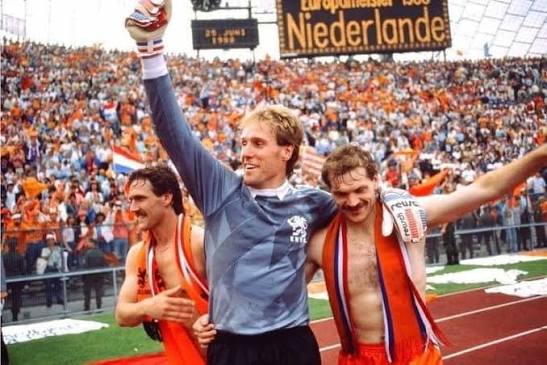
    Van Breukelen’s finest hour came in 1988. He was the Netherlands’ number one as they won the European Championship, saving a crucial penalty in the final against the USSR. But it was his all-round game that set him apart. He was not just a shot-stopper; he was the team’s first playmaker, often receiving back-passes and distributing short to defenders to maintain possession under pressure. His performance in the final was a masterclass in the sweeper-keeper role, and it helped legitimize the style on the international stage.

    The same year, van Breukelen led PSV to the European Cup, saving two penalties in the final shootout against Benfica. That triumph was the culmination of Hiddink’s tactical revolution, and van Breukelen was its on-pitch embodiment. He was named Dutch Footballer of the Year in 1988 and 1989, a rare honor for a goalkeeper, and a testament to his influence on the game.

    The Back-Pass Rule and the Acceleration of Change

    Ironically, the 1992 rule change that forbade goalkeepers from handling deliberate back-passes made the sweeper-keeper role even more relevant. Goalkeepers were now forced to use their feet more, accelerating the evolution van Breukelen had already begun. The rule change was a response to time-wasting tactics, but it also pushed goalkeepers to become better with the ball at their feet. Van Breukelen was ahead of his time; he had already embraced the role that the rule change would make mandatory for top-level keepers.

    The Skeptics and the Rivals

    Not everyone was convinced. Critics pointed out that van Breukelen was occasionally caught out of position, and that his style was only viable because PSV dominated the Dutch league. Some argued that the true pioneers were René Higuita of Colombia or Jorge Campos of Mexico, who were more flamboyant but less systematic. Higuita’s scorpion kick and Campos’s acrobatics were attention-grabbing, but neither had the tactical discipline or team-wide impact of van Breukelen.

    The debate misses the point. Van Breukelen was not a showman; he was a system player. His role was not about individual flair but about team structure. He was the first to make the sweeper-keeper a coherent, repeatable tactical principle at the highest level of European club football. Higuita and Campos were exceptions; van Breukelen was a rule.

    The Modern Legacy

    Van Breukelen’s influence is most visible in the modern game’s elite goalkeepers. Manuel Neuer, widely considered the best sweeper-keeper of his generation, has cited van Breukelen as an influence. Ederson and Alisson, the Premier League’s most celebrated keepers, are both products of the same lineage. They are all comfortable with the ball at their feet, quick off their line, and central to their teams’ build-up play. The modern archetype—the goalkeeper as an extra outfield player—owes its existence to van Breukelen’s pioneering work.

    In an era when goalkeepers were often the most isolated and thankless players on the pitch, van Breukelen turned the position into the most tactically influential one. He was a revolutionary, and his legacy is written in every goal kick, every sweeping clearance, and every short pass out from the back in the modern game.

    Hans van Breukelen didn’t invent the sweeper-keeper out of thin air—he synthesized earlier experiments into a systematic role that transformed the goalkeeper from a passive last line of defense into an active participant in every phase of play. His success with PSV and the Netherlands in 1988 proved that a goalkeeper could be a playmaker, a fifth defender, and a first attacker, all at once. The modern game, with its high press and build-from-the-back philosophy, is unthinkable without him. Van Breukelen didn’t just change the position; he changed how we watch the game.

    Summary

    • Hans van Breukelen pioneered the ‘sweeper-keeper’ role at PSV in the 1980s, systematically combining shot-stopping with active participation in build-up play.
    • His style, refined under Guus Hiddink, allowed PSV to press high and compress the pitch, making him an extra outfielder and first playmaker.
    • Van Breukelen’s 1988 European Championship and European Cup victories showcased his all-round game, including a penalty save in the Euro 88 final and two in the European Cup shootout.
    • The 1992 back-pass rule change made the sweeper-keeper role more relevant, but van Breukelen was ahead of his time.
    • Modern goalkeepers like Manuel Neuer, Ederson, and Alisson trace their lineage to van Breukelen, who redefined the position for the modern era.

    FAQ

    Q: What exactly is a ‘sweeper-keeper’?
    A: A sweeper-keeper is a goalkeeper who actively participates in build-up play, acting as an extra outfield player. They often rush off their line to intercept through balls, clear long passes behind the defense, and distribute the ball short to teammates to maintain possession. This role was pioneered by Hans van Breukelen in the 1980s.

    Q: How did van Breukelen differ from earlier goalkeepers like Jan Jongbloed?
    A: Jan Jongbloed was an outfield player converted to goalkeeper and was comfortable with his feet, but he was still primarily a shot-stopper. Van Breukelen, under Guus Hiddink, was explicitly instructed to play as a ‘keeper-sweeper’—a systematic tactical role that involved sweeping up balls behind the defense and starting attacks. He was the first to do this consistently at the highest level of European club football.

    Q: Why is the back-pass rule relevant to the sweeper-keeper’s evolution?
    A: The 1992 rule change forbade goalkeepers from handling deliberate back-passes, forcing them to use their feet more. This accelerated the evolution toward the sweeper-keeper role, but van Breukelen had already embraced it years before the rule change. He was ahead of his time.

    Q: Who else was a pioneer of the sweeper-keeper role?
    A: Gyula Grosics of Hungary in the 1950s experimented with a similar style, and Italian football had the ‘libero’ goalkeeper concept. René Higuita and Jorge Campos were more flamboyant but less systematic. Van Breukelen was the first to make it a team-wide tactical principle at the highest level of European club football.

    Q: How has van Breukelen influenced modern goalkeepers?
    A: Manuel Neuer has cited van Breukelen as an influence. Ederson and Alisson are also products of the same lineage. Modern goalkeepers are expected to be comfortable with the ball at their feet, quick off their line, and central to their team’s build-up play—all traits that van Breukelen pioneered.

  • The Tactical Evolution of Football: From Catenaccio to Tiki-Taka and Beyond

    The Tactical Evolution of Football: From Catenaccio to Tiki-Taka and Beyond

    Football tactics are not just formations on a chalkboard; they are the living expression of a team’s philosophy, shaped by rule changes, cultural identity, and the relentless pursuit of an edge. From the rigid defensive shell of Catenaccio to the fluid, possession-based dominance of Tiki-Taka, the game has undergone a profound transformation. Understanding this evolution is not merely an academic exercise—it reveals how the sport’s greatest minds have adapted to constraints and opportunities, and why the modern game looks the way it does.

    This article traces the arc of tactical history, examining the key systems, the matches that defined them, and the figures who dared to innovate. We’ll explore how each era’s dominant approach was a response to what came before, and how the cycle of adaptation continues today. For fans and analysts alike, this journey offers a deeper appreciation of the beautiful game’s strategic depth.

    The Birth of Structure: The WM Formation

    Before the 1920s, football was largely a chaotic affair, with the 2-3-5 Pyramid formation favoring relentless attack. But the 1925 offside rule change—reducing the number of defenders needed between an attacker and the goal from three to two—sent shockwaves through the sport. Suddenly, defenses were vulnerable, and a new structure was needed.

    Herbert Chapman, the visionary manager of Arsenal, answered with the WM formation. This 3-2-2-3 shape created a back three, with two wing-halves in front, and two inside forwards supporting a central striker. It was the first truly structured system, designed to provide defensive solidity while still allowing for attacking flair. Chapman’s Arsenal dominated English football in the 1930s, and the WM became the standard for decades.

    But the WM’s rigidity was its downfall. The ‘Match of the Century’ in 1953 exposed its limitations when Hungary’s Mighty Magyars, playing a fluid and mobile system, thrashed England 6-3 at Wembley. The English press was stunned; the era of static formations was over.

    The tactical evolution of football is a testament to human ingenuity and adaptability. From the rigid lines of the WM to the fluid interchanges of Total Football, from the defensive pragmatism of Catenaccio to the possession-based artistry of Tiki-Taka, each system has been a response to the challenges of its time. As the game continues to evolve, one thing remains certain: the cycle of innovation and counter-innovation will never stop. The next great tactical revolution is already brewing, waiting for the right visionary to unleash it.

    Summary

    • Tactical evolution is driven by rule changes, athleticism, technology, and counter-adaptation.
    • Key systems include the WM, Catenaccio, Total Football, Gegenpressing, and Tiki-Taka.
    • Iconic matches like the 1953 Hungary-England game and the 2011 Champions League final marked turning points.
    • Modern tactics are hybrid and matchup-specific, blending defensive solidity with rapid transitions.
    • The romantic vs. pragmatic debate continues, but winning remains the ultimate metric.

    FAQ

    Q: What is the difference between Catenaccio and Tiki-Taka?
    A: Catenaccio is an ultra-defensive system focused on man-marking and counter-attacks, while Tiki-Taka emphasizes high possession and short passing to control the game. They represent opposite philosophies: one prioritizes defensive solidity, the other offensive control.

    Q: Why did Tiki-Taka decline?
    A: Tiki-Taka’s decline was due to teams learning to defend deep and compact, limiting space for short passes. Additionally, the physical demands of high pressing and the need for a plan B made pure possession less effective against well-organized low blocks.

    Q: How did the back-pass rule change tactics?
    A: The 1992 rule preventing goalkeepers from handling back-passes forced teams to build from the back and press higher, accelerating the shift toward possession-based and pressing styles.

    Q: What is Gegenpressing?
    A: Gegenpressing, or counter-pressing, is the immediate attempt to win the ball back after losing it, rather than retreating. It was popularized by Jürgen Klopp and is a key component of modern high-intensity football.

    Q: Are tactics more important now than in the past?
    A: Tactics have always been important, but modern analytics and video analysis have made them more sophisticated and matchup-specific. The margin for error is smaller, and tactical flexibility is crucial at the highest level.

  • The Tactical Pendulum: How Football’s Greatest Systems Rose, Fell, and Reinvented Themselves

    The Tactical Pendulum: How Football’s Greatest Systems Rose, Fell, and Reinvented Themselves

    Football tactics are not just about formations on a chalkboard; they are a living, breathing arms race where every dominant system eventually breeds its own antidote. From the iron curtain of Catenaccio to the hypnotic passing webs of Tiki-Taka, the sport’s tactical evolution is a story of genius, rebellion, and the relentless pursuit of an edge. Understanding this cycle isn’t just for coaches—it’s the key to appreciating why the beautiful game looks the way it does today.

    This isn’t a dry history lesson. It’s a journey through the minds of the game’s greatest innovators—Helenio Herrera, Rinus Michels, Johan Cruyff, and Pep Guardiola—and the counter-revolutionaries who dared to tear down their creations. We’ll explore not just what happened on the pitch, but why it happened, and how the tactical pendulum continues to swing today.

    The Door-Bolt: Catenaccio and the Art of Controlled Chaos

    In the 1960s, Italian football was a fortress. The brainchild of Austrian coach Karl Rappan in the 1940s and perfected by the Argentine-Italian Helenio Herrera at Inter Milan, Catenaccio—Italian for “door-bolt”—was a system built on defensive solidity and ruthless efficiency. The key innovation was the “libero,” or sweeper, a free defender positioned behind the back line who could mop up any ball that slipped through. This allowed the team to absorb pressure, man-mark opponents tightly, and then explode forward on the counter-attack.

    Inter’s success was staggering: two consecutive European Cups (1964, 1965) and three Serie A titles in the mid-1960s. The system was so effective that it became synonymous with Italian football for decades. Yet, it was also reviled as negative, boring, and anti-football. Critics argued it prioritized results over entertainment, but its defenders pointed to the tactical intelligence required to execute it perfectly. Catenaccio wasn’t just about defending; it was about waiting for the precise moment to strike, turning defense into attack in seconds.

    Total Football: The Beautiful Rebellion

    If Catenaccio was the lock, Total Football was the key. Developed by Rinus Michels at Ajax and the Netherlands national team in the early 1970s, it was a radical departure from everything that came before. The core principle was positional interchangeability: players were not tied to fixed roles but could swap positions fluidly, with defenders pushing forward and forwards dropping back. This created a dynamic, unpredictable style that overwhelmed opponents with constant movement and high pressing.

    Ajax won three consecutive European Cups (1971–1973), and the Dutch national team reached the 1974 World Cup final, playing some of the most breathtaking football ever seen. The system’s genius lay in its collective intelligence—every player understood the space and the movement of their teammates, creating a seamless whole. Johan Cruyff, the system’s on-field maestro, later took these principles to Barcelona as a coach, laying the foundation for the club’s future identity.

    The Barcelona Laboratory: From Cruyff to Guardiola

    Cruyff’s tenure at Barcelona (1988–1996) was a tactical revolution in itself. He instilled a philosophy based on possession, pressing, and positional play, turning the club into a laboratory for Total Football’s evolution. The “Dream Team” that won the 1992 European Cup was a testament to his vision, but the true flowering came later, under Pep Guardiola.

    Guardiola, a product of Cruyff’s school, refined the philosophy into what the world would come to know as Tiki-Taka. Between 2008 and 2012, his Barcelona team dominated world football with a style that seemed almost alien in its precision. Short, quick passes; relentless pressing after losing the ball; and a false nine (often Lionel Messi) created a system that suffocated opponents and controlled games with 60–70% possession. The results were historic: 14 trophies in four years, including two Champions League titles. Spain, under Vicente del Bosque, adopted the same principles and won Euro 2008, the 2010 World Cup, and Euro 2012—a feat never before achieved.

    The Backlash: When Possession Becomes Sterile

    But every system has its expiration date. Tiki-Taka’s dominance bred a counter-revolution. Critics began to label it “sterile possession”—passing for the sake of passing, without penetration. Teams like José Mourinho’s Inter Milan (2010) and Diego Simeone’s Atlético Madrid showed that a deep defensive block, combined with rapid transitions, could neutralize the possession game. The 2014 World Cup was a turning point: Spain’s tiki-taka was dismantled by the Netherlands’ direct, vertical style, and Germany won the title with a more pragmatic, hybrid approach.

    This counter-revolution wasn’t just about negativity. It was about intelligence—finding the spaces that possession-based systems leave behind. Klopp’s Liverpool (2018–2022) combined high pressing (gegenpressing) with lightning-fast transitions, creating a style that was both aggressive and efficient. The tactical pendulum had swung again, but it didn’t swing back to Catenaccio; it moved toward a synthesis of the best elements of past systems.

    The Modern Synthesis: Hybrids and the Future

    Today, top teams rarely adhere to a single, pure philosophy. Guardiola’s Manchester City, for example, uses positional play with elements of Total Football and Tiki-Taka, but also incorporates a high press and tactical flexibility. The three-at-the-back formation has made a resurgence, offering both defensive solidity and attacking width. The game has become a chess match where managers must adapt to their opponent’s strengths and weaknesses, often within a single match.

    The evolution of tactics is not a linear progression but a cycle. Each dominant system creates the conditions for its own downfall, and the next great innovation often comes from an unexpected source. The lesson for fans and analysts alike is that football’s tactical landscape is never static—it’s a living, breathing entity that reflects the cultural, economic, and athletic forces of its time.

    From the iron curtain of Catenaccio to the intricate passing webs of Tiki-Taka, football tactics have always been a reflection of the human desire to solve problems creatively. The tactical pendulum continues to swing, and the next great system is already being born in the minds of coaches and players around the world. As fans, we are privileged to witness this endless evolution—a game within the game that makes football the world’s most captivating sport.

    Summary

    • Catenaccio (1960s–70s) used a sweeper and man-marking to absorb pressure and counter-attack, winning Inter Milan two European Cups.
    • Total Football (1970s) introduced positional interchangeability and high pressing, leading Ajax to three consecutive European Cups and influencing Cruyff’s Barcelona.
    • Tiki-Taka (2008–2012) refined possession and pressing, yielding 14 trophies for Guardiola’s Barcelona and three consecutive major titles for Spain.
    • Counter-revolution (2010s–present) saw low-block counter-attacking (Simeone, Mourinho) and high-pressing transitions (Klopp) challenge tiki-taka’s dominance.
    • Modern tactics are hybrid, blending elements of past systems, as seen in Guardiola’s Manchester City and the resurgence of three-at-the-back formations.

    FAQ

    Q: What is the main difference between Catenaccio and Total Football?
    A: Catenaccio is a defensive system focused on absorbing pressure and counter-attacking, using a sweeper and man-marking. Total Football is an attacking system based on positional interchangeability and high pressing, where players fluidly swap roles.

    Q: Why did Tiki-Taka decline?
    A: Tiki-Taka declined because teams found ways to neutralize it, often by defending deep in a low block and hitting on the counter. Critics also argued that some teams used it without enough penetration, making possession sterile.

    Q: How did Johan Cruyff influence modern football?
    A: Cruyff brought Total Football principles to Barcelona as a coach, emphasizing possession, pressing, and positional play. This laid the foundation for the club’s identity and directly influenced Pep Guardiola’s Tiki-Taka.

    Q: What is gegenpressing?
    A: Gegenpressing is a tactic where a team immediately presses the opponent after losing the ball, aiming to win it back quickly in dangerous areas. It was popularized by Jürgen Klopp and is a key feature of modern high-intensity football.

    Q: Are defensive tactics like Catenaccio still relevant today?
    A: Yes, but in evolved forms. Teams like Atlético Madrid under Diego Simeone use a deep defensive block and rapid transitions, which is a modern adaptation of Catenaccio’s principles, proving that defensive solidity remains a viable path to success.

  • Chelsea’s Danny Welbeck Gamble: Veteran Wisdom or a Stopgap Too Far?

    Chelsea’s Danny Welbeck Gamble: Veteran Wisdom or a Stopgap Too Far?

    in a transfer market dominated by astronomical fees and teenage prodigies, Chelsea have made a move that feels almost anachronistic: signing 35-year-old Danny Welbeck on a free transfer. The two-year deal, announced with little fanfare, raises eyebrows across the Premier League. Is this a shrewd piece of business to add experience to a youthful squad, or a sign that the club’s ambitious striker hunt has stalled?

    Welbeck arrives from Brighton, where he enjoyed a late-career renaissance, scoring 10 league goals last season. For a Chelsea side that has struggled for consistency in front of goal, his signing offers a pragmatic, low-risk solution. But it also begs the question: in a squad built on potential, can a veteran with a storied injury history truly make a difference?

    This move is more than just a squad filler. It’s a statement about Chelsea’s evolving recruitment philosophy, a test of Welbeck’s durability, and a fascinating tactical experiment under Enzo Maresca. Let’s break down what the veteran brings to Stamford Bridge, the risks involved, and what it means for the club’s future.

    The Context: A Squad of Kids in Need of a Father Figure

    Chelsea’s recent transfer strategy has been clear: buy the best young talent in the world and develop them into stars. The average age of their squad is among the lowest in the Premier League, with players like Cole Palmer, Nicolas Jackson, and Moisés Caicedo still in their early 20s. While this approach has long-term potential, it has also led to a lack of on-pitch leadership and composure in crucial moments. The dressing room has been described as ‘quiet’ and ‘lacking characters’ by pundits.

    Enter Danny Welbeck. With over 500 senior appearances, a Premier League title, and 42 England caps, he brings a wealth of experience that cannot be taught. His presence is not just about what he does on the pitch, but what he offers off it. Young strikers like Jackson and Marc Guiu can learn from his movement, his pressing triggers, and his professionalism. This is a classic ‘Thiago Silva’ move—a veteran free agent who can mentor the next generation while still contributing on the field.

    The Stakes: A Stopgap or a Statement?

    Chelsea’s pursuit of elite strikers like Victor Osimhen and Benjamin Šeško has been well-documented. The club’s fans have been promised a marquee signing to lead the line. Instead, they get Welbeck. On the surface, this feels like a downgrade in ambition. But look closer, and you’ll see a calculated move.

    Welbeck is not meant to be the long-term answer. He is a rotation option, a squad player who can start 20-25 games a season and provide a different dimension. His signing allows Chelsea to be patient in the transfer market, waiting for the right opportunity rather than overpaying for a striker who may not fit Maresca’s system. It also sends a message to the existing forwards: perform or be replaced. The stakes are clear—Welbeck is here to compete, not to make up the numbers.

    Tactical Fit: More Than Just a Poacher

    Under Enzo Maresca, Chelsea have adopted a possession-based, high-pressing style. Welbeck is a perfect fit for this system. Despite his age, he remains one of the most industrious forwards in the league, ranking highly in sprints and defensive actions per 90 minutes. He is not a traditional target man; instead, he excels at dropping deep, linking play, and creating space for runners like Palmer and Madueke.

    His movement is intelligent, and his ability to hold up the ball allows Chelsea to build attacks more patiently. He also offers a threat from set pieces, with several headed goals for Brighton last season. In a team that often struggles to break down low blocks, Welbeck’s clever runs and link-up play could be invaluable.

    The Injury Question: A Risk Worth Taking?

    Welbeck’s injury history is well-documented: a broken leg in 2019, recurring hamstring issues, and over 100 missed games throughout his career. However, his time at Brighton has been remarkably stable. He played 30+ league games in each of his last two seasons, suggesting that his body has adapted to the demands of top-level football. Chelsea’s medical team will have done their due diligence, and the two-year deal (with an option for a third) indicates they are confident in his durability.

    That said, the risk remains. At 35, injuries can strike at any time, and a long-term absence would leave Chelsea short in attack. But as a free transfer, the financial risk is minimal. Even if he only plays 20 games a season, his contribution could justify the deal.

    Fan Reaction: Pragmatism vs. Ambition

    The reaction from Chelsea fans has been mixed. Some see this as a panic signing, a lack of ambition from a club that should be competing for the league title. Others view it as a smart, low-risk move that adds depth without blocking the path for young players. There’s also a hint of nostalgia—Welbeck was once a Manchester United player, and some fans may view him with suspicion. But most recognize that he is a professional who will give his all for the badge.

    Brighton’s Loss: A Leader Departs

    Brighton have lost a reliable, experienced forward who was popular in the dressing room and with fans. His departure leaves a void in leadership and goals. The Seagulls will need to replace his output, likely through internal promotion (Evan Ferguson) or a new signing. But Brighton’s data-driven model means they are well-equipped to find a replacement. For Welbeck, the move to Chelsea represents a final chance to win silverware and prove he can still perform at the highest level.

    Danny Welbeck’s move to Chelsea is a fascinating gamble. It’s a low-risk, high-reward signing that addresses a clear need for experience and leadership in a young squad. While he may not be the marquee striker fans were hoping for, his tactical fit, professionalism, and recent form suggest he can make a meaningful contribution. The real test will be whether he can stay fit and whether Maresca can integrate him effectively. If he does, this could be one of the smartest free transfers of the summer. If not, it’s a minor blip in Chelsea’s long-term rebuild. Either way, it’s a move worth watching.

    Summary

    • Chelsea have signed Danny Welbeck on a free transfer from Brighton, with a two-year deal and an option for a third.
    • Welbeck brings 500+ senior appearances, a Premier League title, and 42 England caps, offering much-needed leadership to a young squad.
    • His recent form at Brighton (10 goals in 30 league games) shows he can still contribute at the top level.
    • The signing is a tactical fit for Maresca’s high-pressing, possession-based system, with Welbeck excelling as a link-up forward.
    • The main risk is his injury history, but his improved availability at Brighton and the low financial cost make this a calculated gamble.

    FAQ

    Q: Why did Chelsea sign a 35-year-old Danny Welbeck?
    A: Chelsea needed experienced leadership in a very young squad, and Welbeck offers that at no transfer cost. He provides depth, mentorship, and a tactical fit for the manager’s system.

    Q: Is Welbeck still good enough to play in the Premier League?
    A: Yes. He scored 10 goals in 30 league appearances for Brighton last season and maintained high pressing numbers, proving he can still perform at the top level.

    Q: What will Welbeck’s role be at Chelsea?
    A: He is likely to be a rotation option, starting some games and coming off the bench in others. He will also serve as a mentor to younger strikers like Nicolas Jackson and Marc Guiu.

    Q: How long is Welbeck’s contract?
    A: He has signed a two-year deal running until summer 2027, with an option for a further year.

    Q: What are the main risks of this signing?
    A: The primary risk is his injury history, but he has been relatively durable in recent seasons. The financial risk is low due to the free transfer and modest wages.