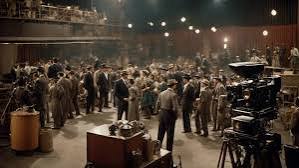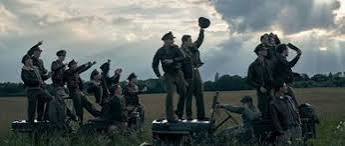
In 1942, Hollywood wasn’t just making movies about the war it was making the war. Studios churned out propaganda features like Casablanca and Mrs. Miniver, while Frank Capra’s Why We Fight series played in barracks across the globe. The Office of War Information reviewed scripts, and the War Activities Committee shipped prints to troops. The result was a generation of filmmakers who learned their craft in service of a single, unambiguous story: the good war against fascism.
Eighty years later, that story still dominates our screens. From Saving Private Ryan to Call of Duty, WWII remains the default setting for moral clarity in entertainment. But the war’s influence runs deeper than recycled plotlines. It shaped how Hollywood works with the Pentagon, how we remember (and forget) history, and why a superhero created as propaganda in 1941 still headlines blockbusters today.
The Birth of the Modern Blockbuster
The war didn’t just give cinema a subject it gave it a template. The combat film, perfected in the 1940s and 1950s, established the beats we still see today: the rag-tag squad, the reluctant hero, the sacrificial last stand. Twelve O’Clock High (1949) and The Bridge on the River Kwai (1957) added psychological depth, but the core structure stuck. When Steven Spielberg shot the Omaha Beach sequence for Saving Private Ryan (1998), he wasn’t inventing a new language he was amplifying one forged in the 1940s.
But the war’s influence isn’t just aesthetic. It’s institutional. The Pentagon’s film liaison office, born from wartime collaboration, still reviews scripts today. Productions that want military hardware and cooperation must submit to oversight. That’s why you see the same heroic framing of American troops in films from Top Gun to Transformers—a direct legacy of the OWI’s wartime mandate.
The Cold War’s Invisible Censor
Here’s a fact that might surprise you: the Eastern Front, where Germany suffered roughly 80% of its military casualties, barely appears in American WWII films made before the 1990s. That’s not an accident. As the Cold War hardened, Hollywood quietly downplayed the Soviet role to avoid glorifying a rival superpower. The result was a Western-centric narrative that cast the US as the sole liberator a story that still shapes perceptions today.
International filmmakers pushed back. Come and See (1985), a Soviet film, showed the war as brutal, chaotic, and morally ambiguous. Das Boot (1981) put Germans in the submarine, making audiences empathize with the enemy. Downfall (2004) humanized Hitler’s inner circle. These films didn’t just fill gaps they challenged the clean hero/villain binary that American cinema had cemented.
The Pacific Theater and the Bomb’s Long Shadow
The Pacific war never fit neatly into the “good war” narrative. The racialized brutality of island-hopping, the firebombing of Tokyo, and the atomic bombs raised questions that American films often sidestepped. The Thin Red Line (1998) and Letters from Iwo Jima (2006) approached the Pacific with more nuance, but it was Oppenheimer (2023) that finally forced a mainstream reckoning with the bomb’s moral weight. The film’s success showed that audiences are hungry for complexity, not just heroics.
Alternate History: The War as Sandbox
What if the Nazis won? That question has fueled a subgenre of speculative fiction, from Philip K. Dick’s The Man in the High Castle (1962) to the Wolfenstein video game series. These works use WWII as a moral sandbox, exploring what happens when evil isn’t defeated. Inglourious Basterds (2009) rewrote history so that Jewish soldiers assassinate Hitler a cathartic fantasy that critiques the very idea of historical accuracy. And Captain America: The First Avenger (2011) turned a 1941 propaganda comic into a modern origin story, proving that the war’s symbols still resonate.
The Fading of Living Memory
Tom Brokaw’s 1998 book The Greatest Generation cemented a narrative that has dominated American culture for two decades. But as the last veterans die, the war is shifting from personal testimony to mediated history. That’s why Band of Brothers (2001) and Masters of the Air (2024) feel like monuments they’re preserving a story before it’s gone. The risk is that this story becomes frozen, stripped of controversy and complexity. The challenge for filmmakers is to keep the war alive without turning it into a theme park.
What the War Means Now
WWII endures because it offers something modern conflicts rarely do: moral clarity. The fight against fascism was unambiguous, the stakes existential. That clarity is seductive, especially in an era of gray-area warfare. But it’s also a trap. The best WWII art Come and See, The Pianist, Letters from Iwo Jima resists that clarity, showing war as chaos, suffering, and moral decay. The war’s influence on pop culture is undeniable, but its true power lies in the questions it keeps asking.
World War II shaped the infrastructure of modern cinema, the narratives we inherit, and the way we imagine heroism. But as living memory fades, the war is becoming something else: a mirror we hold up to ourselves. The films we make about it heroic, revisionist, or speculative reveal more about our own anxieties than about 1945. That’s why the war will never really end on screen. It’s too useful as a story, and too dangerous to forget.
Summary
- WWII established the combat film template and Hollywood’s ongoing partnership with the Pentagon.
- The Cold War suppressed the Soviet role in Western narratives, shaping a Western-centric view.
- International films like Come and See and Das Boot challenged the hero/villain binary.
- Alternate history and superhero films use WWII as a moral sandbox, critiquing the present.
- As living memory fades, WWII storytelling is shifting from testimony to mediated history.
FAQ
Q: Why does Hollywood still make WWII movies if the war ended 80 years ago?
A: WWII offers moral clarity—a rare commodity in modern storytelling. It also has institutional support: the Pentagon’s film liaison office, a legacy of wartime collaboration, still facilitates productions that portray the military favorably.
Q: How did the Cold War affect WWII films?
A: To avoid glorifying the Soviet Union, American cinema downplayed the Eastern Front, where 80% of German casualties occurred. This created a Western-centric narrative that persisted for decades.
Q: What are some non-American WWII films that offer different perspectives?
A: Come and See (Soviet, 1985), Das Boot (German, 1981), Downfall (German, 2004), and The Pianist (Polish, 2002) all resist the clean hero/villain binary, focusing on suffering and moral ambiguity.
Q: How does alternate history use WWII?
A: Works like The Man in the High Castle and Wolfenstein ask “what if” the Nazis won, using the war as a sandbox to explore themes of resistance, evil, and the fragility of history.
Q: Is the “Greatest Generation” narrative accurate?
A: It’s a powerful but selective story. It emphasizes American heroism and unity while often marginalizing Black soldiers, Japanese-American internees, and the broader Allied coalition. Recent films and historians are complicating that narrative.