Tag: animal communication

  • Crow Conversations: How Regional Dialects Emerge in Caw Patterns

    Crow Conversations: How Regional Dialects Emerge in Caw Patterns

    If you’ve ever listened to crows cawing in a city park and then heard them in a rural forest, you might have noticed a difference not just in volume, but in the tone and rhythm of their calls. These differences aren’t random; they’re regional dialects, much like human accents. Crows in different areas develop distinct ‘caw’ patterns, and these patterns are learned, not inherited, making them a fascinating window into animal culture.

    But how do these dialects form, and what do they mean? Research on American Crows and carrion crows in Europe reveals that these birds are not just making noise; they’re participating in a complex system of vocal communication that varies from place to place. Understanding this system not only illuminates crow behavior but also challenges our assumptions about what animals can learn and pass down.

    The Anatomy of a Caw

    Contrary to popular belief, a crow’s “caw” is not a single, uniform sound. Acoustic analysis has identified multiple distinct call types, each serving a different purpose. There are alarm caws, which are sharp and harsh, used to warn of predators. Contact caws, which are softer and more rhythmic, help maintain social bonds within a flock. There are also “ko” calls and “rattle” calls, each with its own frequency profile. When researchers study dialects, they focus on specific call types, particularly the scolding or alarm calls, because these show the most measurable variation between regions.

    Dr. Andrea Townsend and her colleagues have documented that American Crow alarm calls vary in pitch, duration, and rhythm between populations separated by just a few hundred kilometers. These variations are consistent enough that a trained ear—or a spectrogram—can often tell where a crow is from.

    Learning the Local Lingo

    Crows are vocal learners, a trait they share with humans, parrots, and hummingbirds. This means that their calls are not hardwired from birth; instead, juvenile crows learn their regional call patterns by listening to and imitating the adults in their natal area. This learning process is crucial: a crow that moves to a new region can adopt the local call patterns, demonstrating that dialects are cultural, not genetic.

    Behavioral studies support this. When researchers play recordings of local versus foreign crow calls to wild crows, the birds respond more aggressively to local calls, suggesting they recognize and favor the familiar. This response indicates that dialects are not just acoustic variations but carry social significance.

    Why Do Dialects Exist?

    So, why do crows develop regional dialects in the first place? Several hypotheses have been proposed, and it’s likely a combination of factors:

    • Kin recognition and group cohesion: Local calls help crows identify members of their own social group or territory, which is essential for cooperative behaviors like mobbing predators.
    • Mate selection: Female crows may prefer males with local calls, leading to assortative mating that reinforces dialects.
    • Environmental adaptation: The acoustic adaptation hypothesis suggests that calls are shaped by the local sound environment. Urban crows, for example, produce calls with higher pitch and shorter duration, which are better at cutting through low-frequency traffic noise.
    • Cultural drift: Similar to how human languages evolve, dialects may arise from random copying errors that accumulate over generations.

    The Urban Crow Phenomenon

    Urbanization provides a natural experiment for studying dialect formation. In cities, crows face continuous low-frequency noise, and research shows they adjust their calls to be higher-pitched and shorter. This is a form of behavioral plasticity—crows can change their calls within their lifetime to adapt to their environment. It’s not a genetic change but a learned adjustment, highlighting the flexibility of crow vocalizations.

    Crows and the Concept of Culture

    The existence of learned, geographically distinct vocal traditions in crows raises a provocative question: does this constitute “culture”? In biology, culture is defined as socially transmitted behavior, and by that definition, crow dialects are a form of culture. These traditions persist across generations, passed down not through DNA but through observation and imitation.

    This finding aligns with what we know about corvid intelligence. Crows are renowned for problem-solving, tool use, and social cognition. Their vocal flexibility is another manifestation of their cognitive sophistication, suggesting that the mental machinery required for cultural transmission is not unique to humans.

    How Scientists Study Crow Calls

    To study crow dialects, researchers use spectrograms—visual representations of sound frequency over time. By measuring parameters like pitch (frequency), duration, and rhythm, they can quantify differences between populations. Playback experiments, where they broadcast recorded calls to wild crows, allow them to test behavioral responses.

    One notable study by Yorzinski and Vehrencamp (2009) showed that crows can discriminate between familiar and unfamiliar individual voices, adding another layer to their communication system. This individual recognition, combined with regional dialects, suggests a rich social structure.

    Common Questions About Crow Dialects

    Are crow dialects a form of language?

    No, not in the human sense. Crow calls lack syntax, recursion, or symbolic reference. They are more like accents or regional variations in non-linguistic vocalizations. The “secret language” framing is evocative but scientifically imprecise.

    Can crows from different regions understand each other?

    Yes, they can. Studies show that crows respond to foreign calls, though less intensely than to local ones. This suggests that while dialects differ, there is enough commonality for basic communication.

    Do all crows have dialects?

    Dialects have been documented in American Crows and carrion crows, but the extent varies by species and region. European carrion crows show less pronounced regional variation than American Crows.

    How long does it take for a crow to learn its local dialect?

    Juvenile crows begin producing adult-like calls after several months, and their calls “crystallize” into the local pattern as they mature. The exact timeframe can vary.

    Can crows change their dialect if they move?

    Yes, because dialects are learned, a crow that moves to a new area can adopt local call patterns. This flexibility is a key feature of vocal learning.

    Crow dialects are more than just background noise—they are a window into the social and cognitive lives of these remarkable birds. By studying how regional variations in caws emerge, we gain insight into the mechanisms of vocal learning, the importance of social transmission, and the very nature of culture in the animal kingdom. Next time you hear a crow caw, listen closely: it might be speaking in its own local accent.

    Summary

    • Crows are vocal learners, not born with calls but learning them from adults in their community.
    • Regional dialects in alarm calls vary measurably, even between populations separated by a few hundred kilometers.
    • Dialects serve functions like kin recognition, mate selection, and environmental adaptation.
    • Urban crows adjust their calls to be higher-pitched to overcome city noise, showing behavioral flexibility.
    • Crow dialects are culturally transmitted, making them a form of animal culture.

    FAQ

    Q: Are crow dialects really like human accents?nA: Yes, in a limited way. Crows in different regions have distinct call patterns that are learned, not innate. However, crow calls lack the complexity of human language.

    Q: Can crows from different regions understand each other?nA: Yes, they can communicate, but they respond more strongly to local calls, indicating they recognize the difference.

    Q: Do crows change their calls if they move to a new area?nA: Yes, because dialects are learned, a crow can adopt the local call patterns after moving.

    Q: Why do urban crows have different calls?nA: Urban crows produce higher-pitched and shorter calls to be heard over low-frequency traffic noise, an example of environmental adaptation.

    Q: Is crow vocal learning evidence of culture?nA: Yes, since culture is defined as socially transmitted behavior, crow dialects qualify as cultural traditions.

  • The Secret Language of Elephant Rumbles: How Infrasound Communication Shapes Herd Society

    The Secret Language of Elephant Rumbles: How Infrasound Communication Shapes Herd Society

    Imagine a conversation so deep that it shakes the ground beneath your feet, yet you can’t hear a single word. That’s how elephants talk. Their most important messages ride on sound waves below 20 hertz—far too low for human ears. For decades, we missed the whole conversation.

    In the 1980s, biologist Katy Payne was at a zoo when she felt a strange throbbing in the air, like the bass from a distant concert. That sensation led to a discovery: elephants communicate with infrasound, allowing them to coordinate across miles of savanna. This hidden acoustic world is the glue of elephant society, enabling everything from a mother’s call to her calf to a matriarch’s decision to lead her herd to water.

    What Is Infrasound, and Why Do Elephants Use It?

    Sound is a vibration traveling through air (or water or ground). Human hearing typically ranges from 20 to 20,000 hertz (Hz). Elephants produce rumbles between 14 and 35 Hz, with some calls dipping even lower. These low-frequency sounds are called infrasound because they fall below our hearing range.

    Why go so low? In the open savanna, high-frequency sounds scatter easily against vegetation and get absorbed by the atmosphere. Low frequencies, however, have long wavelengths that bend around obstacles and travel for kilometers without losing much energy. Under ideal conditions, an elephant’s rumble can be heard up to 10 kilometers away. That’s like a human shouting from downtown to the suburbs—except the message stays clear.

    Elephants produce these rumbles using their larynx, just like other mammals. But their vocal folds are massive, vibrating slowly to create those deep tones. The trunk and nasal passages act as resonating chambers, adding richness to the call.

    How Elephants ‘Hear’ with Their Feet

    Hearing infrasound through the air is only half the story. Elephants also pick up vibrations that travel through the ground. When an elephant rumbles, the sound waves also couple with the earth, creating seismic waves that can travel even farther. Elephants detect these vibrations through specialized nerve endings called Pacinian corpuscles, which are densely packed in their feet and trunk. They can sense the tiny tremors of another herd’s footsteps or the rumble of an approaching storm.

    This dual channel—acoustic and seismic—means elephants have a remarkably robust communication system. If wind noise masks the airborne call, the ground still carries the message. Researchers like Caitlin O’Connell-Rodwell have shown that elephants can distinguish between the seismic vibrations of different elephants and even different types of calls.

    The Matriarch’s Voice: Coordination and Leadership

    Elephant society is matriarchal. A family group consists of related females and their offspring, led by the oldest and often largest female—the matriarch. Her experience is the herd’s collective memory: where to find water in a drought, which paths are safe from predators, and how to respond to unfamiliar elephants.

    But how does she transmit that knowledge? Through infrasound. The matriarch’s rumbles coordinate group movement, signaling when to start walking, when to stop, and which direction to take. Studies by Karen McComb at the University of Sussex found that older matriarchs have larger vocal repertoires and are better at distinguishing between the calls of familiar and unfamiliar elephants. Herds led by experienced matriarchs make more accurate decisions, and this is reflected in higher calf survival rates.

    Each elephant has a unique “voiceprint” in its rumble—a combination of pitch, rhythm, and harmonics that acts like a name. Calves learn their mother’s call within days, and mothers can recognize their offspring’s call even in a crowd. This individual recognition is vital for maintaining bonds in a fission-fusion society, where groups split and reunite regularly.

    Rumbles of Love and Warning: The Social Functions

    Infrasound is not just for navigation; it carries emotional and reproductive information. When a female elephant enters estrus, she emits a distinctive series of rumbles that advertise her readiness to mate. Males, especially those in musth—a period of heightened testosterone and aggression—respond with their own low-frequency calls. These calls can travel for kilometers, allowing males to find females without direct visual contact.

    Alarm calls are another critical use. If a herd senses danger—a lion, a poacher, or a human settlement—the matriarch emits a sharp, urgent rumble that sends the group into defensive formation. Calves learn to interpret these alarms from a young age, and even playbacks of recorded alarm rumbles trigger the same response.

    Greeting and bonding are also conducted via rumbles. When separated family members reunite, they exchange a series of contact calls—a kind of acoustic hug. Mothers and calves maintain near-constant vocal contact in the first years of life, ensuring the calf is never truly alone.

    The Discovery That Changed Our View

    Before the 1980s, scientists thought elephant rumbles were just basic grunts. Then Katy Payne, working at the Cornell Lab of Ornithology, noticed something odd at the Washington Park Zoo in Portland. She felt a flutter in the air, like the vibration from a pipe organ, when elephants were seemingly silent. Intrigued, she recorded the elephants and analyzed the audio, finding a wealth of low-frequency calls that humans simply couldn’t hear.

    Payne’s 1986 paper in Behavioral Ecology and Sociobiology documented these infrasonic calls for the first time. It opened a new field of study and revealed that elephants were engaging in long-distance conversations all along. Since then, researchers have used specialized microphones and accelerometers to decode the complexity of elephant communication.

    Recent advances in machine learning have accelerated this work. Algorithms can now classify different rumble types—contact, greeting, alarm, estrus—and even identify individual elephants by their calls with high accuracy. This technology is not just academic; it’s being used to monitor wild elephant populations and assess their social health.

    Why This Matters for Conservation

    Understanding infrasound is not just a scientific curiosity. It has practical implications for elephant conservation. As human development fragments elephant habitats, it also fragments their acoustic landscape. A road or a town can block the transmission of infrasound, isolating herds and disrupting their social networks. Conservationists designing wildlife corridors now consider not just physical space but also acoustic space, ensuring that herds can mantain contact over long distances.

    In human-elephant conflict zones, knowledge of infrasound can help mitigate clashes. For example, if elephants can sense human activity from kilometers away, they may avoid areas where they feel threatened—or, conversely, they may become bolder if they perceive no danger. Researchers are exploring whether playing back alarm rumbles could deter elephants from entering farmlands, offering a non-lethal way to protect both crops and elephants.

    In captivity, elephants are highly social animals that suffer when isolated. Understanding their communication needs has led to changes in zoo and sanctuary design, such as housing elephants in compatible social groups and providing opportunities for long-distance vocal contact between facilities.

    The Unheard Orchestra

    Elephant society is a symphony of low-frequency notes, a conversation that we are only now beginning to appreciate. Each rumble is a thread in the social fabric, binding individuals across time and space. As we decode this secret language, we gain not only scientific insight but also a profound respect for the intelligence and emotional depth of these magnificent creatures.

    The next time you see an elephant, remember that it’s not just the trunk, ears, and tusks that tell the story. Beneath the audible trumpets and growls lies a deeper channel—a world of infrasound that carries the herd’s history, its decisions, and its bonds. By listening to these rumbles, we are finally beginning to understand the true complexity of elephant society, and perhaps, in doing so, we can better protect it.

    Summary

    • Elephants use infrasound (below 20 Hz) to communicate over distances up to 10 km.
    • They produce these low-frequency rumbles with their larynx and detect them through both ears and seismic sensors in their feet.
    • Infrasound enables matriarchal coordination, reproductive signaling, alarms, and individual recognition.
    • Discovery by Katy Payne in the 1980s revealed the hidden acoustic world of elephants.
    • Understanding infrasound is key for conservation, human-elephant conflict mitigation, and captive elephant welfare.

    FAQ

    Q: Can humans hear elephant rumbles?
    A: No, most elephant rumbles are below 20 Hz, which is the lower limit of human hearing. We can feel them as vibrations, but we need special equipment to hear them as sound.

    Q: How far can elephant infrasound travel?
    A: Under ideal conditions, an elephant’s rumble can be heard up to 10 kilometers away. Seismic vibrations through the ground can travel even farther.

    Q: Do all elephants use infrasound?
    A: Yes, both African savanna elephants and Asian elephants use infrasound, though the specific acoustic features differ slightly between species.

    Q: How do elephants detect seismic vibrations?
    A: Elephants have specialized nerve endings called Pacinian corpuscles in their feet and trunk that are sensitive to vibrations. These allow them to sense ground-borne signals from other elephants.

    Q: Why is infrasound important for elephant conservation?
    A: Human development can block acoustic communication, isolating elephant herds. Conservation corridors must consider acoustic space, and understanding infrasound helps in designing non-lethal deterrents and improving captive elephant welfare.

  • The Secret Language of Crows: Regional Dialects and Social Structures

    The Secret Language of Crows: Regional Dialects and Social Structures

    Imagine walking through a park and hearing a crow caw. It might sound like a simple, harsh call, but to another crow, that sound could be a warning, a greeting, or a sign of a food stash. Crows are not just noisy birds; they have a complex vocal system that varies across the globe, much like human languages.

    Recent research has shown that crows have regional dialects, can recognize individual human faces, and pass down vocal traditions through generations. This article explores the secret language of crows, revealing how their calls and social structures differ around the world, and what this tells us about animal intelligence and culture.

    The Crow’s Vocal Toolkit

    Crows are members of the genus Corvus, which includes over 40 species worldwide. From the American Crow (Corvus brachyrhynchos) to the New Caledonian Crow (Corvus moneduloides), these birds produce a wide range of sounds: caws, rattles, clicks, and coos. The familiar “caw” is not a single sound it varies in pitch, duration, and rhythm depending on the situation. For instance, a short, sharp caw might signal alarm, while a longer, softer caw could be a contact call between mates.

    Scientists use spectrograms visual representations of sound to analyze these calls. By examining the frequency and timing, they can identify distinct call types and even individual variations. This is similar to how a human voiceprint can identify a person.

    Regional Dialects: A Crow’s Accent

    Just as humans from different regions speak with distinct accents, crows have regional dialects. Studies on American Crows have found that the structure of their caw and rattle calls differs measurably between populations, such as those in California versus New York. These differences are not genetic; they are learned. Juvenile crows acquire their calls by listening to their parents and group members, a process known as vocal learning.

    This cultural transmission means that a crow’s “accent” is passed down through generations, much like a human language. In urban environments, crows have also adapted their calls to overcome background noise, producing higher-pitched or shorter sounds. This is a form of behavioral plasticity, allowing them to communicate effectively in noisy cities.

    Social Structures and Family Ties

    Crows are highly social birds, often living in extended family groups with cooperative breeding. Offspring may stay with their parents for 1 to 5 years, helping to raise younger siblings. This extended family structure is crucial for vocal learning, as young crows pick up calls from multiple family members, not just their parents.

    The social complexity of crow groups is reflected in their communication. They have calls for different predators, food sources, and social interactions. For example, a crow might use a specific call to alert others to a hawk, while another call signals the discovery of a carcass. This ability to convey specific information suggests a level of cognitive sophistication.

    Individual Recognition and Memory

    Crows are famous for their ability to recognize individual humans. In a well-known study at the University of Washington, researchers wearing masks captured crows. Later, the crows scolded those same masks, even years later, showing they remembered the faces. They also communicated this information to other crows, who would scold the masks without having been captured themselves.

    This individual recognition extends to vocalizations. Crows can identify the calls of specific individuals, whether other crows or humans. This skill is likely tied to their complex social lives, where keeping track of friends and foes is essential.

    Cultural Transmission: More Than Instinct

    Crow vocalizations are not purely innate; they are learned, making them a form of animal culture. This challenges the old view that animal behavior is purely instinctual. The New Caledonian Crow, famous for its tool-making abilities, also shows cultural variation in tool use. Different populations use different techniques, passed down through social learning.

    This cultural transmission is a key feature of crow intelligence. It allows them to adapt to new environments and challenges, such as urban living or new food sources. By learning from others, crows can acquire knowledge without having to figure it out from scratch.

    The Question of Language

    While crows have a complex vocal system, scientists are careful not to call it a “language” in the human sense. Human language has syntax and grammar, allowing for infinite combinations of words. Crows, on the other hand, use a limited set of calls, though they may combine them in sequences to convey more information.

    However, the study of crow communication offers insights into the evolution of language. By understanding how crows use calls to convey specific messages, we can learn about the building blocks of communication in animals. This research also highlights the intelligence of crows, which rivals that of some primates.

    Global Perspectives: Crows Across Cultures

    Crows are found on every continent except Antarctica and South America, and they have adapted to a variety of environments, from wilderness to urban centers. Their behavior varies accordingly, with urban crows often being bolder and more innovative.

    Human cultures have also shaped how we perceive crows. In Japanese folklore, crows are messengers of the gods; in some Native American traditions, they are tricksters. The same “caw” may be seen as an omen of death in one culture and a sign of good luck in another. These cultural interpretations reflect our long history with these intelligent birds.

    Conservation and Coexistence

    As crows thrive in human-dominated landscapes, they sometimes come into conflict with people, leading to calls for culling. However, understanding their communication and social structures can help us find ways to coexist. For example, noise pollution can disrupt crow calls, so reducing noise in urban areas might help them communicate better.

    Research on crow behavior also has implications for conservation. By studying their dialects and social structures, we can better understand how populations are connected and how they respond to environmental changes. This knowledge can inform conservation strategies for both crows and other species.

    The secret language of crows is a testament to their intelligence and adaptability. Regional dialects, individual recognition, and cultural transmission all point to a complex social world that we are only beginning to understand. As we continue to study these remarkable birds, we not only learn about them but also about the nature of intelligence and communication itself.

    Summary

    • Crows have a diverse vocal repertoire, including caws, rattles, clicks, and coos, each with specific meanings.
    • Regional dialects in crow calls are learned, not genetic, and are a form of cultural transmission.
    • Crows live in complex family groups with cooperative breeding, which aids in vocal learning.
    • They can recognize individual human faces and voices, and pass this information to other crows.
    • Their communication system, while not a language in the human sense, offers insights into animal intelligence and the evolution of language.

    FAQ

    Q: Do crows have different dialects in different regions?
    A: Yes, studies have shown that crow calls, such as the caw and rattle, differ measurably between geographically separated populations. These dialects are learned, not genetic, and are passed down through social learning.

    Q: Can crows recognize individual humans?
    A: Yes, crows can remember human faces and voices for years. In experiments, they have scolded researchers who captured them, even when the researchers wore masks, and they have communicated this information to other crows.

    Q: Is crow communication considered a language?
    A: No, crow communication does not have syntax or grammar like human language. However, they use a variety of calls and can combine them in sequences to convey more complex information, which is a subject of ongoing research.

    Q: How do crows learn their calls?
    A: Crows learn their calls by listening to their parents and other group members during a juvenile period. This is a form of vocal learning, similar to how humans learn speech.

    Q: Why do crows adapt their calls in urban areas?
    A: Urban crows have been observed producing higher-pitched or shorter calls to overcome background noise, a phenomenon known as the “urban noise effect.” This is a behavioral adaptation that helps them communicate effectively in noisy environments.

  • The Waggle Dance: How Honeybees Share Directions Through Vibration

    The Waggle Dance: How Honeybees Share Directions Through Vibration

    Inside a dark hive, a honeybee performs a figure-eight dance that tells her sisters exactly where to find food. This dance, called the waggle dance, was decoded by Karl von Frisch in the 1940s, earning him a share of the 1973 Nobel Prize. It’s a remarkable example of symbolic communication in the animal kingdom, conveying distance and direction with surprising precision.

    But how does a bee ‘read’ a dance she can’t see? The answer lies in touch and vibration. Follower bees press their antennae against the dancer, feeling her movements and the vibrations she sends through the comb. This article breaks down the mechanics of the waggle dance, the information it encodes, and the scientific debate that once questioned its very existence.

    The Dance Floor: Where and How It Happens

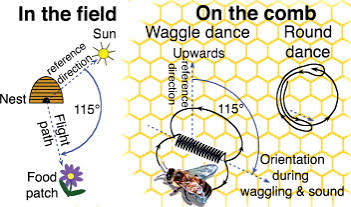
    The waggle dance takes place on the vertical surface of the honeycomb, inside the pitch-dark hive. The dancer, a forager bee, moves in a figure-eight pattern. The straight part of the figure is called the ‘waggle run,’ where she vibrates her abdomen side-to-side. Then she loops back to the starting point, alternating left and right. This run is the key: its angle and duration carry the essential information.

    Decoding the Message: Direction and Distance

    Direction: The angle of the waggle run relative to vertical tells followers the angle of the food source relative to the sun’s position. If the bee waggles straight up, the food is in the same direction as the sun. If she waggles 45 degrees to the right of vertical, the food is 45 degrees to the right of the sun. This works because bees have an internal clock that compensates for the sun’s movement across the sky.

    Distance: The duration of the waggle run correlates with the distance to the food. Roughly 75 milliseconds of waggle run equals about 1 kilometer. So a longer waggle means a farther food source. Bees can communicate distances from about 50 meters to over 10 kilometers, though accuracy decreases with distance.

    Beyond the Basics: Quality and Scent

    A bee doesn’t just give directions; she also indicates how good the food is. The vigor of the dance—how many runs she performs, how fast she moves, how long she dances—reflects the quality of the food source, such as sugar concentration and nectar volume. Followers can also smell the floral scent on the dancer’s body, providing an olfactory cue about the specific flowers. And they may taste a drop of nectar from her mouthparts to assess quality directly.

    The Round Dance: A Shortcut for Nearby Food

    For food sources very close to the hive (less than about 50 meters), bees perform a ’round dance’—a looping pattern without a distinct waggle run. This just says ‘nearby’ without giving precise direction. It’s a graded system, not a binary one, showing the dance’s flexibility.

    How Followers ‘Hear’ the Dance: Touch and Vibration

    In the dark hive, visual cues are useless. Instead, follower bees position themselves behind the dancer and touch her with their antennae. They track her movements through these mechanosensory contacts. The dancer also produces vibrations at about 200–300 Hz, transmitted through the comb. These vibrations, generated by the waggle itself (at about 13–15 Hz) and by a brief thoracic pulse, are critical for recruiting followers. Recent research by James Nieh and others suggests the vibration signal may also encode information about food profitability, adding another layer to the message.

    The Controversy: Is It Really a Language?

    The waggle dance’s status as a true language wasn’t always accepted. In the 1960s and 70s, biologist Adrian Wenner argued that scent cues alone could explain how bees found food, and the dance was just a byproduct. This sparked a heated debate. But experiments by James Gould in the 1970s settled it: using robotic bees and misdirection experiments, Gould showed that bees could locate a specific place based solely on the dance’s information, even when scent was controlled. The dance is real, but it’s not the only channel—bees use a combination of dance, scent, and vibration to make decisions.

    The Bigger Picture: Swarm Intelligence

    Thomas Seeley at Cornell has shown that the waggle dance is part of a decentralized decision-making system. When a hive needs a new nest site, scout bees dance to advertise different options. The intensity of each dance acts like a vote, and the colony eventually chooses the best site through a democratic process. The dance is thus not just about foraging; it’s a key component of the hive’s collective intelligence.

    How a Bee’s Tiny Brain Handles This

    Given that a bee has only about a million neurons, how does it translate a dance into a flight vector? Research suggests that bees use optic flow—the apparent movement of the environment as they fly—to measure distance, and they may compare the dance’s instructions with their own flight experience. The exact neural mechanisms are still being studied, but the bee’s ability to extract and use this information is a testament to the power of small brains.

    The Evolution of the Dance

    Not all bees dance the same way. The dwarf honeybee Apis florea, for instance, dances on a horizontal surface, using the sun’s actual direction rather than a vertical abstraction. Stingless bees use simpler recruitment methods like scent trails. This suggests the waggle dance evolved as a derived trait within the honeybee lineage, becoming more sophisticated over time.

    Conclusion: A Small Dance, a Big Message

    The waggle dance is a remarkable example of symbolic communication in animals. It conveys precise information about direction, distance, and quality, all through vibrations in the dark. It’s a system that has evolved to meet the complex needs of a eusocial colony, and it continues to fascinate scientists and laypeople alike. Next time you see a bee buzzing around, remember there’s a whole language hidden in those wiggles.

    The waggle dance is a vivid reminder that communication doesn’t require sound or sight. Through touch and vibration, honeybees pass along directions that can lead their sisters to food kilometers away. This tiny dance carries a big message, and it’s one of nature’s most impressive feats of information transfer.

    Summary

    • The waggle dance is a figure-eight movement performed by forager bees on the vertical honeycomb surface.
    • The angle of the waggle run indicates direction relative to the sun; the duration indicates distance (~75 ms per km).
    • Dance vigor and scent convey food quality.
    • Followers perceive the dance through touch (antennae) and vibration (~200–300 Hz).
    • The dance was decoded by Karl von Frisch (Nobel Prize 1973) and confirmed by experiments like James Gould’s robotic bees.

    FAQ

    Q: What is the waggle dance?
    A: It’s a figure-eight dance performed by honeybees to communicate the location of food sources.

    Q: How do bees know the direction from the dance?
    A: The angle of the waggle run relative to vertical corresponds to the angle of the food source relative to the sun.

    Q: How do bees communicate distance?
    A: The duration of the waggle run is proportional to distance; longer waggles mean farther food.

    Q: Do bees use the dance for anything else?
    A: Yes, they also use it to choose nest sites, with each dance acting as a vote in a collective decision.

    Q: Can bees see the dance?
    A: No, they feel it with their antennae and sense vibrations through the comb.