On February 5, 1916, in a smoky back room of a Zurich tavern, Hugo Ball recited a poem that made no sense. He stood in a cardboard costume, wings flapping, and shouted syllables: “gadji beri bimba glandridi laula lonni cadori.” The audience, mostly artists and exiles, didn’t laugh. They understood. The war raging across Europe had turned millions of young men into statistics, and the language that had justified it—patriotism, honor, progress—was a lie. Dada was born not as a style, but as a scream.
This was not art for art’s sake. It was art against the very idea of art, against the reason that had built machine guns and propaganda. Dadaists didn’t want to soothe or beautify; they wanted to shatter. In the chaos of a world gone mad, they chose nonsense as their weapon, and absurdity as their truth.
A Nightclub in Neutral Switzerland
Zurich in 1916 was a strange bubble. While Europe bled in trenches, the Swiss city thrived with spies, refugees, and revolutionaries—Lenin lived a few streets away from the Cabaret Voltaire. Hugo Ball, a German theater director who had fled conscription, rented the space above a seedy bar and turned it into a performance venue. He and his partner Emmy Hennings, a cabaret singer, wanted to create a place where artists could respond to the horror with total freedom.
The cabaret was a mess of noise, poetry, and dance. Ball recited his sound poems—words stripped of meaning, pure vocal texture. Tristan Tzara, a Romanian poet, shouted manifestos that declared, “Dada means nothing.” Hans Arp, an Alsatian sculptor, glued paper squares at random, letting chance decide the composition. Marcel Janco painted masks that looked like tribal relics. None of it was meant to be beautiful. It was meant to break the spell of a culture that had produced the war.
“I do not want words that other people have invented,” Ball wrote in his diary. “I want my own stuff, my own rhythm, and vowels and consonants to match.” The destruction of language was a political act. If words like “fatherland” and “glory” had been used to send millions to death, then those words deserved to be shredded.
The Name That Means Nothing
The movement’s name, “Dada,” was reportedly discovered on April 18, 1916, when Ball and his friends flipped through a French-German dictionary. They landed on “dada,” the French word for hobbyhorse, a child’s toy. It was meaningless, infantile, and perfect. Tzara later claimed it could mean anything—or nothing at all. The choice was deliberate: a name that defied interpretation, just like the movement itself.
This anti-meaning stance extended to the group’s publications and performances. Tzara’s 1918 manifesto instructed readers to “take a newspaper, take some scissors, cut out the words… put them in a bag, shake gently, then take out the scraps one after another.” The result was a poem that made no logical sense, but it mirrored the randomness of war—where a shell could land anywhere, on anyone, for no reason.
Readymades and Revolt
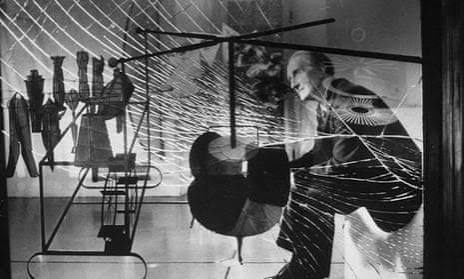
Meanwhile, in New York, Marcel Duchamp was taking the same idea into the gallery. In 1917, he bought a porcelain urinal from a plumbing supply store, signed it “R. Mutt,” and submitted it to the Society of Independent Artists’ exhibition. The piece, titled Fountain, was rejected—not because it was offensive, but because it was a urinal. Duchamp’s point was sharp: art was whatever an artist chose to call art. The institutions, the critics, the public—they had no real authority. They were just playing a game, and Dadaists refused to play by the rules.
The readymade was a slap at the art market, but it was also a comment on mass production. A factory-made object had no “aura” of genius, yet Duchamp elevated it by choice. In a world where industrial technology had produced poison gas and tanks, why should art celebrate beauty? Better to force people to look at a toilet and ask: what is art, and who decides?
Berlin: Politics and Photomontage
After the war, Dada took a harder turn in Berlin. The November Revolution of 1918 had failed, the Spartacist uprising was crushed, and the new Weimar Republic was shaky. Berlin Dadaists like George Grosz, John Heartfield, and Hannah Höch were explicitly political. They didn’t want to escape the world; they wanted to tear it apart with scissors.
Höch’s Cut with the Kitchen Knife Dada Through the Last Weimar Beer-Belly Cultural Epoch of Germany (1919-1920) is a visual riot. She pasted together photographs of politicians, wrestlers, dancers, and machinery into a chaotic collage. The title itself is a mockery of the German establishment. The work shows a map of Europe with heads of military leaders, a picture of a woman’s legs, a gearwheel, and the word “Dada” scrawled across. It’s a jumble, but it’s methodical: Höch was attacking the male-dominated, militaristic culture that had led Germany into ruin.
Photomontage was a new medium, born from the mass media that had mushroomed during the war. Posters, newspapers, and advertisements were everywhere. Dadaists stole these images and recombined them, showing how propaganda manipulated reality. If the press could create a fake world, Dada could create a deliberately fake one that exposed the lies.
The End and the Echo
By 1924, the movement had largely dissolved. Tzara moved to Paris, where André Breton was gathering the Surrealists. Some Dadaists joined him, finding a new home in the exploration of the unconscious. Others went into architecture, design, or politics. But the spirit didn’t die. It resurfaced in the 1950s and 1960s as Neo-Dada, influencing Fluxus, Pop Art, and performance art. Every time an artist uses everyday objects, every time a performance shocks an audience, every time a work refuses to mean something—that’s Dada’s echo.
The movement was a reaction to a specific catastrophe, but its core insight remains: when reason becomes a tool for mass death, absurdity is the only honest response. Dada didn’t offer solutions. It offered a mirror, cracked and distorted, showing the world what it had become.
Dada was not a style you could hang on a wall. It was a nervous breakdown, a tantrum, a refusal. It lasted only a few years, but it changed how we think about art—not as a decoration, but as a weapon. In the face of a war that made no sense, the Dadaists answered with nonsense. A century later, that answer still stings.
Summary
- Dada emerged in Zurich in 1916 as a direct response to the horrors of World War I, rejecting reason and logic as tools of propaganda and slaughter.
- The movement used absurdist performances, sound poetry, and chance-based art to protest bourgeois values and nationalist culture.
- Key figures like Hugo Ball, Tristan Tzara, and Hans Arp created works that deliberately defied meaning, such as Ball’s sound poem Karawane and Arp’s chance collages.
- Marcel Duchamp’s readymades, including the infamous Fountain (a urinal), challenged the institutional definition of art itself.
- Berlin Dadaists like Hannah Höch used photomontage to critique political and gender oppression, leaving a lasting influence on later movements like Surrealism and Neo-Dada.
FAQ
Q: Why did Dadaists choose the name “Dada”?
A: The name was reportedly found by flipping through a dictionary, landing on “dada,” French for hobbyhorse. It was deliberately meaningless, reflecting the movement’s rejection of fixed meaning.
Q: Was Dada purely negative?
A: No. While it rejected traditional values, it was also creative—inventing new forms like sound poetry and photomontage, and opening up art to everyday objects.
Q: How did Dada respond to World War I specifically?
A: Dadaists saw the war as the result of nationalist reason and technological progress. They countered with irrationality, nonsense, and anti-art as a moral protest.
Q: What happened to Dada after 1924?
A: Many members joined Surrealism, but the movement’s ideas lived on in Neo-Dada and later avant-garde practices, influencing everything from Pop Art to performance art.
Q: Was Dada successful in its anti-war aims?
A: It didn’t stop wars, but it changed art—making it a space for political and philosophical protest, and inspiring generations of artists to question authority.