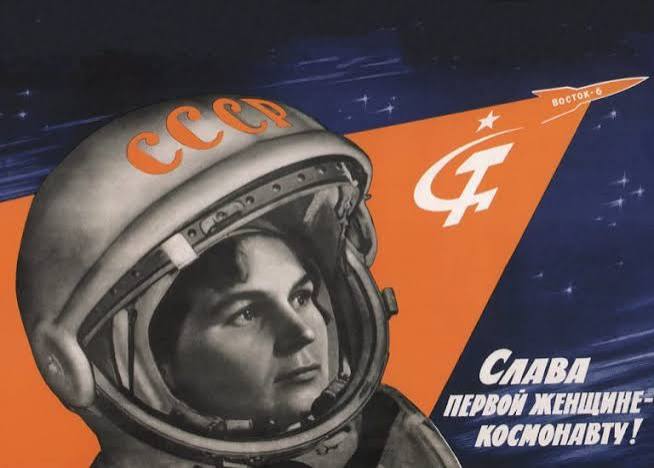
In 1957, a small metal sphere beeped its way into orbit, and the Soviet Union began a visual campaign that would define an era. Space posters, printed by the tens of thousands, turned abstract technological triumphs into heroic, emotional images for a population that was largely rural and semi-literate. These posters were not mere decorations; they were state-directed tools of persuasion, designed to ‘engineer the human soul’ and prove the superiority of socialism.
For nearly four decades, from Sputnik to the USSR’s collapse, these posters shaped how millions imagined space—and their place in it. They blended the bold geometry of Constructivism with the idealized realism of Socialist Realism, creating a unique visual language that celebrated cosmonauts as modern folk heroes. But as the space program’s early triumphs gave way to tragedy and stagnation, the posters evolved too, mirroring the shifting fortunes of a superpower.
A Visual Textbook for the Masses
The Soviet space poster program was born from a simple need: to explain and glorify complex scientific achievements to a vast, diverse population. In 1957, when Sputnik 1 beeped its way into history, most Soviet citizens lived in rural areas with limited access to education or media. Posters, displayed in train stations, factories, schools, and shop windows, became the ‘visual textbooks’ of the Space Age.
These posters used a bold, flat color palette dominated by red, white, and blue—the state’s colors—alongside cosmic blues and blacks. Heroic figures of cosmonauts, often depicted in gleaming spacesuits, stood against backgrounds of stars, orbits, and rockets. Slogans in Cyrillic, such as ‘Вперёд, к звёздам!’ (‘Forward, to the stars!’), were imperative and aspirational, driving home the message of Soviet technological supremacy.
The style drew from two distinct traditions. Socialist Realism, mandated since the Stalin era, demanded idealized, heroic depictions of Soviet life. But the posters also incorporated elements of Constructivism, the avant-garde movement of the 1920s that celebrated geometric abstraction and photomontage. Artists like Valentina Kulachinskaya and Viktor Saveliev found ways to reconcile these seemingly opposing approaches, creating images that were both realistic and abstract, grounded and futuristic.
The Golden Age: 1957–1975
The ‘Golden Age’ of Soviet space posters coincided with the USSR’s most spectacular space achievements. The launch of Sputnik 1 in 1957 and Yuri Gagarin’s Vostok 1 flight in 1961 were not just scientific milestones; they were ideological victories, proof that socialism could outpace capitalism in the most advanced fields of human endeavor.
Posters from this period are triumphalist and future-oriented. Cosmonauts are depicted as modern-day folk heroes, their faces radiating confidence and determination. Rockets streak across the sky, orbits trace elegant ellipses, and stars seem to welcome humanity’s first steps into the cosmos. One iconic poster from 1961 shows Gagarin’s helmeted profile against a red star, with the simple, powerful text: ‘The first cosmonaut—Soviet man.’
These posters were not just domestic propaganda. They were also exported to allied nations and displayed at international fairs like Expo ’58 in Brussels and Expo ’67 in Montreal, serving as soft power in the Cold War’s cultural battle. For many people around the world, these images were their first glimpse of the Space Age—and they were unmistakably Soviet.
The Evolution: From Triumph to Memorialization
As the 1960s gave way to the 1970s, the tone of Soviet space posters began to shift. The initial euphoria of the Space Race gave way to a more consolidated, domestic focus. Posters from 1964–1975 increasingly depicted everyday life touched by space: satellite communications improving weather forecasts, television broadcasts reaching remote villages, and space technology aiding agriculture and industry. The cosmonaut remained a hero, but now he shared the frame with farmers, engineers, and schoolchildren.
This period also saw a notable development in gender representation. Valentina Tereshkova’s 1963 flight as the first woman in space was celebrated in a distinct subset of posters. However, these often framed her achievement in domesticated terms—shown with children or in traditional roles, emphasizing her femininity rather than her competence as a pilot. This duality reflected broader Soviet gender policies, which celebrated women’s participation in the workforce while still expecting them to fulfill traditional family roles.
The mid-1970s brought tragedy, with the Soyuz 1 disaster in 1967 and the Soyuz 11 tragedy in 1971, which killed three cosmonauts. Poster imagery shifted from pure triumphalism to include elements of memorialization. Fallen cosmonauts were eulogized as martyrs to progress, their portraits rendered with somber respect. The optimism of the early years was never fully recaptured.
The Decline: 1976–1991
By the late 1970s, the Soviet space program was losing its edge. The United States had landed on the Moon, and the USSR’s own program was plagued by technical problems and budget constraints. The posters reflected this stagnation. Output decreased, and the imagery became more nostalgic or repetitive, recycling the familiar icons of rockets and cosmonauts without the freshness of earlier decades.
Television and Western visual culture also eroded the poster’s centrality. Soviet citizens could now see spaceflight in real-time broadcasts, and Western advertising—with its glamorous, consumerist appeal—offered a seductive alternative to state-sanctioned art. By the time the Soviet Union dissolved in 1991, the space poster had become a relic of a bygone era, its bold colors and heroic figures fading into memory.
The Artistic Legacy and Comparisons
Soviet space posters occupy a unique place in art history. They represent a rare moment when state propaganda and graphic design merged to produce works of striking aesthetic power. Their visual language—bold colors, dynamic compositions, and a blend of realism and abstraction—influenced later poster art and continues to inspire contemporary designers.
A useful comparison is with Polish poster art of the same period. Polish posters, such as those by Franciszek Starowieyski, were far more experimental and less constrained by state ideology. They pushed the boundaries of surrealism and expressionism, while Soviet posters remained tethered to Socialist Realism. This contrast highlights the role of censorship and creative freedom in shaping artistic output.
In the West, NASA commissioned art from illustrators like Robert McCall, and corporations like McDonnell Douglas produced their own space-themed advertising. But these efforts were not state-directed mass propaganda. They lacked the sheer scale and ideological urgency of the Soviet poster campaign, which aimed to reach every citizen and convince them that the future was Soviet.
The forgotten art of Soviet space posters is more than a footnote in Cold War history. It is a vivid record of how a state used visual propaganda to shape public imagination, turning abstract scientific achievements into shared emotional experiences. These posters may have been tools of an authoritarian system, but they also captured a genuine human aspiration—the desire to reach for the stars. Today, as we look back at these images, we see not just propaganda, but a complex fusion of art, politics, and hope, whose echoes still linger in our own visions of space.
Summary
- Soviet space posters were produced from 1957 to 1991, with a ‘Golden Age’ from 1957–1975, serving as mass propaganda to celebrate Soviet space achievements.
- They combined Socialist Realism and Constructivism, using bold colors, heroic cosmonauts, and cosmic imagery to convey ideological messages.
- Posters were printed in large runs and displayed in public spaces, also exported as soft power to international audiences.
- The imagery evolved from triumphalist to domestic-focused, then to memorialization and nostalgia, reflecting the space program’s fortunes.
- The posters offer insights into gender representation, artistic censorship, and the cultural dimensions of the Space Race.
FAQ
Q: Who created Soviet space posters?\nA: Posters were created by state-employed artists like Valentina Kulachinskaya, Viktor Saveliev, and Yuri Kerimoff, working under the direction of state publishing houses such as Iskusstvo and Plakat.\n\nQ: What was the purpose of these posters?\nA: They served as mass propaganda to educate and inspire the Soviet population, translating complex space achievements into heroic and emotional images that reinforced the superiority of socialism.\n\nQ: How do Soviet space posters compare to Polish poster art?\nA: Polish posters were more experimental and less constrained by state ideology, allowing for surrealist and expressionist styles, while Soviet posters adhered to Socialist Realism with a focus on heroic realism.\n\nQ: How did the portrayal of women in these posters evolve?\nA: Early posters were male-dominated, but after Valentina Tereshkova’s flight in 1963, women appeared in a distinct subset, often framed in domesticated roles, reflecting Soviet gender policies of celebrating women’s achievements while maintaining traditional expectations.\n\nQ: Why did Soviet space posters decline?\nA: The decline from the late 1970s was due to the space program’s stagnation, reduced output, and competition from television and Western visual culture, which eroded the poster’s role as a primary medium of public communication.