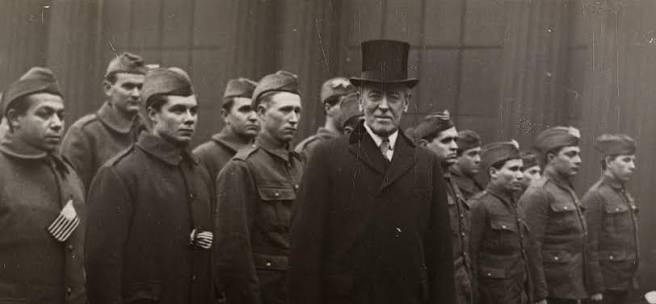
On a cold January evening in 1918, Woodrow Wilson stood before a joint session of Congress and unveiled a vision that would redefine the world’s understanding of peace. The 14 Points were not a treaty or a list of demands, but a moral blueprint—a declaration that the slaughter of millions must end not with vengeance, but with justice. Wilson’s words echoed beyond the chamber, reaching the trenches of the Western Front and the chancelleries of Europe, promising a new order where open diplomacy, self-determination, and a league of nations would banish the shadows of secret alliances and imperial greed.
Yet the dream that captivated the world would crumble within a year, betrayed by the very leaders who sat at the peace table—and by the American Senate that rejected its own president’s triumph. The 14 Points were never fully realized, but their legacy is not failure. It is a story of how ideals, however compromised, can reshape the course of history, for better and for worse.
A Speech That Shook the World
Wilson’s address on January 8, 1918, was a masterstroke of timing. Russia had just exited the war, leaving the Allies to face the full might of the Central Powers alone. The American president, who had entered the war only nine months earlier, needed to give the conflict a purpose beyond territorial conquest. He needed to offer the German and Austrian publics a reason to turn against their own leaders.
The speech was the product of months of intense intellectual labor. Wilson had assembled a team of about 150 scholars—geographers, historians, economists—known as The Inquiry. They pored over maps, ethnic distributions, and economic data, producing voluminous reports that Wilson distilled into a single, soaring vision. The result was a document of remarkable clarity: open covenants, freedom of the seas, free trade, disarmament, and a league of nations to guarantee the peace.
Each point was a direct repudiation of the old world order. Point 1, banning secret treaties, struck at the heart of the diplomatic culture that had dragged Europe into war. Point 14, the League of Nations, was the keystone—a permanent institution to enforce the new rules. Wilson was not merely proposing a peace; he was proposing a revolution in international affairs.
The Paris Chessboard
When Wilson sailed for France in December 1918, he became the first sitting American president to travel to Europe. He was greeted by crowds of ecstatic Parisians, who saw him as a savior. But the euphoria did not last.
At the Paris Peace Conference, Wilson faced three formidable opponents. Georges Clemenceau of France, known as ‘The Tiger,’ cared little for ideals; he had seen his country invaded twice in a generation and demanded security. David Lloyd George of Britain was determined to preserve the British Empire and naval supremacy. Vittorio Orlando of Italy sought territorial gains for his young nation.
The Big Four negotiated in secret, a direct violation of Point 1. Clemenceau pushed for the Rhineland to be detached from Germany, while Lloyd George insisted on a punitive naval blockade. Wilson fought for his principles, but he was forced to make compromises. Germany was saddled with a ‘war guilt’ clause and crushing reparations. The Treaty of Versailles, signed on June 28, 1919, incorporated only some of the 14 Points—and even those were often watered down.
The German Betrayal
Perhaps the most tragic consequence of the Versailles Treaty was its impact on Germany. Germany had agreed to the armistice in November 1918 on the explicit understanding that the peace would be based on the 14 Points. When the treaty was unveiled, the Germans were stunned. The territorial losses, the war guilt clause, the astronomical reparations—none of it matched Wilson’s promised ‘peace without victory.’
The sense of betrayal was not just diplomatic; it was visceral. German nationalists, including a young Adolf Hitler, would use this ‘stab in the back’ myth to undermine the Weimar Republic. The treaty’s harshness did not create Nazism, but it provided the fuel for the fire. Wilson’s dream of a just peace had become, in the eyes of many Germans, a tool of Allied vengeance.
The League That Never Was
The League of Nations was created in 1920, with its headquarters in Geneva. Wilson had staked his presidency on it, but he faced an insurmountable obstacle at home: the U.S. Senate. Isolationists, led by Henry Cabot Lodge, opposed the League’s Article X, which committed members to protect each other’s territorial integrity. Wilson refused to compromise, and the Senate refused to ratify the Treaty of Versailles. The United States never joined the League.
Without American participation, the League was crippled from birth. It had no enforcement mechanism, no standing army, and no great-power unity. It failed to prevent the Italian invasion of Ethiopia, the Japanese annexation of Manchuria, or the rise of Hitler. By 1939, the League was a hollow shell, and the world was at war again.
The Colonial Blind Spot
Wilson’s vision of self-determination was revolutionary, but it had a glaring flaw: it applied only to Europeans. Point 5 called for an ‘impartial adjustment of colonial claims,’ with equal weight given to the interests of colonial peoples. But in practice, the victors simply divided up the German and Ottoman empires under the mandate system. The peoples of Africa, the Middle East, and Asia were given no say in their own futures.
The League’s mandate system was a fig leaf for continued imperial control. ‘Self-determination’ was a promise for the Balkans and the Austro-Hungarian Empire, but not for the subjects of British, French, or Belgian empires. Wilson’s idealism, which had inspired anticolonial movements worldwide, ultimately reinforced the very structures it claimed to reform.
A Legacy That Endures
Despite its failures, the 14 Points did not vanish. The League of Nations, however flawed, established the template for the United Nations. The principle of self-determination reshaped the world map, leading to the independence of dozens of nations in the decades after World War II. The idea of open diplomacy, free trade, and international law became the bedrock of the postwar order.
Wilson received the 1919 Nobel Peace Prize, but he died in 1924 a broken man, convinced his life’s work had failed. He could not foresee that his ideas would outlive him. The 14 Points were a profound moral statement—a recognition that peace cannot be built on revenge, that nations must be governed by law, and that the world’s peoples have a right to shape their own destinies.
As we look at the wars and conflicts of the 21st century, the questions Wilson raised remain urgent. Can international institutions truly guarantee peace? Can self-determination be reconciled with territorial integrity? The 14 Points were a dream, but dreams have consequences. They may not be realized, but they set the course.
Woodrow Wilson’s 14 Points remain a touchstone of internationalist thought, a reminder that peace is not merely the absence of war but a positive vision of justice. The dream failed in its time, but it planted seeds that would grow into the architecture of the modern world. Whether we look at the United Nations, the European Union, or the ongoing struggles for self-determination, Wilson’s shadow looms large. His dream was imperfect, and its consequences were often tragic, but it gave the world a new language of hope—one that we still speak today.
Summary
- The 14 Points were delivered on January 8, 1918, as a blueprint for a just peace, with significant input from The Inquiry, a team of ~150 experts.
- Only some points were incorporated into the Treaty of Versailles, which was far harsher than Wilson promised, fueling German resentment and the ‘stab in the back’ myth.
- The League of Nations was created but the U.S. Senate refused to join, leaving it without great-power support and doomed to fail.
- Wilson’s self-determination was applied selectively, ignoring the colonial peoples of Africa and Asia, and the mandate system merely legitimized imperial control.
- Despite its failures, the 14 Points inspired the UN and modern international institutions, and remain a powerful symbol of the pursuit of peace.
FAQ
Q: What were the main goals of the 14 Points?
A: The 14 Points aimed to establish a framework for a just and lasting peace after World War I, including open diplomacy, freedom of the seas, free trade, disarmament, self-determination for European peoples, and the creation of a League of Nations to guarantee peace.
Q: Why did the U.S. not join the League of Nations?
A: The U.S. Senate refused to ratify the Treaty of Versailles, partly because of objections to Article X, which required members to protect each other’s territorial integrity. This was a victory for isolationist sentiment led by Senator Henry Cabot Lodge.
Q: How did Germany react to the Treaty of Versailles?
A: Germany felt betrayed because it had agreed to the armistice on the assumption that peace would be based on the 14 Points. The treaty’s harsh terms—war guilt, reparations, territorial losses—created a deep sense of injustice that nationalist leaders later exploited.
Q: Did the 14 Points apply to colonial peoples?
A: No, despite Point 5 calling for impartial adjustment of colonial claims, the mandate system simply transferred control, and self-determination was applied only to European nations, not to people in Asia, Africa, or the Middle East.
Q: What is the lasting legacy of the 14 Points?
A: The 14 Points influenced the creation of the United Nations and other international institutions, and the principle of self-determination reshaped global politics. They remain a symbol of the ideal that peace can be built on justice rather than vengeance, even if that ideal is never fully achieved.