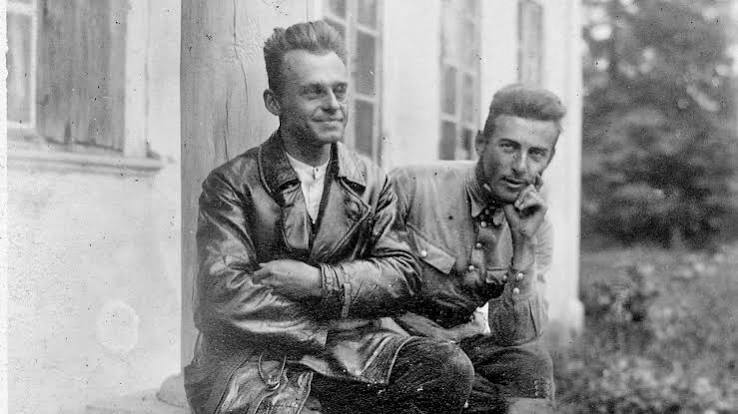
In September 1940, a Polish cavalry officer named Witold Pilecki made a decision that defies easy comprehension. He walked into the heart of Nazi terror not as a prisoner, but as a volunteer. His mission: to infiltrate Auschwitz, gather intelligence, and organize resistance from within. For nearly two and a half years, he lived among the horrors he had come to document, sending out reports that would later be dismissed by Allied leaders who couldn’t believe the truth.
Pilecki’s story is not just a tale of extraordinary courage. It is a stark reminder of how easily truth can be ignored when it is inconvenient. This is the account of a man who risked everything to bear witness—and who paid the ultimate price not at the hands of the Nazis, but his own country’s post-war communist regime.
The Man Behind the Mission
Witold Pilecki was born on May 13, 1901, in Olonets, Russia, into a Polish noble family. Raised in the eastern borderlands, he grew up with a deep sense of patriotism and duty. He fought in the Polish-Soviet War of 1919–1921, then settled as a cavalry officer and landowner. When Germany invaded Poland in September 1939, Pilecki was already involved in underground resistance. He helped organize networks that would become the foundation of the Polish Underground State.
By 1940, the Nazis had established Auschwitz as a concentration camp for Polish political prisoners. Pilecki saw an opportunity. If he could get inside, he could gather firsthand intelligence on the camp’s operations and atrocities—and perhaps even spark an uprising. In September 1940, he deliberately allowed himself to be caught in a Warsaw street roundup, using the cover name “Tomasz Serafiński.” On September 22, he arrived at Auschwitz as prisoner number 4859.
Inside the Camp
The conditions Pilecki encountered were beyond anything he had imagined. Prisoners were beaten, starved, and worked to death. Executions were routine. Yet Pilecki’s resolve did not waver. He began quietly recruiting fellow prisoners who shared his commitment to resistance. Within months, they formed the ZOW (Związek Organizacji Wojskowej—Union of Military Organization), a secret cell dedicated to gathering intelligence and preparing for a possible uprising.
The ZOW operated under the constant threat of betrayal. Any slip could mean torture and death. Despite this, they managed to smuggle out detailed reports on camp conditions, including the gas chambers and medical experiments. Pilecki’s reports were among the earliest firsthand accounts of the Holocaust to reach the outside world.
The Uprising That Never Came
Pilecki and his comrades hoped that if the Allies knew the truth, they would act—perhaps by bombing the camp or supporting an armed uprising. They prepared plans, cached weapons, and waited for a signal that never came. The Allies received Pilecki’s reports but were skeptical. Many officials simply could not believe the scale of the atrocities. Others argued that bombing the camp was not feasible or strategically justified.
By 1943, Pilecki realized that an uprising without outside support would be suicidal. He also knew that his continued presence endangered the ZOW network. On the night of April 26–27, 1943, he escaped with two comrades, using a diversion and bribed guards. He had spent nearly two and a half years inside Auschwitz.
The Report and Its Fate
After his escape, Pilecki wrote a detailed account of his experiences—known as the Pilecki Report. He delivered it to the Polish Underground, who passed it to the British government. The report described the camp’s layout, the daily brutality, the mass murder of Jews, and the possibility of an uprising. It was a treasure trove of intelligence.
Yet the Allies did little with it. The report was filed away, and Auschwitz remained a target that was never bombed. The British government later acknowledged receiving the information but said it was “not considered to be of great importance.” Pilecki’s mission had succeeded in gathering the truth, but the world was not ready to act on it.
War After Auschwitz
Pilecki did not stop fighting after his escape. In 1944, he participated in the Warsaw Uprising against the Germans. When the uprising was crushed, he was captured and sent to POW camps in Lamsdorf and Murnau. He survived the war, but his ordeal was far from over.
In 1945, Poland fell under Soviet influence, and the new communist government viewed former resistance fighters as enemies. Pilecki returned to Poland in 1947, hoping to resume a normal life. Instead, he was arrested and accused of espionage and plotting to overthrow the government. After a show trial, he was executed by firing squad on May 25, 1948, in Warsaw’s Mokotów Prison. His body was buried in a secret location.
Legacy
For over four decades, Pilecki’s name was erased from Polish history. It was only after the fall of communism in 1990 that he was officially rehabilitated. In 2006, he was posthumously awarded the Order of the White Eagle, Poland’s highest state decoration. Today, he is remembered as a national hero—a man who voluntarily entered hell to bear witness and who paid for his courage with his life.
Witold Pilecki’s story is a reminder that courage is not always rewarded, and that truth does not always prevail. He gave up his freedom, risked his life, and ultimately lost it—all in the hope that his reports would move the world to action. They did not. But his legacy endures as a testament to the power of individual conscience in the face of unimaginable evil. In a world that often looks away, Pilecki chose to look directly into the abyss and tell us what he saw.
Summary
- Witold Pilecki voluntarily infiltrated Auschwitz in September 1940, becoming prisoner number 4859.
- Inside the camp, he organized a resistance network called ZOW and smuggled out detailed reports on atrocities.
- His reports were largely ignored by Allied leaders, who doubted their accuracy or deemed them not actionable.
- Pilecki escaped in April 1943, fought in the Warsaw Uprising, and was later executed by Poland’s communist regime in 1948.
- He was rehabilitated in 1990 and posthumously awarded the Order of the White Eagle in 2006.
FAQ
Q: Why did Witold Pilecki volunteer to enter Auschwitz?
A: Pilecki’s mission was to gather intelligence on the camp’s conditions and atrocities, organize a resistance network inside, and prepare for a potential uprising or Allied liberation. He believed that if the Allies knew the truth, they would act.
Q: How did he escape from Auschwitz?
A: In April 1943, Pilecki escaped with two comrades after being assigned to the camp bakery, which gave him access to the outer perimeter. The escape was aided by a planned diversion and bribed guards.
Q: What was the Pilecki Report?
A: The Pilecki Report was a detailed firsthand account of Auschwitz, including the gas chambers, medical experiments, and daily life in the camp. It was delivered to the Polish Underground and then to the British government, but was largely ignored.
Q: Why didn’t the Allies bomb Auschwitz?
A: The decision not to bomb Auschwitz remains debated. Some argue it was not strategically feasible, while others believe the Allies were skeptical of the reports or prioritized other military objectives.
Q: How was Pilecki treated after the war?
A: Pilecki returned to Poland in 1947, where the Soviet-backed communist government arrested him on false charges of espionage. He was executed in 1948, and his name was cleared only after the fall of communism in 1990.