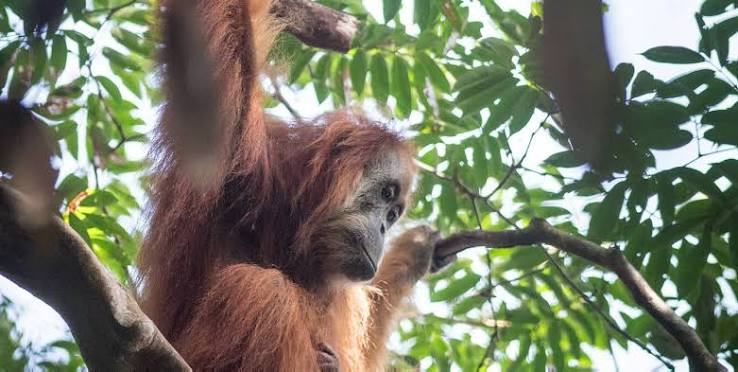
In the dense rainforests of North Sumatra, fewer than 800 Tapanuli orangutans cling to existence. This great ape, recognized as its own species only in 2017, lives in a single fragmented ecosystem called Batang Toru. Now, a comprehensive new study reveals that the dangers it faces are not isolated problems but a web of interacting pressures that compound each other.
For decades, conservation efforts have often focused on single threats, like a proposed hydroelectric dam. But the new research, which systematically assesses cumulative impacts, paints a more complex picture: mining, logging, agriculture, and climate-driven disasters are hitting the orangutan simultaneously. The result is a survival challenge far more severe than any one threat alone.
A Species on the Edge
The Tapanuli orangutan (Pongo tapanuliensis) is the rarest great ape on Earth. With fewer than 800 individuals scattered across a forest area of roughly 1,000 square kilometers, its entire population could fit into a small town. It is also one of the most evolutionarily distinct: separated from other orangutans for hundreds of thousands of years, it has unique genetic and behavioral traits.
Despite its precarious status, the Tapanuli orangutan was only formally described as a distinct species in 2017, the first new great ape species named since the bonobo in 1929. But the species’ small range is its Achilles’ heel. Any loss of habitat in Batang Toru directly threatens a significant portion of the global population.
The Study: Cumulative Threats, Not Just One
The new study, published by an international team of researchers, goes beyond the usual single-threat analysis. It uses a cumulative impact assessment framework to map how multiple stressors interact. The findings are stark: threats like logging, mining, and agricultural expansion do not occur in a vacuum. They amplify each other.
For example, logging opens up the forest canopy, making it more susceptible to drought and fire. Climate change then increases the frequency of El Niño-driven droughts, which further stresses the trees that orangutans depend on for food. The result is a downward spiral that a single-threat approach would miss.
The Big Four: Mining, Logging, Agriculture, and Climate
The study identifies four major threat categories, each with its own timeline and intensity.
Extractive Industries
Gold mining has long been a presence in Batang Toru, with both legal and illegal operations. The mercury used in artisanal mining contaminates water and soil, affecting the entire ecosystem. Geothermal energy development, while cleaner than fossil fuels, still requires clearing forest for infrastructure, fragmenting orangutan habitat further.
The proposed Batang Toru hydropower project has generated the most headlines. Its construction area overlaps with critical orangutan habitat. While the project has faced legal challenges and international scrutiny, it is just one piece of a larger puzzle.
Logging: Legal and Illegal
Decades of logging, both legal and illegal, have carved up the forest. Legal logging concessions have given way to selective logging, but even this alters the forest structure. Illegal logging persists in more remote areas, driven by demand for timber and land.
Agricultural Expansion
Oil palm, coffee, and rubber plantations are encroaching on the orangutan’s range. These crops often replace primary forest, which the orangutans cannot survive in secondary growth. The expansion is driven by global commodity markets, making it a particularly thorny issue for conservationists.
Climate-Related Disasters
Indonesia’s tropical forests are increasingly vulnerable to climate change. El Niño events bring severe droughts, which dry out the forest and make it prone to fires. In 2015, a major El Niño caused widespread fires in Sumatra, and climate models predict more frequent extreme weather in the region. For the Tapanuli orangutan, a single severe drought could destroy a significant portion of its food supply.
The Compounding Effect
The study’s key insight is that these threats interact. For instance, a logged forest is more flammable, so when a drought hits, the fire risk is higher. An oil palm plantation next to a forest edge increases human-orangutan conflict, as animals wander into plantations for food. A geothermal plant may bring roads, which open up the area to further illegal logging.
This compounding effect means that addressing just one threat is insufficient. The study calls for a holistic conservation strategy that tackles multiple pressures simultaneously. It also highlights the need for better enforcement of existing laws, as the species is legally protected but habitat loss continues.
The Human Element
Local communities, including the Batak people, depend on the forest for their livelihoods. They use it for water, timber, and cultural practices. Some support conservation, but others view restrictions as infringing on their land rights. Land tenure conflicts further complicate conservation planning, as it is often unclear who has the legal right to manage the land.
Companies involved in mining and energy argue that they bring economic benefits, providing jobs and infrastructure. They point to mitigation measures, such as wildlife corridors, as evidence of their commitment to sustainability. However, the study suggests that these measures are often inadequate, especially when cumulative impacts are considered.
What Can Be Done?
The study offers no easy answers, but it does point to priorities. Protecting the remaining forest is crucial, which means halting illegal logging and mining, and carefully regulating legal ones. The proposed dam project should be redesigned or cancelled if it cannot avoid critical habitat.
Climate change is a global problem, but local actions can help: reforestation, fire prevention, and creating corridors to connect fragmented populations. Genetic diversity is also a concern, as the small population is vulnerable to inbreeding. Some researchers have suggested translocating individuals to boost genetic health, but this is a controversial and risky move.
The Bottom Line
The Tapanuli orangutan is on the brink. The new study makes it clear that saving it requires a comprehensive, integrated approach. It is not just about stopping one dam; it is about addressing the entire web of threats that are pushing this species toward extinction.
The Tapanuli orangutan is a test case for conservation in the 21st century, where threats are rarely simple or singular. This study shows that protecting a species means understanding the complex interactions between human activities, climate, and ecology. Without a coordinated effort that tackles all these forces, the world’s rarest great ape may not survive beyond this century.
Summary
- The Tapanuli orangutan is the world’s rarest great ape, with fewer than 800 individuals in a single ecosystem in North Sumatra.
- A new study finds that multiple threats—mining, logging, agriculture, and climate disasters—act simultaneously and compound each other’s effects.
- The species is critically endangered and legally protected, but habitat loss continues due to weak enforcement.
- Conservation efforts must address cumulative impacts, not just single threats like the proposed hydroelectric dam.
- Climate change is already affecting the orangutan’s habitat, making drought and fire more frequent.
FAQ
Q: Why is the Tapanuli orangutan considered a separate species?
A: Genetic analysis in 2013 revealed it was distinct from other orangutans, and it was formally described as a new species in 2017. It has been isolated for hundreds of thousands of years, giving it unique genetic and behavioral traits.
Q: How many Tapanuli orangutans are left?
A: Fewer than 800 individuals, making it the rarest great ape species globally. The population is fragmented into three subpopulations by a river and a road.
Q: What is the biggest threat to the Tapanuli orangutan?
A: The study shows that no single threat is the biggest; rather, the combination of mining, logging, agriculture, and climate-related disasters creates a cumulative effect that is more damaging than any one alone.
Q: Is the Batang Toru dam project the main cause of decline?
A: No, it is a significant threat, but the study emphasizes that other pressures like illegal mining and logging are equally pressing in aggregate.
Q: Can the Tapanuli orangutan be saved?
A: It is possible, but requires immediate, comprehensive action: halting illegal activities, enforcing protection laws, mitigating climate impacts, and addressing the cumulative threats holistically.