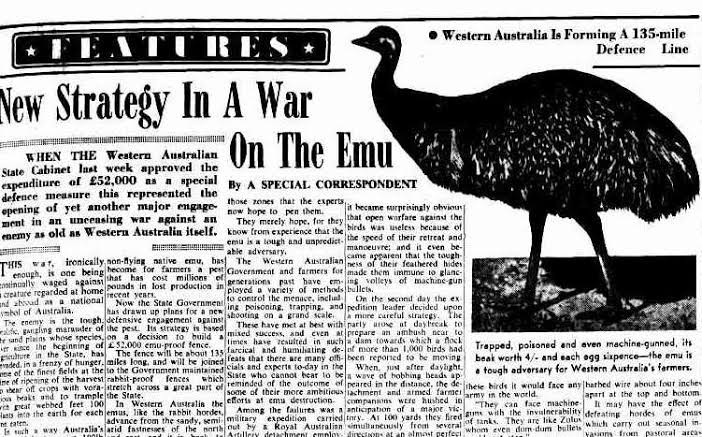
In 1932, Australia found itself in an unlikely conflict: a military campaign against emus. With machine guns mounted on trucks, soldiers were sent to Western Australia to cull thousands of flightless birds that were devastating wheat crops. The operation, quickly dubbed the ‘Emu War,’ became a global joke—but behind the absurdity lay a desperate struggle for survival during the Great Depression.
This is the story of how a government’s attempt to solve an agricultural crisis with military force turned into a bizarre chapter in military history, complete with evasive birds, jammed guns, and a humiliated army. It’s a tale that raises questions about bureaucracy, ecology, and the limits of conventional tactics—and it’s a reminder that sometimes reality is stranger than fiction.
The Setting: A Perfect Storm of Crisis
The Great Emu War didn’t happen in a vacuum. It was the product of a perfect storm of economic hardship, environmental change, and political desperation.
In the early 1930s, Western Australian wheat farmers were already reeling from the Great Depression. Wheat prices had plummeted, and a severe drought had made the land even more unforgiving. For many, the harvest was the difference between survival and ruin.
Then came the emus. These large, flightless birds—standing up to two meters tall—are native to Australia and migrate seasonally. In 1932, a massive influx of emus moved inland from the coast after breeding, coinciding perfectly with the wheat harvest. The birds descended on the crops, eating the grain and, perhaps worse, breaking fences that kept out rabbits—another agricultural pest. For farmers already on the brink, this was a catastrophe.
They petitioned the government for help, and the government, under Prime Minister Joseph Lyons, responded in a way that would go down in history: they sent in the army.
The Military Solution: A Plan Doomed from the Start
The operation was approved with surprising speed. Minister of Defence Sir George Pearce, a Western Australian senator, championed the idea of using the military as a cheap and quick solution. The Royal Australian Artillery was tasked with the job, and Major G.P.W. Meredith of the 7th Heavy Battery was put in command.
On 2 November 1932, Meredith and his men arrived in the Campion district with two Lewis machine guns mounted on trucks. The plan was simple: drive at the emus, open fire, and thin the herds. It sounded straightforward on paper.
But the emus had other ideas.
Emus are not just fast—they can run up to 50 km/h—but they are also remarkably evasive. They scatter in unpredictable patterns, making them difficult targets. The trucks, meanwhile, were slow and clumsy, unable to keep up with the birds or navigate the rough terrain.
The Lewis guns, a World War I-era weapon, proved unreliable. They jammed frequently, and the heat and dust of the Australian outback didn’t help. Meredith and his men found themselves firing at birds that seemed to dodge bullets with uncanny skill. At one point, Meredith compared the emus to “Zulu warriors” for their tactical cunning.
The Battle Unfolds: A Week of Frustration
The first phase of the operation lasted about a week. Despite firing roughly 2,500 rounds of ammunition, the soldiers managed to kill an estimated 986 emus—a fraction of the 10,000 to 20,000 birds believed to be in the area. The emus were winning, and the press was having a field day.
Newspapers around the world ran headlines like “Emu War” and “Birds Defeat Army.” The operation became a laughingstock, a symbol of bureaucratic absurdity. The Australian government, embarrassed, called off the military deployment on 10 December 1932, officially describing it as a “crop protection measure” rather than a war.
But the story didn’t end there. A second, smaller operation was attempted in mid-November, and a follow-up in 1934 used a different approach—bounties for emu scalps rather than soldiers. This proved more effective, but the damage to the government’s reputation was done.
The Aftermath: A Legacy of Laughter and Lessons
The Great Emu War has become a cultural touchstone, a meme before memes existed. It’s often cited in lists of “weird history” and used as a metaphor for futile wars and government overreach. But there’s more to the story than comedy.
From a military perspective, the operation is a case study in the failure of conventional tactics against unconventional targets. Machine guns and trucks were no match for fast, agile birds. It’s a lesson that has been echoed in modern counterinsurgency and irregular warfare.
From an agricultural and economic standpoint, the farmers’ desperation was real. The Depression-era hardship made crop losses a matter of survival. The “war” was a symptom of a broader crisis, not just a joke.
And from an environmental perspective, the cull raises ethical questions about human-wildlife conflict. Emus are native wildlife, and the European settlers’ approach to managing them was in stark contrast to the sustainable practices of Indigenous Australians, who had long coexisted with the birds.
The Myths and the Reality
One of the most persistent myths is that “the emus won.” While it’s true that the military withdrew, the birds didn’t achieve a strategic victory. Hundreds were killed, and the 1934 bounty system was more effective. The “victory” is a narrative device, not a fact.
Another myth is that this was a “declared war.” It wasn’t. There was no formal declaration—just a military deployment for pest control, later dubbed a “war” by the press. The government was explicit in denying the term, but the label stuck.
Finally, the scale of the operation is often exaggerated. It was a minor footnote in Australian history, involving a handful of soldiers and a few weeks of work. But its absurdity has given it a lasting place in popular culture.
Why It Still Matters Today
The Great Emu War is more than a quirky historical anecdote. It’s a reminder of the dangers of bureaucratic overreach, the importance of understanding the environment before acting, and the limits of military power. It’s also a testament to human resilience—and the ability to laugh at ourselves.
In an era of climate change and increasing human-wildlife conflict, the lessons of 1932 are more relevant than ever. Modern Australia uses fencing and controlled culls to manage emu populations, not machine guns. But the underlying challenge—balancing agricultural needs with ecological preservation—remains.
So the next time you hear about the Emu War, remember: it’s not just a joke. It’s a story about a nation’s struggle to adapt, a bird’s unexpected cunning, and the enduring power of a good headline.
The Great Emu War of 1932 may have been a military embarrassment, but it’s also a fascinating glimpse into a moment when desperation met absurdity. It reminds us that even the most well-intentioned plans can go hilariously wrong, and that sometimes the best response to a crisis is not a machine gun, but a bit of humility and a willingness to learn from the world around us.
Summary
- In 1932, the Australian military deployed machine guns and trucks to cull emus damaging wheat crops in Western Australia.
- The operation lasted from 2 November to 10 December 1932, with soldiers firing ~2,500 rounds and killing ~986 emus.
- The emus’ speed and evasive tactics, combined with unreliable guns, made the operation ineffective and a global laughingstock.
- The “war” was never formally declared; it was a crop protection measure that became a media sensation.
- The event highlights the failure of conventional tactics against unconventional targets and raises ethical questions about human-wildlife conflict.
FAQ
Q: Did the emus actually win the war?
A: Not in a strategic sense. The military withdrew, but hundreds of emus were killed, and a later bounty system was more effective. The “victory” is a narrative device, not a fact.
Q: Was the Emu War a formally declared war?
A: No. It was a military deployment for pest control, later dubbed a “war” by the press. The government explicitly denied the term.
Q: How many emus were killed?
A: Estimates vary, but the military killed around 986 emus in the 1932 operation, with some sources suggesting up to 2,000 including wounded. This was less than 5% of the local population.
Q: Why were emus such a problem?
A: Emus are large, migratory birds that ate wheat crops and broke fences, allowing rabbits into fields. During the Great Depression, this was a catastrophic threat to farmers’ livelihoods.
Q: What happened after the war?
A: The government switched to a bounty system, which was more effective. The 1934 follow-up used bounties, not soldiers, and the emu population remained high, but the “war” became a symbol of bureaucratic absurdity.