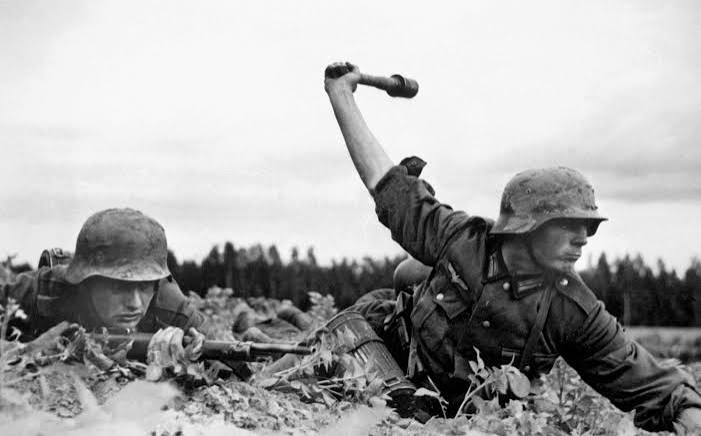
At 3:15 AM on June 22, 1941, German artillery opened fire along a front stretching from the Baltic Sea to the Black Sea. Within hours, 3.8 million Axis troops crossed the Soviet border, supported by 3,600 tanks and 4,300 aircraft. It was the largest military operation in history, and it would end in disaster for the invaders.
Hitler’s plan was simple on paper: destroy the Red Army west of the Dvina–Dnieper line, capture Moscow and Ukraine, and win the war in eight to ten weeks. The Wehrmacht had conquered Poland in 27 days and France in six weeks. The Soviet Union, crippled by Stalin’s purges and caught off guard, seemed ripe for the taking.
But the invasion stalled before Moscow, and by December, the first major German defeat on land had been inflicted. This is the story of how a blitzkrieg met its match not in a single battle, but in a vast, brutal campaign that reshaped the Second World War.
The Blueprint for Annihilation
Operation Barbarossa was not just a military campaign; it was a war of ideology. In Mein Kampf (1925), Hitler had written that the German people needed Lebensraum—living space—in the East, and that the Soviet Union, with its Slavic population and Bolshevik government, was the enemy to be destroyed. The Molotov–Ribbentrop Pact of 1939 was a temporary convenience, a non-aggression pact with secret protocols that allowed Hitler to invade Poland without Soviet interference. Stalin knew the pact was fragile, but he believed Hitler would not attack until 1942 at the earliest.
The German high command expected a quick victory. The Red Army was in disarray after Stalin’s purges of 1937–38, which had executed or imprisoned an estimated 30,000 to 40,000 officers. Soviet defensive lines along the new western border—created after the annexation of eastern Poland, the Baltics, and Bessarabia—were incomplete. German intelligence, overconfident after victories in Poland, France, and the Balkans, badly underestimated Soviet troop numbers and industrial capacity.
Three army groups were deployed. Army Group North, under Field Marshal Wilhelm Ritter von Leeb, aimed at Leningrad. Army Group Center, led by Fedor von Bock, targeted Moscow via Minsk and Smolensk. Army Group South, commanded by Gerd von Rundstedt, drove toward Kiev and Ukraine. The plan was a classic blitzkrieg: encircle and destroy the Red Army in a series of massive pincer movements, then seize the key cities before autumn rains turned the roads to mud.
The First Blows and the Miscalculations
The opening weeks seemed to justify German confidence. In the first month, Army Group Center advanced 450 kilometers, encircling huge Soviet forces near Bialystok and Minsk. At Smolensk, in July 1941, the Germans trapped 300,000 Soviet troops in another giant pocket. The Red Army appeared to be collapsing. But the Battle of Smolensk, which lasted until September, was different. Soviet counterattacks, though costly, delayed the German advance for two critical months. The Wehrmacht had expected to reach Moscow in six weeks; by late July, they were still 300 kilometers short.
Hitler’s decision to divert Army Group Center’s panzer groups south to Kiev in August remains one of the most debated choices of the war. The Battle of Kiev was a stunning tactical victory: the largest encirclement in history, capturing over 600,000 Soviet prisoners. But it cost time—precious weeks that the Germans needed to reach Moscow before winter.
The Soviet Union, meanwhile, was on the brink of collapse but did not break. Stalin ordered a scorched-earth policy, destroying anything that could help the invaders. Over 1,500 factories were dismantled and moved east of the Urals, where they would continue producing tanks and aircraft. Millions of reserves were mobilized, and the Red Army, though losing staggering numbers, kept reconstituting its units.
The Gates of Moscow
By October 2, 1941, Army Group Center launched Operation Typhoon, the final push on Moscow. The Germans made initial gains, advancing to within 20 kilometers of the city by early December. The vanguard units could see the spires of the Kremlin through their binoculars. But the offensive had run out of steam. Fuel was scarce, ammunition was low, and the autumn rains had turned the roads into quagmires. Then the winter arrived—early and brutal. Temperatures dropped to -40°C. German soldiers, equipped only for a summer campaign, froze in their summer uniforms. Tanks and vehicles seized up.
On December 5, 1941, General Georgy Zhukov launched a massive counteroffensive with fresh Siberian divisions, transferred from the Far East after Japan signed a neutrality pact with the Soviet Union in April. The Germans were pushed back 100 to 250 kilometers. It was the first major German defeat on land in the war. The legend of the Wehrmacht’s invincibility was shattered.
The Cost of Failure
The human toll was catastrophic. By the end of 1941, German losses were around 750,000 to 830,000 dead, wounded, and missing. Soviet losses were far worse: 3 to 4 million dead and 3.3 million prisoners taken, of whom about 2 million died in German captivity by early 1942. The invasion was also a war of annihilation from the start. The Einsatzgruppen—mobile killing squads—followed the army, murdering Jews, Roma, Communist officials, and anyone deemed a threat. By the end of 1941, over 500,000 Jews had been killed in the occupied territories. Civilians suffered unimaginably, with millions dying from starvation, disease, and reprisals.
The failure of Barbarossa set the stage for a four-year attritional war on the Eastern Front that would ultimately destroy the Wehrmacht. The total death toll on that front from 1941 to 1945 is estimated at 27 to 30 million Soviet citizens—military and civilian—and 4 to 5 million Axis military deaths. No other theater of war came close to these numbers.
Operation Barbarossa was a gamble based on arrogance and underestimation. The German military machine, which had conquered Western Europe with stunning speed, was not prepared for the scale, the distances, or the resilience of the Soviet Union. The decision to invade broke Hitler’s strategic ambitions, but the war of annihilation it unleashed caused suffering on an unimaginable scale. The echoes of that campaign—the largest in history—still shape the memory of the Second World War.
Summary
- Operation Barbarossa, launched June 22, 1941, was the largest military invasion in history, involving 3.8 million Axis troops.
- The German plan assumed a quick blitzkrieg victory, but delays at Smolensk and Kiev, then the Soviet counteroffensive at Moscow, ended that hope.
- By December 1941, the Germans had suffered their first major land defeat, and the Eastern Front became a grinding war of attrition.
- Soviet losses were catastrophic: 3–4 million dead and 3.3 million POWs in 1941 alone, while German losses reached 750,000–830,000.
- The invasion was a racial-ideological war, marked by mass killings of Jews and civilians, leading to the Holocaust by bullets.
FAQ
Q: Why did Germany lose Operation Barbarossa?
A: Germany underestimated Soviet resistance, logistics, and the onset of winter. The diversion of forces to Kiev in August delayed the drive on Moscow, allowing the Red Army to prepare a counteroffensive.
Q: What was the largest encirclement in history?
A: The Battle of Kiev in September 1941, where German forces trapped over 600,000 Soviet soldiers, resulting in the largest single encirclement ever.
Q: How many soldiers were involved in the invasion?
A: Approximately 3.8 million Axis troops crossed the border, facing 2.9–3.2 million Soviet troops initially, with millions more in reserve.
Q: What was the impact of the Moscow counteroffensive?
A: It pushed the Germans back 100–250 kilometers, marking the first major German defeat on land and shattering the myth of blitzkrieg invincibility.
Q: How many civilians died during the war on the Eastern Front?
A: Total Soviet civilian and military deaths from 1941–45 are estimated at 27–30 million, with millions dying from starvation, disease, and deliberate killings.