Tag: weapons

  • Greek Fire: The Byzantine Weapon That Burned on Water—and Vanished


    Imagine a weapon that could set enemy ships ablaze while floating on water, a fire that refused to die when doused, and a government so terrified of its secret that it was whispered only among a handful of trusted hands. That weapon was Greek Fire, the Byzantine Empire’s most guarded asset, which for centuries kept the world’s most powerful navies at bay. Its formula was so sacred that emperors swore their heirs to secrecy yet today, we don’t know exactly what it was. The story of Greek Fire is not just a tale of ancient warfare; it’s a lesson in how technology, secrecy, and geopolitics can intertwine and how a secret can vanish with the empire that guarded it.

    The Fire That Burned on Water

    Greek Fire was not a myth or a legend—it was a terrifying reality. First deployed in the 7th century, this incendiary weapon could burn on the surface of water, making it the ultimate naval nightmare. Byzantine warships, called dromons, were equipped with bronze siphons that shot streams of liquid fire at enemy vessels. The effect was devastating: wooden ships turned to infernos, crews leapt into the sea only to find the flames following them, and entire fleets were reduced to ash and smoke.

    The weapon’s most famous appearances came during the Arab sieges of Constantinople in 673–678 CE and again in 717–718 CE. In both cases, the Byzantine navy, vastly outnumbered, used Greek Fire to break the Arab blockades and save the empire. The Arab fleets, which had expected an easy victory, were repelled with catastrophic losses. For the Byzantines, Greek Fire was not just a military advantage—it was a divine gift, a symbol of God’s favor.

    A Secret Worthy of Death

    The Byzantine government treated Greek Fire’s formula as a state secret of the highest order, perhaps the first example of a weapon of mass destruction kept under lock and key. Emperor Constantine VII Porphyrogenitus, writing in the 10th century, explicitly warned his son in his manual De Administrando Imperio: never reveal the secret, for it was given by God to the Byzantines alone. The formula was reportedly divided among a few trusted families or guilds, and the penalty for disclosing it was death. Some legends even claimed an angel delivered the recipe to Emperor Constantine IV, cementing its sacred status.

    This secrecy had practical consequences. Because the formula was never written down openly, it was passed orally or in coded form. As the empire’s fortunes declined, the knowledge became ever more concentrated—and ever more vulnerable. By the 12th century, references to Greek Fire in battle dwindle, and by the Fourth Crusade in 1204, when Constantinople was sacked by Western Christians, the weapon appears to have been largely lost or degraded.

    What Was Greek Fire? The Scientific Mystery

    Modern historians and chemists have long debated the composition of Greek Fire. The most widely accepted theory is that it was a petroleum-based mixture, likely naphtha (a flammable liquid derived from crude oil, found in the Caucasus or Dead Sea regions), thickened with resins like pine tar to make it stick to targets. Sulfur and quicklime may have been added: quicklime reacts violently with water, generating heat that could ignite the naphtha—a plausible mechanism for a fire that burned on water.

    Other theories propose saltpeter-based mixtures, which would have made it an early form of gunpowder, but evidence for that is thin. Some modern chemists have suggested calcium phosphide, a compound that self-ignites on contact with water, but ancient technology likely couldn’t produce it. The most probable recipe, according to historical consensus, is a blend of naphtha, sulfur, and resin—a sticky, flammable cocktail that could be sprayed from a siphon and would cling to enemy ships, burning even as the crew tried to douse it with water.

    The Decline and Disappearance

    Why did such a formidable weapon vanish? Several factors likely contributed. First, the Byzantine Empire itself was shrinking. The territories that supplied the ingredients—particularly the oil fields of the Caucasus—fell to enemies, cutting off the raw materials. Second, the Byzantine navy, once the empire’s pride, declined in size and importance as the empire focused on land defenses and diplomatic alliances.

    Third, the tight secrecy may have backfired. If the formula was held by a specific family or guild that died out or lost power, the knowledge could have died with them. Finally, new technologies emerged. By the 12th century, Arab and Western navies were developing their own incendiary weapons, and later, gunpowder-based firearms and cannons made Greek Fire obsolete. Some historians argue the formula wasn’t truly “lost” but simply became irrelevant—a weapon replaced by more effective means of destruction.

    The Legacy of Lost Knowledge

    The story of Greek Fire endures as a classic “lost knowledge” narrative. It reminds us that ancient civilizations often possessed technologies we still don’t fully understand, and that the loss of a single formula—or the knowledge of how to build a machine—can alter the course of history. The Byzantine Empire’s rise and fall was shaped in part by this weapon, but its decline was equally shaped by the inability to innovate beyond it.

    For modern readers, Greek Fire is a testament to the power of secrecy and the fragility of knowledge. It also underscores a paradox: the more a state protects its technological secrets, the more vulnerable those secrets become to extinction. In an age of open-source intelligence and rapid innovation, the Byzantine model of guardianship seems archaic—yet it offers a cautionary tale about the risks of over-reliance on a single, closely held advantage.

    Greek Fire was a weapon born of desperation and genius, a secret that helped a dwindling empire survive for centuries. Its formula may be lost, but its mystery persists, fueling both historical debate and our imagination. The next time you see a flame that refuses to die, remember the Byzantines—and the fire that once ruled the seas, only to vanish with the empire that kept it.

    Summary

    • Greek Fire was an incendiary weapon used by the Byzantine Empire from the 7th to 12th centuries, capable of burning on water and used primarily in naval warfare.
    • Its formula was a closely guarded state secret, with emperors swearing heirs to secrecy; the penalty for revealing it was death.
    • The most likely composition was a petroleum-based mixture (naphtha) thickened with resins, possibly with sulfur and quicklime; modern theories include calcium phosphide but are considered unlikely.
    • The weapon’s use declined due to loss of territories for ingredients, decline of the Byzantine navy, and the emergence of new technologies like gunpowder.
    • The story of Greek Fire illustrates the fragility of secret knowledge and the risks of over-reliance on a single technological advantage.

    FAQ

    Q: Was Greek Fire actually fire that burned on water?
    A: Yes, Greek Fire could burn on water, which made it devastating in naval combat. Its exact mechanism is debated, but a mixture of naphtha and quicklime is a plausible explanation: quicklime reacts with water to generate heat, potentially igniting the flammable naphtha.

    Q: Who invented Greek Fire?
    A: It is traditionally attributed to Kallinikos, a Greek-speaking engineer from Heliopolis (modern Baalbek, Lebanon), who fled to Constantinople around 672 CE during the Arab conquests. However, the formula may have been developed earlier or refined by Byzantine chemists.

    Q: Why is the formula lost?
    A: The formula was kept secret and passed down orally or in coded form among a few trusted families. As the Byzantine Empire declined, the knowledge became concentrated and eventually died out. Additionally, the loss of territories that supplied key ingredients like naphtha made production impossible.

    Q: Could Greek Fire be extinguished?
    A: Contemporary sources say it was notoriously difficult to extinguish. Sand, vinegar, or urine were reportedly the only effective countermeasures, though these were not always practical in battle.

    Q: Did Greek Fire lead to the development of gunpowder?
    A: No, Greek Fire was a separate technology. It was primarily based on petroleum, whereas gunpowder is a mixture of saltpeter, charcoal, and sulfur. However, some later recipes in texts like Liber Ignium blended both, but these are considered medieval inventions rather than authentic Byzantine formulas.
  • From Trench Knives to Flamethrowers: How WWI Reshaped the Infantryman’s Arsenal

    From Trench Knives to Flamethrowers: How WWI Reshaped the Infantryman’s Arsenal

    In 1914, infantrymen went to war with bolt-action rifles, long bayonets, and sabers—weapons designed for open battlefields that no longer existed. By 1918, the trenches had forced a revolution in personal weaponry, giving rise to trench knives, grenades, shotguns, and even flamethrowers.

    This article traces that transformation, from the improvised clubs of the first trench raids to the world’s first submachine gun, and shows how the static stalemate of the Western Front turned close-quarters combat into a brutal science.

    The Problem: Long Rifles in a Short-Range War

    Before 1914, infantry doctrine emphasized massed rifle fire at ranges of 500 to 800 yards. The standard-issue rifles—the British Lee-Enfield SMLE, the German Mauser Gewehr 98, and the French Lebel M1886—were accurate and powerful, but they were long, heavy, and awkward in a trench. Bayonets were even longer: the French Épée-Baïonnette measured a full 20 inches, designed for bayonet drills that never anticipated a muddy ditch 6 feet wide.

    Trench warfare shattered these assumptions. By late 1914, the Western Front had congealed into a network of zigzagging trenches, and attacks across No Man’s Land meant closing with the enemy at distances under 100 yards—often less than 30. In this environment, a bolt-action rifle with a 30-inch barrel was a liability. Soldiers needed weapons that were compact, quick to deploy, and devastating at point-blank range.

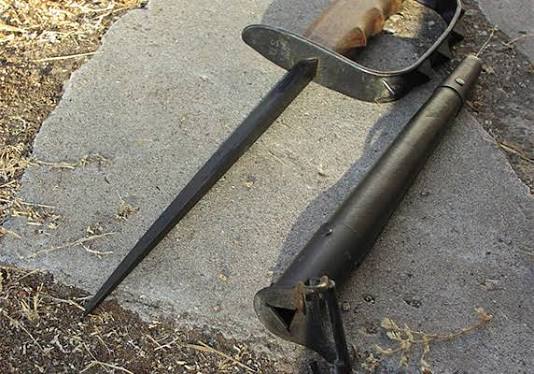
    The result was a frantic period of improvisation. Troops on all sides fashioned clubs from entrenching tools, wire, and scrap metal. They lashed bayonets to wooden handles to make spears. They traded rifles for pistols and knives. By 1915, armies began issuing purpose-built trench knives, such as the French Couteau Poignard M1916 and the German Nahkampfmesser. Many featured brass knuckles on the grip, turning the knife into a dual-purpose weapon for stabbing and punching.

    The Grenade: From Improvisation to Mass Production

    Grenades were almost nonexistent in 1914. Pre-war armies had experimented with hand-thrown explosives, but none had standardized them. The trench experience changed that overnight. Soldiers soon discovered that a thrown explosive could clear a trench section or bunker without exposing the thrower to enemy fire.

    The early war saw a flood of improvised grenades—jam tins packed with nails and gunpowder, glass bottles filled with explosives. But these were dangerous and unreliable. The first practical answer came in 1915 with the British Mills bomb, a fragmentation grenade with a serrated cast-iron body and a lever-and-pin mechanism. It could be thrown accurately and exploded into dozens of lethal fragments.

    The Germans took a different approach with the Stielhandgranate, or stick grenade. Its long wooden handle allowed for longer throws and could be rolled into trenches. By 1918, Britain alone had produced roughly 75 million grenades, compared to about 500,000 in 1914. The grenade had gone from a makeshift tool to a standard infantry weapon, essential for trench raids and assaults.

    The Trench Gun: America’s Controversial Addition

    When the United States entered the war in 1917, it brought a weapon that no European army had used: the pump-action shotgun. The Winchester Model 1897, already a civilian hunting gun, was modified with a bayonet mount and a heat shield, earning the nickname “trench broom” or “trench sweeper.”

    Its effectiveness was undeniable. Each pump-action blast fired a spread of buckshot that could hit multiple targets in a confined space. In the close quarters of a trench, it was arguably the most lethal personal weapon on the battlefield. The Germans were so outraged that they issued a formal protest in 1918, claiming the shotgun violated the Hague Conventions’ ban on inhumane weapons. The US rejected the protest, noting that shotguns were not explicitly prohibited. The controversy illustrates how desperate the war had become—and how quickly new weapons blurred the line between acceptable and barbaric.

    The Flamethrower: Terror as a Weapon

    The flamethrower was the most terrifying weapon introduced in the war. The Germans first used the Flammenwerfer on July 30, 1915, at Hooge, Belgium, against British troops. The effect was immediate and psychological: men fled in panic, and the weapon’s ability to clear bunkers and trenches made it a feared assault tool.

    Portable models, such as the Kleinflammenwerfer, could project a stream of burning fuel up to 20 or 30 meters. Larger static versions, like the British Livens Large Gallery Flame Projector, could reach 40 meters but were effectively one-shot devices. The flamethrower’s tactical value was limited—the operator was vulnerable to snipers, and the fuel tanks were heavy—but its terror value was immense. A soldier facing a stream of fire had to break cover or burn, which made flamethrowers effective at forcing enemy troops out of strongpoints.

    The weapon’s legality was murky. The Hague Conventions banned poison gas and expanding bullets but said nothing about fire. As with the shotgun, Germany used flamethrowers extensively, so the moral high ground was shaky. The weapon’s legacy was clear: future wars would see improved versions, and the psychological impact of fire would never be forgotten.

    Early Machine Guns and Submachine Guns: The Seeds of Modern Firepower

    Machine guns existed before the war—the Maxim gun had been in service since 1884—but they were treated as artillery, not infantry weapons. The war changed that. The British Lewis Gun, the French Chauchat, and the German MG 08/15 were all portable enough to accompany infantry, though they were heavy, prone to jamming, and required crews to operate.

    The real breakthrough came in 1918 with the German MP 18. Designed for the stormtrooper units that spearheaded the Spring Offensive, the MP 18 was the world’s first practical submachine gun. It fired 9mm pistol ammunition at a rate of about 400 rounds per minute, and its short barrel and detachable magazine made it ideal for close-quarters fighting. Issued to assault troops, the MP 18 allowed a single soldier to lay down a withering volume of fire while moving. It was the direct ancestor of every modern submachine gun and a clear sign of where infantry weapons were headed.

    From Static Lines to Stormtroopers

    The shift in weapons reflected a shift in tactics. By 1917, the Germans had developed infiltration tactics, using small, highly trained teams of stormtroopers armed with grenades, pistols, and flamethrowers to bypass strongpoints and attack command posts and supply lines. This approach required light, portable firepower, which drove the adoption of SMGs and grenades.

    The rest of the Allies followed, though more slowly. By November 1918, the infantryman’s kit was vastly different from 1914. The long bayonet was still present, but it was now a secondary weapon. Grenades were standard issue. Shotguns and submachine guns had made their debut. The flamethrower, though still niche, had proven its psychological power.

    These changes were not just technological; they were cultural. The war had broken the old rules of warfare, and the new weapons reflected a brutal pragmatism. Soldiers no longer fought in lines; they fought in bursts of violence, using whatever tool could give them an edge.

    The Legacy of WWI Infantry Weapons

    The weapons developed between 1914 and 1918 laid the foundation for modern infantry combat. The submachine gun, the fragmentation grenade, and the portable flame weapon all became standard in subsequent conflicts. The trench shotgun, though controversial, was used again in World War II and beyond.

    More importantly, the war demonstrated that infantry weapons must adapt to the realities of the battlefield. The lessons of the trenches—close-quarters lethality, portability, and psychological impact—remain central to small-arms design today. When you see a soldier with a carbine and a grenade launcher, you are seeing a descendant of the MP 18 and the Mills bomb.

    The trenches of WWI were a crucible that forged a new kind of warfare. The weapons that emerged from that crucible were brutal, innovative, and often terrifying. They were also a necessary response to a war that had turned the world upside down.

    World War I forced armies to abandon 19th-century weapons and embrace the close-quarters tools of modern war. From the trench knife to the flamethrower, each innovation was a pragmatic answer to the unique horror of the trenches. These weapons not only changed how wars were fought but also set the stage for the infantry arsenals of the 20th century. The stalemate of the Western Front may have been a deadlock, but it was also a forge—one that produced the tools that would define warfare for generations to come.

    Summary

    • Trench warfare made long rifles and bayonets obsolete, leading to the development of compact close-quarters weapons like trench knives and pistols.
    • Grenades went from improvised jam tins to mass-produced Mills bombs and stick grenades, with Britain producing 75 million by 1918.
    • The US shotgun, or “trench broom,” was so effective that Germany protested it as inhumane, though it was not banned.
    • Flamethrowers, first used by Germany in 1915, were more about psychological terror than tactical efficiency, with ranges of 20–40 meters.
    • The MP 18, the first practical submachine gun, was introduced in 1918 and directly influenced modern infantry weapons.

    FAQ

    Q: Why were trench knives so important in WWI?
    A: Trench knives, often with brass knuckles, were essential for silent raids and close-quarters combat, where rifles were too long and noisy. They were compact, deadly, and could be used in the confined spaces of trenches.

    Q: Did the shotgun really cause a diplomatic protest?
    A: Yes. In 1918, Germany formally protested the US use of pump-action shotguns, claiming they violated the Hague Conventions. The US rejected the protest, and shotguns remained in use.

    Q: How effective were flamethrowers in combat?
    A: Their effectiveness was mixed. They were terrifying and could clear bunkers, but they had short range (20–30 meters), were heavy, and made operators vulnerable. Their main impact was psychological.

    Q: What was the first submachine gun?
    A: The German MP 18, introduced in 1918, is generally considered the first practical submachine gun. It was used by stormtroopers during the Spring Offensive.

    Q: How did grenades change during the war?
    A: Grenades went from improvised, unreliable devices to standardized, mass-produced weapons like the British Mills bomb and German stick grenade. Production increased from about 500,000 in 1914 to 75 million by 1918.