Tag: warfare

  • How Wireless Won the Battlefield: The Birth of Military Radio

    How Wireless Won the Battlefield: The Birth of Military Radio

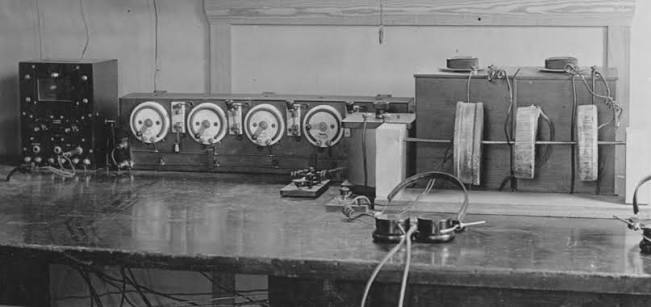
    In 1899, during the Boer War, British Army signals officers unpacked a strange new device: a spark-gap transmitter and coherer receiver, capable of sending Morse code across the veldt without a single wire. It was crude, prone to interference, and weighed over a hundred pounds, but it worked. For the first time, a commander could send orders to troops beyond the horizon in real time, without relying on telegraph lines that the enemy could cut or visual signals that darkness could hide.

    That moment marked the beginning of a revolution that would transform warfare. Within two decades, radio went from a laboratory curiosity to a standard military tool for every major power. The same technology that would one day carry the voice of a ‘walkie-talkie’ operator on D-Day had its roots in these early, crackling spark transmissions.

    This is the story of how radio was born, how the military seized on it, and how it changed the face of conflict forever.

    A World Wired for Failure

    Before radio, military communication was a patchwork of fragile methods. Visual signals—semaphore flags, heliographs, and Aldis lamps—required clear weather and line of sight. Audio signals like bugle calls and drums were short-range and easily drowned out by the noise of battle. Wired telegraphy, established during the Crimean War and perfected in the American Civil War, was a step forward, but it had a fatal weakness: the wires themselves. A single artillery shell could sever a line, and laying cable across hostile terrain was slow and dangerous.

    At sea, the problem was even worse. Once a fleet sailed over the horizon, it was effectively blind and mute to its commanders. Admirals had to rely on pre-arranged plans and visual signals that could be lost in smoke or fog. The ‘fog of war’ wasn’t just a metaphor—it was a literal, physical limitation.

    Into this void stepped a young Italian inventor with a box of spark coils and a dream.

    Marconi’s Spark: From Salisbury Plain to the Sea

    Guglielmo Marconi wasn’t the first to experiment with radio waves—Heinrich Hertz had confirmed their existence in 1887, and Nikola Tesla had filed patents on wireless apparatus as early as 1897. But Marconi was the first to turn radio into a practical communication system. In 1895, he demonstrated wireless telegraphy in Italy; two years later, he sent a signal across the Salisbury Plain in England, a distance of about four kilometers. The British military took notice.

    In 1899, the Royal Navy used Marconi sets in naval exercises, and the British Army deployed them during the Boer War. The sets were primitive by modern standards: spark-gap transmitters produced a crackling, broad-spectrum signal that was hard to tune, and the coherer receiver—a tube of metal filings that suddenly conducted when struck by radio waves—was finicky and slow. But they worked, and they gave military commanders something they’d never had before: instant, wireless communication over distance.

    The Russo-Japanese War of 1904–1905 was the first major conflict where both sides used wireless for naval communication and tactical coordination. Ships could now share intelligence, coordinate maneuvers, and report enemy positions in real time. The age of radio warfare had begun.

    The Voice Breaks Through: Fessenden, de Forest, and the Road to Clarity

    Early radio was all dots and dashes, but a Canadian inventor named Reginald Fessenden was determined to send the human voice. In 1900, he achieved the first voice transmission over radio, a feat that required a continuous-wave transmitter instead of the noisy spark-gap. Fessenden’s work, along with Lee de Forest’s invention of the Audion tube in 1906, made amplification and clearer signals possible. The Audion, a vacuum tube that could boost weak signals, was a game-changer—quite literally, for it enabled voice and long-range communication that was reliable enough for military use.

    The Titanic disaster in 1912 underscored radio’s life-saving potential. The ship’s wireless operator sent distress signals that brought rescue ships to the scene, but the tragedy also revealed the chaos of unregulated airwaves. This spurred international regulation and accelerated military adoption. By the time World War I broke out in 1914, radio was a standard tool for all major powers.

    Trench Warfare and the Push for Portability

    World War I was the crucible that forged modern military radio. Trench warfare demanded rugged, portable sets that could survive mud, shellfire, and constant movement. The early sets were heavy and fragile—the SCR-68, used by the U.S. Army after 1917, weighed over 100 pounds and was often transported by pack mule. But by the end of the war, the U.S. Signal Corps had developed lighter, more reliable sets like the SCR-77, and radio had become essential for coordinating artillery fire, directing reconnaissance, and maintaining contact between frontline units and headquarters.

    Radio also went airborne. Aircraft used wireless to report enemy positions and direct artillery fire, though early sets were heavy and unreliable. The war drove rapid innovation, including Edwin Armstrong’s invention of the superheterodyne receiver in 1918, which made tuning and reception far more precise.

    The interwar years saw further advances: FM radio, invented by Armstrong in 1933, offered clearer, more secure communication than AM, and miniaturization made possible the famous SCR-300 ‘walkie-talkie’ and SCR-536 ‘handie-talkie’ of World War II. These devices put radio in the hands of individual soldiers, transforming small-unit tactics.

    The Revolution in Command and Control

    The military adoption of radio was not just a technological shift—it was a revolution in command and control. At sea, it ended the isolation of ships, enabling coordinated fleet maneuvers and over-the-horizon intelligence. On land, it allowed artillery observers to direct fire in real time, a capability that would prove decisive in both world wars. In the air, it linked pilots to ground commanders, making close air support possible.

    But radio also brought new vulnerabilities. The signal was broadcast, meaning anyone with a receiver could listen in. Interception and jamming became immediate concerns, driving the development of encryption and spread-spectrum techniques that continue to this day.

    Strategically, radio fueled imperial competition. Britain, Germany, Russia, and Japan raced to develop and deploy wireless, recognizing its strategic value. The 1906 Berlin Radiotelegraphic Convention established international frequency allocation, driven partly by military concerns about interference. Radio had become a matter of national security, and it has remained so ever since.

    The birth of military radio was a story of unlikely heroes—inventors, engineers, and soldiers who saw the potential in crackling sparks and vacuum tubes. From the Boer War to the beaches of Normandy, radio transformed warfare from a series of isolated engagements into a coordinated, real-time enterprise. It was one of the fastest adoptions of a technology in military history, and its legacy is still with us in every encrypted frequency-hopping radio, every satellite uplink, and every drone pilot’s video feed. The spark-gap transmitter may be a museum piece, but the revolution it started is still unfolding.

    Summary

    • Radio went from a lab curiosity to a standard military tool in under two decades (1895–1914), driven by naval and imperial needs.
    • Early military radio used spark-gap transmitters and coherer receivers, which were crude but effective for Morse code.
    • Key inventors: Marconi (commercialization), Fessenden (voice), de Forest (amplification), and Armstrong (FM and superheterodyne receiver).
    • WWI drove the development of portable, rugged sets, leading to the SCR-series and eventually the walkie-talkie of WWII.
    • Radio revolutionized command and control—naval coordination, artillery direction, and air support—but also introduced vulnerabilities like interception and jamming.

    FAQ

    Q: What was the first military use of radio?
    A: The first documented military use was in 1899, when the British Royal Navy used Marconi sets in naval exercises, and the British Army used them during the Boer War.

    Q: Who invented the technology behind military radio?
    A: Guglielmo Marconi commercialized wireless telegraphy, but Nikola Tesla and Alexander Popov also filed early patents and demonstrations. Reginald Fessenden sent the first voice transmission, Lee de Forest invented the Audion tube for amplification, and Edwin Armstrong developed FM radio and the superheterodyne receiver.

    Q: How did radio change naval warfare?
    A: Radio allowed ships to communicate beyond visual range, enabling coordinated fleet maneuvers, real-time intelligence sharing, and over-the-horizon targeting. This ended the isolation of ships at sea and transformed naval tactics.

    Q: What was the impact of WWI on military radio?
    A: WWI drove the development of portable, rugged radio sets that could survive trench conditions. It also introduced radio to aircraft and artillery coordination, making it a standard tool for all major powers.

    Q: What were the limitations of early military radio?
    A: Early sets were heavy, fragile, and used spark-gap transmitters that produced noisy, hard-to-tune signals. They were also broadcast, so messages could be intercepted, leading to concerns about security and the development of encryption.
  • The Machine Gun: How a Single Invention Redefined Warfare

    The Machine Gun: How a Single Invention Redefined Warfare

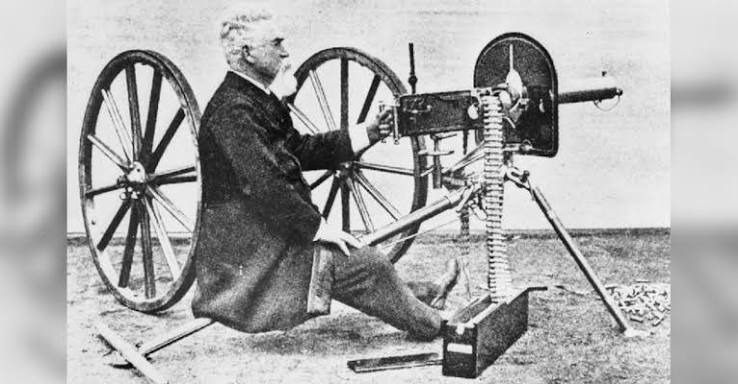
    In 1884, Hiram Maxim patented a weapon that could fire 500 rounds per minute—a rate equivalent to the firepower of dozens of riflemen. Within three decades, it would mow down massed infantry charges, entrench armies in mud, and kill more soldiers than any other weapon of its era. The machine gun didn’t just change battlefields; it upended centuries of military doctrine and reshaped the very nature of conflict.

    This article traces the machine gun’s journey from a mechanical curiosity to the centerpiece of modern warfare. We’ll explore its technical evolution, its brutal debut in colonial wars, its role in the stalemate of World War I, and how it continues to influence tactics today.

    The Pre-Machine Gun Battlefield: A World of Volleys and Charges

    Before the machine gun, infantry tactics revolved around massed volley fire. Muskets and rifles had effective ranges of 100–300 meters, and a trained soldier could fire 2–4 rounds per minute with a muzzle-loader, or 10–15 with a bolt-action repeater. Battles were often decided by disciplined volleys, cavalry charges, and bayonet assaults. Artillery provided indirect fire, but it was slow to adjust and vulnerable to counter-battery fire.

    The machine gun shattered this world. It wasn’t just a faster rifle—it was a fundamentally different tool. A single Maxim gun could lay down a continuous stream of lead, turning open ground into a kill zone. The implications were clear to anyone paying attention, but the weapon’s true impact wouldn’t be felt until it met the massed armies of the 20th century.

    The Industrial Revolution and the Maxim Breakthrough

    The machine gun was a child of the Industrial Revolution. Precision machining, mass production of cartridges, and advances in metallurgy made reliable automatic fire possible. But one invention was crucial: smokeless powder. Introduced in the 1880s, it produced less smoke and fouling than black powder, allowing sustained fire without obscuring the gunner’s view or revealing his position.

    Hiram Maxim, an American-born inventor living in Britain, combined these elements in 1884. His design used the recoil energy of the fired round to eject the spent cartridge, chamber a new round, and cock the hammer—all automatically. The Maxim gun could fire 500–600 rounds per minute, roughly the firepower of 30–50 riflemen. It was a self-contained cycle requiring no external power. This was the first true machine gun.

    Colonial Wars: The Weapon as a Grim Reaper

    The machine gun found its first brutal application in European colonial expansion. At the Battle of Omdurman in 1898, British forces with Maxim guns killed thousands of Sudanese Dervishes while suffering only dozens of casualties. In the Matabele War (1893–94), 50 British soldiers with four Maxims held off thousands of Ndebele warriors. These one-sided victories created a myth of European invincibility and demonstrated the weapon’s devastating potential. But they also set a grim precedent: the machine gun could turn a battlefield into a slaughterhouse.

    World War I: The Machine Gun’s Coming of Age

    When World War I broke out in 1914, every major power had machine guns, but military doctrine lagged. They were treated as artillery or special weapons, not integrated into infantry tactics. The reality of 1914–1918 was brutal: defensive machine gun fire, especially from German MG 08s, made frontal infantry assaults suicidal. The machine gun was the primary cause of the trench warfare stalemate. Some estimates suggest it caused 50–60% of all battlefield deaths in the war.

    The machine gun didn’t just cause casualties—it changed the geometry of warfare. It forced armies underground, creating the vast trench systems that stretched from the English Channel to the Swiss border. The weapon’s defensive power made offensive breakthroughs nearly impossible without overwhelming artillery support or innovative new tactics like infiltration and armor.

    Interwar and WWII Developments: The General-Purpose Machine Gun

    Between the wars, designers sought to make machine guns more mobile and versatile. Germany led the way with the MG 34 and MG 42, which introduced the concept of the general-purpose machine gun (GPMG)—a single weapon usable as a light, medium, or heavy machine gun. The MG 42’s rate of fire of 1,200–1,500 rounds per minute earned it the nickname “Hitler’s Buzzsaw.” Its sound was so distinctive that it struck fear into Allied soldiers.

    The United States relied on the Browning M1919 (medium) and the M2 .50 cal (heavy), the latter still in service today. The Soviet Union produced the DP-27 and later the PKM, providing rugged, reliable squad-level firepower. These weapons were lighter, air-cooled, and more portable than their WWI predecessors, allowing them to be used in mobile offensives rather than just static defense.

    Post-WWII and Modern Systems: From SAWs to Miniguns

    After World War II, the machine gun continued to evolve. Squad automatic weapons (SAWs) like the M249 and light machine guns like the RPK provided infantry squads with portable automatic fire using intermediate cartridges like 5.56×45mm NATO. These weapons were lighter and more controllable, but they retained the core principle of automatic fire.

    Modern systems have pushed the concept even further. The M134 Minigun, an electric-powered Gatling-style weapon, can fire 2,000–6,000 rounds per minute, devastating at close range. Advanced optics, suppressors, and smart fire-control systems have made machine guns more accurate and versatile. Yet the fundamental calculus remains: a machine gun multiplies the firepower of a few soldiers into that of a much larger force.

    The Machine Gun’s Legacy: A Weapon That Changed Everything

    The machine gun’s legacy is profound. It made massed infantry assaults obsolete, forced armies to adopt new tactics like fire-and-maneuver, and accelerated the development of tanks, aircraft, and other countermeasures. It also raised the human cost of war to unprecedented levels. In a sense, the machine gun is a mirror of 20th-century warfare: efficient, industrial, and utterly unforgiving.

    Today, machine guns remain a staple of every military force, from the M249 to the PKM. They are no longer the dominant weapon they once were—guided munitions and drones have taken that role—but they still hold a vital place on the battlefield. The machine gun changed battlefields forever because it solved a timeless problem: how to deliver maximum firepower with minimum manpower. That solution came at a terrible price, but it reshaped warfare in ways that continue to echo.

    The machine gun is more than a weapon; it’s a turning point in military history. From Maxim’s first recoil-operated design to the electric-powered Minigun, it has forced armies to adapt, innovate, and confront the grim arithmetic of industrial warfare. Its legacy is visible in every modern infantry squad, every defensive position, and every military doctrine that prioritizes firepower. The machine gun didn’t just change battlefields—it defined them for a century and continues to shape how wars are fought today.

    Summary

    • The first true machine gun was patented by Hiram Maxim in 1884, using recoil energy to automate the firing cycle.
    • Machine guns caused 50–60% of World War I combat casualties and were the primary driver of trench warfare stalemate.
    • Colonial wars like the Battle of Omdurman demonstrated the weapon’s devastating one-sided effectiveness.
    • Germany’s MG 34 and MG 42 introduced the general-purpose machine gun, which could serve as a light, medium, or heavy weapon.
    • Modern machine guns range from squad automatic weapons like the M249 to electric-powered Miniguns firing 2,000–6,000 rounds per minute.

    FAQ

    Q: What was the first true machine gun?
    A: The Maxim gun, patented by Hiram Maxim in 1884, is widely considered the first true machine gun because it was self-powered, using recoil energy to automate the firing cycle.

    Q: How did the machine gun affect World War I tactics?
    A: The machine gun’s defensive firepower made frontal infantry assaults suicidal, forcing armies to dig trenches and creating a stalemate that lasted for years. It also spurred the development of tanks and new infantry tactics.

    Q: What is a general-purpose machine gun?
    A: A general-purpose machine gun (GPMG) is a single weapon that can serve multiple roles—light, medium, or heavy—by changing its mount and feed system. Examples include the German MG 42 and the modern PKM.

    Q: Why was smokeless powder important for machine guns?
    A: Smokeless powder produced less smoke and fouling than black powder, allowing sustained fire without obscuring the gunner’s view or revealing the weapon’s position. It was essential for the machine gun’s practicality.

    Q: Are machine guns still used in modern warfare?
    A: Yes, machine guns like the M249 SAW, M2 .50 cal, and PKM remain standard equipment in most militaries. They provide suppressive fire and are used in both offensive and defensive roles, though their dominance has been challenged by guided munitions and drones.