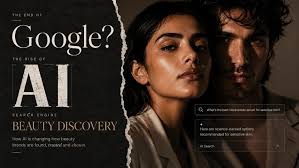
Finding the right foundation or skincare product online has always been a gamble. You can’t test the texture, see the exact shade on your skin, or know if it will irritate your sensitive complexion. Traditional search engines only understand keywords, so typing ‘best moisturizer’ gives you generic results, not something tailored to your oily, acne-prone skin.
AI search in beauty is changing that. Instead of scrolling through endless product pages, you can now upload a selfie to get a skin analysis, snap a photo of a celebrity to find a dupe for their lipstick, or type a conversational query like ‘something for dry skin with SPF 30 under $30.’ This technology is growing fast, with the global AI in beauty market valued at $3–4 billion in 2023 and projected to grow 20–25% annually through 2030. Here’s how it works, why it matters, and what it means for shoppers and brands alike.
The Problem: Beauty Search Is Broken
Beauty is a tricky category to shop for online. Unlike buying a book or a pair of jeans, you can’t easily know if a product will work for you. Shade names are inconsistent—what one brand calls ‘Sand’ another calls ‘Beige.’ Ingredients have multiple names, and skin concerns vary wildly from person to person.
This leads to high return rates—estimated at 20–30% for cosmetics—and a lot of abandoned carts. Shoppers face ‘analysis paralysis’ with thousands of options and no clear way to narrow them down. Traditional search engines fail because they match keywords, not meaning. A query like ‘best foundation for oily skin’ returns generic lists, not personalized recommendations.
How AI Solves It: Visual, Conversational, and Personalized Search
AI search uses computer vision, natural language processing, and recommendation algorithms to understand what you actually need. Here are the main applications:
Visual Search: Find Products by Photo
You can upload a photo of a product, a celebrity, or even your own face. For example, point your camera at a friend’s lipstick and the AI identifies the brand and shade, or finds a dupe. Google Lens and Amazon’s app both offer this. It’s like having a beauty expert who never sleeps and has seen every product ever made.
Skin Analysis: Know Your Skin, Get Better Recommendations
Take a selfie and AI scans your face for concerns like acne, pigmentation, wrinkles, and hydration. L’Oréal’s ModiFace and Perfect Corp’s YouCam are leaders here. The AI assesses your skin’s condition and recommends products that address your specific issues. This goes beyond a generic quiz—it’s a personalized assessment based on visual data.
Conversational Search: Talk to a Virtual Assistant
Instead of typing keywords, you can chat with an AI assistant. Amazon’s Rufus is an example—it answers questions like ‘What’s a good sunscreen for sensitive skin?’ or ‘Show me a hydrating serum with hyaluronic acid under $50.’ The AI understands natural language and can handle complex, multi-part queries.
Personalized Recommendations: Beyond Basic Filters
AI can combine your visual data, purchase history, and stated preferences to recommend products. Sephora’s Color IQ matches foundation shades precisely, and Ulta’s GLAMLab lets you try on makeup virtually. These tools use AI to cut through the noise and present a curated selection just for you.
The Growth of Long-Tail Searches
Search volume for AI beauty is growing, but it’s the long-tail queries that are exploding. Head terms like ‘best foundation’ have high volume but low specificity—everyone searches them, but they don’t lead to conversions. Long-tail terms like ‘dupe for Charlotte Tilbury Pillow Talk for fair neutral skin’ are lower volume individually, but collectively they make up the majority of searches. And they convert much better because the searcher knows exactly what they want.
AI search is perfect for long-tail queries. It can parse them and return precise results. It can even generate new long-tail queries—for example, you might ask ‘show me products for combination skin with niacinamide and no fragrance,’ and the AI will understand and find matches. This is something traditional search can’t do well.
Why Brands Are Investing Heavily
Beauty brands have massive datasets—customer photos, purchase history, reviews—that fuel AI training. This gives them a moat. L’Oréal acquired ModiFace in 2018 to get AR try-on and skin diagnostics. Perfect Corp partners with Estée Lauder and Shiseido. Procter & Gamble uses AI for skin analysis. Sephora and Ulta have their own AI tools.
The payoff is real: brands report 2–3x higher conversion rates with visual search compared to standard search. Lower return rates mean better margins. And AI generates rich customer data that helps with cross-selling and personalized marketing.
Consumer Concerns: Privacy and Bias
Not everything is rosy. Uploading face photos raises privacy concerns. Users worry about how their images are stored and used. There’s also the risk of biased recommendations—if the training data skews toward certain skin tones, the AI might not work well for others. Trust is higher for shade matching than for medical advice, so AI should not replace dermatologists.
The Future: More Conversational, More Integrated
As generative AI improves, expect more conversational search. You’ll be able to have a back-and-forth with an AI that remembers your preferences and adjusts recommendations in real time. AR will become more integrated—Apple’s Vision Pro is already exploring beauty demos. And as AI gets better, it will handle even more complex queries, making beauty shopping feel more like having a personal shopper in your pocket.
AI search in beauty is transforming a frustrating shopping experience into a personalized, efficient one. For consumers, it means less guessing and more confidence. For brands, it’s a competitive advantage that drives sales. As the technology matures, the line between searching and shopping will blur—and the beauty industry will never look the same.
Summary
- AI search uses visual recognition, natural language processing, and recommendation algorithms to help shoppers find beauty products.
- Applications include visual search (photo-based), skin analysis (selfie scans), conversational search (chatbots), and personalized recommendations.
- The AI in beauty market was worth $3–4 billion in 2023 and is growing at 20–25% annually.
- Long-tail queries (specific, detailed searches) are growing faster than head terms and are where AI excels.
- Brands like L’Oréal, Sephora, and Amazon are investing heavily, with conversion rates up to 2–3x higher with visual search.
FAQ
Q: Is AI search in beauty accurate?
A: For shade matching and skin analysis, yes, it’s quite accurate—many tools are trained on diverse datasets. However, it’s not a substitute for professional dermatological advice, and accuracy can vary by skin tone.
Q: Do I have to upload a selfie to use AI beauty search?
A: Not always. Some tools work with product photos or text queries. But features like skin analysis or virtual try-on require a selfie, which raises privacy considerations.
Q: Are AI beauty recommendations biased?
A: There’s a risk if training data isn’t diverse. Some companies are working to improve inclusivity, but it’s an ongoing challenge. Always test products yourself when possible.
Q: How do I know if a brand uses AI search?
A: Look for features like ‘virtual try-on,’ ‘skin analysis,’ ‘shade finder,’ or a chat assistant on their website or app. These are typically powered by AI.
Q: Will AI replace beauty advisors?
A: It complements them. AI handles routine queries and data analysis, but human advisors are still valuable for nuanced advice and building trust.