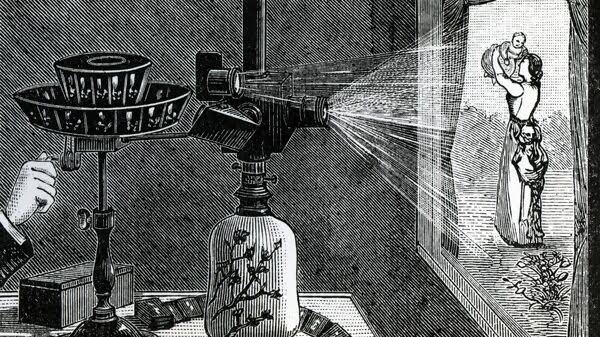
Before the flicker of celluloid, there was the glow of the magic lantern. In the 1790s, Parisian showman Étienne-Gaspard Robert, known as Robertson, filled darkened theaters with phantoms that seemed to float through the air, reaching for terrified audiences. He did it not with spirits, but with a humble optical device: a box with a lens, a light source, and glass slides. This was the magic lantern, the first mass visual entertainment, which for over two centuries projected painted and photographic images onto walls and screens, blending science, spectacle, and superstition.
The magic lantern was more than a toy or a teaching tool; it was a medium that shaped how people saw the world and the supernatural. Its peak, from the 1790s to the 1890s, coincided with the Victorian era, when traveling shows, scientific lectures, and even church services used it to inform and astonish. The lantern’s techniques for creating ghostly illusions—rear projection, moving projectors, double exposures—were so effective that audiences fainted in terror. These tricks would later become the grammar of cinema, influencing pioneers like Georges Méliès, who translated lantern magic into film. To understand the origins of modern visual storytelling, we must revisit the forgotten art of the magic lantern and the projectionists who conjured ghosts before the movies.
The Lantern’s Origins: A Device Born Between Science and Trickery
The magic lantern emerged in the mid-17th century, a time when science and superstition were tangled. While often credited to Athanasius Kircher, whose 1671 book Ars Magna Lucis et Umbrae described a projecting device, the first concrete description came from Dutch scientist Christiaan Huygens in 1659. Huygens may have built it as a clever hoax to spook his family, foreshadowing the lantern’s later role as a tool for both enlightenment and deception.
These early lanterns were rudimentary. A candle or oil lamp provided the light, which passed through a painted glass slide and a lens to cast an image onto a wall. The results were dim and small, but in the darkness of a room, they were magical. The lantern quickly spread across Europe, used by Jesuits for religious instruction and by itinerant showmen for entertainment. By the 1790s, improvements in light sources and slide-making transformed it into a mass medium.
The Golden Age: From Parlor Toy to Mass Spectacle
The “Golden Age” of the magic lantern, from the 1790s to the 1890s, was a period of rapid technological evolution. The dim candle gave way to limelight in the 1820s—a block of calcium oxide heated by an oxyhydrogen flame—which produced a brilliant, intense light. Later, electric arc lamps in the 1860s and 1870s made images even brighter and larger. Each advance allowed projectionists to fill bigger halls with clearer images, enhancing the illusion.
Slides also became more sophisticated. Early hand-painted slides were unique, but mass production in the 19th century made them affordable. Lithographed and hand-colored slides depicted everything from biblical scenes to bawdy jokes. Most remarkable were mechanical slides, which used slipping, rack-and-pinion, or pulley systems to create motion: arms waved, eyes rolled, ships sailed across a stormy sea. These were the ancestors of animation, and they captivated audiences.
The lantern was democratic entertainment. Rich families owned elaborate home sets with dozens of slides, while the poor could attend penny shows in public halls. Missionaries and temperance advocates used it to reach illiterate audiences, and science lecturers employed it to illustrate discoveries. It was also a tool of empire, projecting travelogues of “exotic” lands that reinforced colonial narratives. In all these settings, the lantern was a social experience: a lecturer narrated the images, often with music or sound effects, creating a shared emotional journey.
Conjuring Ghosts: The Phantasmagoria and the Art of Terror
The most sensational use of the magic lantern was the phantasmagoria, a ghost show that terrified audiences across Europe. Robertson, a Belgian-born physicist and showman, pioneered the format in 1790s Paris. He set up his theater in an abandoned convent, filling it with skulls, astrological symbols, and an air of mystery. As the audience settled into darkness, Robertson would deliver a solemn lecture on death and the afterlife, hinting that he could summon the departed.
Then the show began. Using rear projection, he placed a translucent screen between the projector and the audience, hiding the lantern behind it. The projector was mounted on wheels, allowing him to move it closer or farther from the screen. This made the projected image grow or shrink, creating the illusion that a ghost was floating toward the viewers. He combined this with smoke, dim lighting, and eerie sound effects—chains rattling, thunder booming—to amplify the dread.
Robertson’s most famous spectacles included the apparition of a young woman who had died in childbirth, appearing to her grieving mother. He also summoned Robespierre, whose severed head rose from a jar and stared at the audience. The effect was so convincing that spectators screamed, fainted, and even tried to flee. Robertson framed his shows as scientific demonstrations, claiming they were mere optical illusions, yet he deliberately blurred the line between rational explanation and supernatural belief. This paradox was central to the lantern’s appeal: it allowed people to experience the thrill of the supernatural while maintaining a veneer of Enlightenment skepticism.
Paul de Philipsthal brought the phantasmagoria to London in 1801–02, where it became a sensation. He introduced the term “phantasmagoria” and refined the techniques, using multiple lanterns to create dissolves and superimpositions. Ghosts could fade in and out, or appear to interact with the environment. These effects were so effective that some audience members believed they had genuinely seen the dead.
The Science of Illusion: Double Lanterns, Dissolves, and Pepper’s Ghost
The magic lantern was not limited to phantasmagoria. Showmen and lecturers developed a repertoire of tricks to astonish audiences. Double and triple lanterns allowed projectionists to melt one image into another—a technique called a dissolve. By adjusting the intensity of each light source, they could make a landscape transform into a cityscape, or a living person morph into a skeleton. Superimposition, where two images were projected onto the same screen, created transparent apparitions that hovered over scenes.
One of the most famous ghost illusions was not strictly a lantern device but was often combined with it: the Pepper’s Ghost illusion, invented by Henry Dircks in 1862 and popularized by John Henry Pepper. It used a large sheet of glass placed at an angle on stage. A hidden, brightly lit room was reflected in the glass, making a figure appear as a translucent ghost that seemed to walk through solid objects and interact with live actors. The effect was used in theaters to stage ghostly scenes, and later, lantern projection was employed to add backgrounds or additional spectral effects.
These techniques were not just tricks; they were exercises in visual storytelling. The projectionist acted as a director, controlling pacing, choosing angles, and orchestrating sound and light to evoke emotions. Robertson’s memoirs detail his methods: he would begin with a slow, solemn tone, gradually building tension, then suddenly reveal a skeleton with claps of thunder. This mastery of timing and atmosphere was a direct precursor to film direction.
The Showman’s Craft: A Proto-Director
The lanternist was more than an operator; he was a performer. Robertson and his contemporaries were skilled orators, actors, and stage managers. They understood the power of suggestion and the importance of creating a complete sensory experience. They used music, from eerie organ chords to dramatic symphonies, to set the mood. They crafted narratives, often drawing on Gothic literature—ghosts, demons, and haunted castles—or on current events and moral tales.
The craft extended to the creation of slides. Many showmen painted their own slides, carefully choosing colors and details that would project well. They also designed mechanical slides, which required precise engineering to create smooth motion. This blend of artistry and technical skill made the lanternist a jack-of-all-trades, a role that would later be split among directors, cinematographers, and effects artists in cinema.
The Audience’s Experience: Terror, Wonder, and Belief
What was it like to watch a phantasmagoria? Eyewitness accounts describe intense physical reactions: fainting, screaming, and even vomiting. Some audience members were so convinced they had seen real ghosts that they demanded rational explanations afterward. The shows tapped into a cultural moment when the Gothic novel was popular, and death was a constant presence due to disease and high mortality rates. The lantern offered a safe way to confront mortality, to experience the thrill of the supernatural without genuine danger.
But the lantern was not always terrifying. It also inspired wonder and awe. Traveling shows projected images of distant lands, natural wonders, and astronomical phenomena. Audiences gasped at the sight of the moon’s craters or the pyramids of Egypt, images they had only imagined before. The lantern was a window to the world, and for many, it was their first encounter with visual mass media.
The Bridge to Cinema: From Lantern to Lumière
The magic lantern’s decline began in the late 1890s, as motion pictures captured the public’s imagination. The first films were short, silent, and flickering, but they offered something the lantern could not: true photographic motion. Yet the lantern did not vanish overnight. It remained in educational and church use well into the 20th century, and its techniques lived on in cinema.
Early filmmakers were steeped in lantern culture. Georges Méliès, a stage magician, used lantern-inspired tricks such as dissolves, superimposition, and stop-motion to create cinematic magic. His films, like A Trip to the Moon (1902), are essentially phantasmagoria translated into moving images. The Lumières, who are often credited with inventing cinema, had a father, Antoine Lumière, who ran a magic lantern show in Lyon. This family connection is more than a footnote; it shows how the lantern’s visual language—the sequential slides, the narrative structure, the lecturer’s voice—paved the way for film.
Charles-Émile Reynaud took the lantern a step further with his Théâtre Optique, which he debuted in 1892. Using a system of mirrors and a long strip of hand-painted frames, he projected animated sequences that lasted several minutes. This was a direct predecessor to animated film, and Reynaud’s shows were popular attractions at the Musée Grévin in Paris. Yet Reynaud’s device was complex and required a skilled operator, making it less adaptable than the motion picture camera, which soon eclipsed it.
The Legacy: Why the Magic Lantern Matters
The magic lantern is more than a footnote in film history; it is the foundation of visual storytelling. It was the first medium to combine projected images with narrative, sound, and performance, creating a shared experience for mass audiences. Its techniques—dissolves, superimposition, motion effects—became the standard vocabulary of cinema. And its role in both education and entertainment set the stage for the documentary and the feature film.
Today, we can see the lantern’s ghost in every movie theater. The dark room, the beam of light, the enlarged images that transport us to other worlds—these are direct descendants of Robertson’s phantasmagoria. The next time you watch a horror film and feel a chill, remember the showmen of the 18th century who first made audiences scream in delight and terror. They were the first projectionists, the first directors, and the first to prove that light and shadow, when skillfully wielded, can conjure ghosts.
The magic lantern was a revolutionary art form that bridged the gap between the static camera obscura and the moving picture. It gave audiences their first taste of visual mass entertainment and allowed showmen like Robertson to create unforgettable spectacles. Though the lantern was eventually overshadowed by cinema, its techniques and traditions live on in every film that uses dissolve, superimposition, or a well-timed scare. The forgotten art of the magic lantern reminds us that the magic of movies did not begin with celluloid—it began with a flickering flame and a painted slide, cast into the dark to create ghosts that still haunt our screens today.
Summary
- The magic lantern was an early projector that used a light source and glass slides to display images, emerging in the 1650s–1660s and reaching its Golden Age from the 1790s to the 1890s.
- Showmen like Robertson created ghostly illusions through phantasmagoria, using rear projection, moving projectors, smoke, and sound to terrify audiences.
- Mechanical slides and double lanterns allowed motion and dissolves, making the lantern a dynamic visual medium.
- The lantern was used for education, entertainment, and religious instruction, reaching both rich and poor audiences.
- Magic lantern techniques directly influenced early filmmakers like Georges Méliès, and the medium’s narrative structure prefigured cinema.
FAQ
Q: Who invented the magic lantern?
A: The invention is often credited to Athanasius Kircher, whose 1671 book described a projecting device, but earlier references exist, including a 1659 description by Dutch scientist Christiaan Huygens, who may have built it as a hoax.
Q: What is a phantasmagoria?
A: A phantasmagoria was a terrifying magic lantern show that used rear projection, moving projectors, smoke, darkness, and sound effects to create the illusion of ghosts and skeletons floating toward the audience. It was pioneered by Étienne-Gaspard Robert (‘Robertson’) in 1790s Paris.
Q: How did the magic lantern create ghosts?
A: By using techniques like rear projection, moving projectors to make images grow and shrink, and double lanterns for dissolves and superimposition, projectionists could make ghostly figures appear to fade in and out or fly toward the audience.
Q: What is Pepper’s Ghost?
A: Pepper’s Ghost is an illusion invented by Henry Dircks and popularized by John Henry Pepper in 1862. It uses a sheet of glass at an angle to reflect a hidden, brightly lit figure, creating a translucent ‘ghost’ that appears on stage. It was often combined with magic lantern projection.
Q: Why did the magic lantern decline?
A: The magic lantern was displaced by motion pictures in the late 1890s, which offered true photographic motion. However, lantern slides remained in use for education and church purposes into the 20th century.