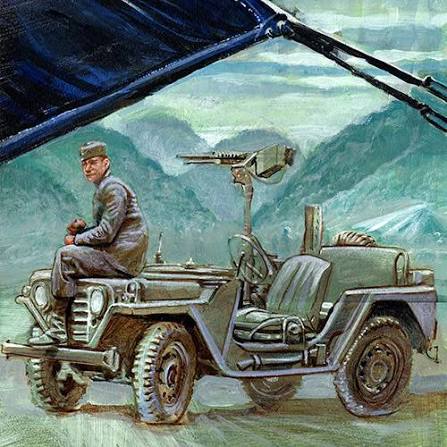
In the summer of 1940, as German Panzers rolled through France, the U.S. Army realized it had a mobility problem. Its reconnaissance fleet was a patchwork of motorcycles, sidecars, and modified civilian cars none of which could keep pace with a modern mechanized army. So the Army drafted a spec for a small, rugged, four-wheel-drive vehicle that could go almost anywhere. The result, after a frantic competition among three automakers, was a machine that would become as recognizable as the rifle: the Jeep.
By the war’s end, American factories had produced over 640,000 of them. They landed on Normandy beaches, crossed the Rhine, clawed through Pacific jungles, and rolled into Berlin. But the Jeep was more than a vehicle it was a symbol of industrial might, a mobile command post, and a lifeline for soldiers who needed to move fast and hit hard.
The Spec That Started It All
The Army’s initial request, issued in 1940, was deceptively simple: a lightweight reconnaissance car weighing no more than 1,300 pounds, with a payload of 600 pounds and a wheelbase under 75 inches. But the requirements quickly grew more demanding four-wheel drive, a crew of three, and the ability to be air-dropped. The weight limit was later revised to 2,160 pounds, which still seemed impossibly tight for a vehicle that needed to haul troops, machine guns, and radio gear.
Three companies answered the call: the American Bantam Car Company, Willys-Overland, and Ford. Bantam, a small Pennsylvania firm, delivered the first working prototype in September 1940 a feat of engineering speed that earned it a place in history. But Bantam lacked the production capacity to build thousands of vehicles. Willys won the main contract, thanks to its more powerful engine: a 60-horsepower L-head four-cylinder nicknamed the “Go-Devil.” Ford, with its enormous factories, built the same vehicle under license. The result was near-identical: the Willys MB and the Ford GPW.
Between 1941 and 1945, they rolled off assembly lines at a staggering pace—363,000 from Willys, 277,000 from Ford. Bantam, after losing the contract, mostly built trailers. The Jeep, as it was soon called, was standardized, reliable, and cheap. Its flat hood doubled as a map table. Its 80-inch wheelbase let it turn on a dime. And its 4×4 drivetrain could climb a 40-degree slope, ford a stream, or plow through mud that would swallow a truck.
The Name: A Myth and a Mystery
Everyone knows the Jeep’s name came from “GP”—General Purpose. But that’s likely a myth. Ford’s “GPW” designation stood for “Government, 80-inch wheelbase, Willys design,” not “General Purpose.” The word “jeep” was already in American slang before the vehicle existed: it appeared in Popeye comic strips in the 1930s and was used by soldiers to describe new recruits or unproven equipment.
The name stuck to the vehicle after a 1941 Washington Daily News article described a soldier test-driving a prototype and calling it a “jeep.” The Army officially adopted the name in 1942. Whatever its true origin, the name was perfect—short, tough, and impossible to forget.
Mobility for the Small Unit
The Jeep’s greatest military contribution wasn’t any single battle. It was the way it transformed small-unit mobility. Before the Jeep, a squad on patrol had to walk or pile into a truck that couldn’t leave the road. The Jeep gave them wings—or at least wheels that could go almost anywhere.
In North Africa, British Long Range Desert Group patrols mounted machine guns and extra fuel cans on Jeeps to raid Axis airfields hundreds of miles behind the lines. In Burma, Brigadier Orde Wingate’s Chindits used Jeeps to move deep into jungle territory, resupplying by air and striking at Japanese supply lines. On D-Day, Jeeps rolled off landing craft onto Omaha Beach, some fitted with waterproofing kits to wade ashore. In the Battle of the Bulge, Jeeps hauled ammunition, food, and radio equipment to surrounded American units at Bastogne.
The Jeep was also a weapons platform. A .30-caliber machine gun mounted on the passenger side turned it into a light attack vehicle. Some crews added a .50-caliber for heavier firepower. Others stripped the doors and windshield for better visibility, or welded on armor plate for protection.
But the Jeep’s versatility went beyond combat. Medics used them as field ambulances, carrying wounded on stretchers across the hood and rear. Officers used them as mobile command posts, with radios bolted to the dash. Engineers used them to pull anti-tank guns and trailers. And when roads were destroyed, the Jeep could be fitted with flanged wheels to run on railroad tracks—a trick that proved invaluable in Italy and France.
The Logistical Workhorse
Some historians argue the Jeep’s most important role was logistical. With thousands of vehicles in the field, the Army needed a machine that was easy to maintain and repair. The Jeep was that machine. Its engine was simple, its parts were standardized, and a mechanic with basic tools could fix most problems in the field. This reliability reduced the strain on supply lines and kept units moving.
The Jeep was also easy to transport. It could be air-dropped by parachute, loaded into gliders, or lashed to the deck of a landing craft. In the Pacific, where islands were small and airstrips scarce, this was critical. A Jeep could be delivered to a unit that had no road at all.
Lend-Lease shipments spread the Jeep across the globe. The Soviet Union received about 50,000 Jeeps, which they used for everything from reconnaissance to towing artillery. British forces used them in North Africa, Burma, and Europe. Free French, Chinese, and Polish units all received Jeeps. For many soldiers, the Jeep was their first taste of American industrial production—and it was a taste they never forgot.
A Symbol for the GI
Beyond its practical utility, the Jeep became a cultural icon. Its open body, flat hood, and rugged simplicity matched the image of the American GI: informal, resourceful, and a little bit irreverent. War correspondents photographed Jeeps everywhere, from the sands of Iwo Jima to the ruins of Berlin. Newsreels showed GIs driving Jeeps through liberated villages, waving to crowds. The Jeep appeared in cartoons, on posters, and in the letters soldiers sent home.
But the Jeep wasn’t universally loved by the men who drove it. It was noisy, cold, and drafty. Its brakes were weak, and its high center of gravity made it prone to tipping. Soldiers complained about the hard ride and the lack of doors. Many modified their Jeeps with improvised heaters, extra padding, or battle-scarred armor.
Still, the Jeep’s strengths outweighed its flaws. It started in cold weather, climbed steep hills, and kept running when other vehicles broke down. For the GI, it was a lifeline—a way to get from one place to another without walking, and a way to carry the gear that made survival possible.
The Postwar Legacy
When the war ended, thousands of Jeeps were left behind in Europe and Asia. Some were sold to civilians. Others were shipped home with returning soldiers. The Jeep’s rugged design inspired a new generation of civilian 4×4 vehicles: the Willys CJ series, the Land Rover, and the Toyota Land Cruiser all trace their lineage to the wartime Jeep.
The Jeep also left a mark on popular culture. It starred in TV shows like MASH and The Rat Patrol*, and became a staple of veteran reunions and military museums. Today, the word “Jeep” is a brand, a style, and a symbol—but it all started with a simple spec and a desperate need for mobility.
The Truth About Bantam
One of the most persistent myths about the Jeep is that Bantam invented it and was cheated out of the contract. The truth is more complicated. Bantam built the first prototype, but the Army required a company that could produce tens of thousands of vehicles. Bantam, with its small factory in Butler, Pennsylvania, simply couldn’t scale up. Willys and Ford had the capacity and the engineering resources to meet the demand.
The Army didn’t cheat Bantam—it made a pragmatic choice. But Bantam’s contribution was real. Its engineers, led by Karl Probst, worked around the clock to design the prototype in just 49 days. That prototype set the template for everything that followed. Bantam may have lost the contract, but its name is forever linked to the Jeep’s origin.
The Jeep in the Pacific and Beyond
The Jeep proved its worth in every theater, but the Pacific presented unique challenges. Dense jungles, narrow trails, and island terrain demanded a vehicle that could squeeze through tight spaces and handle muddy, rutted tracks. The Jeep did both. Marines used them to haul supplies across beaches, to tow artillery pieces, and to evacuate wounded from forward positions.
In the Aleutians and the frozen north, Jeeps struggled with extreme cold, but still managed to start and run. In the deserts of North Africa, they outran German patrols and outlasted their supply lines. In the mountains of Italy, they climbed switchbacks that would stall a truck.
By 1945, the Jeep was everywhere. It was the workhorse of the Allied war effort—not glamorous, but essential. It carried messages, ammunition, food, and wounded men. It pulled guns, hauled trailers, and even served as a mobile field kitchen. The Jeep didn’t win the war alone, but it helped win it in ways that are easy to overlook.
The Enduring Icon
The Jeep’s story is a reminder that sometimes the simplest tools are the most important. It wasn’t the fastest, the most comfortable, or the most powerful vehicle of the war. But it was reliable, versatile, and everywhere. It connected the front lines to the rear, the soldier to his supplies, and the Allied armies to each other.
After the war, the Jeep became a symbol of freedom and adventure. It inspired a global 4×4 industry and a culture of off-road exploration. But for the veterans who drove it, the Jeep was more than a symbol—it was a piece of home, a reliable friend, and a reminder that even in the chaos of war, American industry could build something that worked.
The Jeep is still with us today, in various forms, on roads and trails around the world. But its greatest legacy is not the vehicles that bear its name. It’s the memory of the soldiers who drove it, the battles it fought, and the simple idea that a lightweight, four-wheel-drive car could change the course of history.
The Jeep was a simple vehicle that became an icon because it was exactly what the Allies needed at exactly the right moment. It was fast to produce, easy to maintain, and capable of going almost anywhere. More than that, it was a symbol of American ingenuity and industrial might. As the historian Paul Fussell once wrote, the Jeep was “one of the few good things to come out of the war.” It remains a testament to the power of design, the value of simplicity, and the enduring bond between a soldier and his machine.
Summary
- The Jeep was developed from a 1940 Army spec for a lightweight, 4×4 reconnaissance car, with prototypes from Bantam, Willys, and Ford.
- Willys won the main contract due to its powerful “Go-Devil” engine, and Ford built the same vehicle under license, producing over 640,000 units combined.
- The name “Jeep” likely came from Army slang and a 1941 newspaper article, not from “General Purpose” as commonly believed.
- The Jeep’s versatility made it essential in every theater: scout car, ambulance, weapons platform, radio car, and even a rail vehicle.
- Post-war, the Jeep inspired the civilian 4×4 market, including the Land Rover and Toyota Land Cruiser.
FAQ
Q: Where did the Jeep’s name come from?
A: The name likely came from Army slang and a 1941 newspaper article, not from “General Purpose.” The “GP” in Ford’s GPW stood for “Government, 80-inch wheelbase, Willys design.”
Q: How many Jeeps were produced during World War II?
A: Over 640,000 units were built between 1941 and 1945—about 363,000 by Willys and 277,000 by Ford.
Q: Did Bantam invent the Jeep?
A: Yes, Bantam built the first prototype, but the Army chose Willys and Ford for mass production due to their larger manufacturing capacity.
Q: What was the Jeep used for in the war?
A: The Jeep was used as a scout car, ambulance, weapons platform, radio car, command vehicle, artillery tractor, and even a makeshift rail vehicle.
Q: How did the Jeep affect post-war vehicles?
A: The Jeep’s design inspired civilian 4×4 vehicles like the Willys CJ series, the Land Rover, and the Toyota Land Cruiser.