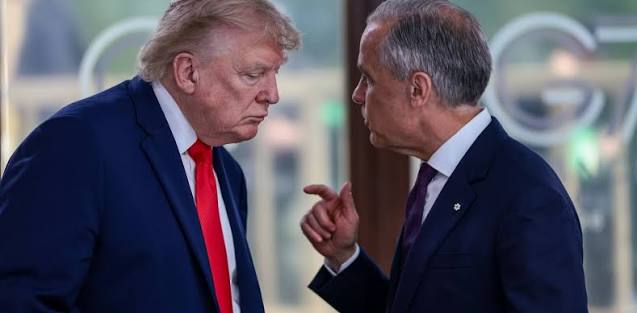
Donald Trump’s 1987 book The Art of the Deal is often cited as a blueprint for negotiation. But its actual practice, as seen in trade deals, climate accords, and nuclear agreements, reveals a different pattern: agreements are not final, they are starting points for further demands. For Canada, facing a 25% tariff threat and a looming USMCA review, the lesson is clear: capitulation will not buy stability; it will invite the next demand.
The Myth of the ‘Deal’ in Trump’s Playbook
Trump’s book famously claims that “the best deal is one where both sides walk away happy.” Yet his real-world negotiating record tells a different story. Treaties and contracts under his signature have been treated as provisional, subject to re-opening whenever he sees an advantage.
Consider the Paris Climate Accord. Trump withdrew the U.S. in 2017, re-entered under Biden, and then withdrew again in 2025. The Iran Nuclear Deal, a multilateral agreement with U.S. signature, was unilaterally abandoned in 2018. Even the Taliban Agreement of 2020 was later modified and disavowed in parts. The pattern is consistent: agreements are not sacred;
they are tools to be used as leverage.
NAFTA to USMCA: The Same Old Story
The North American Free Trade Agreement, in place since 1994, was a cornerstone of continental trade. Trump renegotiated it under threat of withdrawal, producing the USMCA in 2020. But no sooner was it signed than he began criticizing it, and during the 2024 campaign he threatened to re-open it. The mandated joint review in July 2026 is now a looming deadline that Trump is already using to extract concessions.
This is not an anomaly. Trump’s approach to the trade ceasefire with China followed the same arc: “Phase One” deal signed, then allowed to lapse as tariffs escalated. The Hanoi summit with North Korea ended with Trump walking away, declaring “no deal better than a bad deal.” For Trump, a deal is not a conclusion; it is a lull in an ongoing negotiation.
Why Canada’s Capitulation Would Backfire
Canada shares the world’s largest bilateral trade relationship with the U.S., approximately $1.3 trillion CAD annually. About 75% of Canadian exports go south of the border. This dependency is precisely why Trump’s pressure tactics bite, but it is also why capitulation would be a mistake.
If Canada yields to Trump’s current demands whether on dairy, defense spending, or border enforcement it would set a precedent. Trump would interpret it as evidence that pressure works, and he would return with new demands. The USMCA was supposed to end the trade disputes; instead, Trump immediately threatened to re-open it. Concessions do not buy stability with a negotiator who sees every agreement as a stepping stone.
Canada has leverage, too. The U.S. relies on Canadian energy, critical minerals, lumber, aluminum, and potash. Canada is the top export destination for 36 U.S. states. Retaliatory tariffs on U.S. goods—from bourbon to motorcycles—have already been deployed. The political cost of harming American consumers and workers is a real constraint on Trump’s escalation.
The Historical Precedent: Quiet Concessions Haven’t Worked
Canada has a history of making quiet concessions to avoid escalation, particularly in softwood lumber disputes. But this approach has not produced lasting stability; it has merely postponed the next confrontation. Trump’s transactional view of alliances treats security guarantees and trade preferences as “paying for protection.” Canada’s willingness to accommodate could be seen as validation of that worldview.
Public opinion in Canada strongly opposes capitulation. The idea of Canada becoming a “51st state,” floated by Trump, is widely rejected. Capitulation would undermine Canadian sovereignty and set a dangerous precedent for other U.S. allies.
A Firm Stance Is the Only Viable Path
The evidence is clear: Trump’s “art of the deal” means treating agreements as temporary. Canada cannot capitulate because concessions will not bring stability. Instead, Canada must hold firm, use its own leverage, and prepare for the 2026 USMCA review as a negotiation, not a surrender. The rules-based order that Canada has relied on may be frayed, but abandoning it would be worse.
Trump’s negotiation philosophy treats deals as perpetual, not final. Canada’s best response is to recognize this pattern and refuse to capitulate. Standing firm, using leverage, and preparing for the 2026 review is the only way to protect Canadian interests and avoid a cycle of endless concessions.
Summary
- Trump’s negotiation record shows a pattern of reneging on agreements, from the Paris Accord to the Iran Deal to USMCA.
- Concessions do not buy stability with Trump; they invite further demands.
- Canada’s leverage—energy, minerals, and political cost—makes a firm stance viable.
- The 2026 USMCA review is a looming deadline; Canada must approach it as a negotiation, not a surrender.
FAQ
Q: Has Trump actually reneged on trade deals?
A: Yes, he renegotiated NAFTA, then threatened to re-open the replacement USMCA. He also let the Phase One trade deal with China lapse.
Q: Why would capitulation be counterproductive?
A: Because Trump treats agreements as starting points, not final. Concessions would signal weakness and invite further demands.
Q: What leverage does Canada have?
A: Canada supplies the U.S. with energy, critical minerals, lumber, and other goods. Retaliatory tariffs on U.S. products can also be escalated.
Q: What is the 2026 USMCA review?
A: It is a mandated joint review of the trade agreement, which Trump may use to extract concessions from Canada.