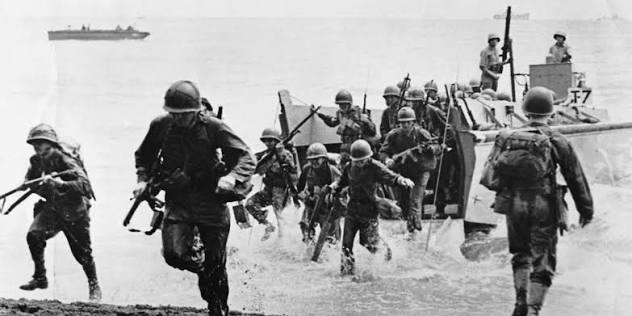
On August 7, 1942, a force of nearly 19,000 U.S. Marines stormed the beaches of Guadalcanal, a small, jungle-covered island in the Solomon Islands. They expected a quick seizure of a half-built airfield. Instead, they ignited a six-month furnace of jungle warfare, naval clashes, and aerial duels that would become the turning point of the Pacific War.
This was not a single battle but a relentless campaign of attrition, fought across land, sea, and air. By the time the Japanese evacuated in February 1943, the Allies had inflicted the first major defeat on the Empire of Japan, shifting the momentum of the war. The fight for Guadalcanal proved that the Allies could not only hold their own but also push back against an enemy that had seemed unstoppable since Pearl Harbor.
The Strategic Gamble: Why Guadalcanal Mattered
In mid-1942, Japan’s empire stretched from the Indian Ocean to the central Pacific. After the stunning loss of four fleet carriers at Midway in June, Japan still held the initiative in the South Pacific. Their plan was to build an airfield on Guadalcanal, extending their defensive perimeter and threatening the vital supply lines between the United States and Australia. From this base, they could launch further offensives toward Fiji, Samoa, and New Caledonia.
American intelligence, aided by Australian coastwatchers hidden behind Japanese lines, detected the airfield’s construction. The Allies decided to strike first, launching Operation Watchtower with remarkable speed. The 1st Marine Division, many of whom had never seen combat, landed on August 7, 1942. They caught the Japanese construction crews and their guards off guard, capturing the nearly complete airfield within two days. They renamed it Henderson Field, in honor of a Marine aviator killed at Midway.
The Jungle War: Land Battles and the Fight for Henderson Field
The Marines dug in, but the Japanese were not about to surrender the island quietly. Over the next months, they launched repeated attempts to retake the airfield. One of the most desperate came in September 1942, when Japanese forces attacked along a grassy ridge south of the airfield. The Marines, outnumbered and low on ammunition, held their line through the night, repelling wave after wave of charges. The ridge became known as Edson’s Ridge, after the Marine colonel who led the defense. The Japanese lost over 1,000 men in that single assault.
Supply was a constant problem. The Marines had landed with only a fraction of their equipment, and Japanese naval forces controlled the waters around the island at night. They survived on captured Japanese rice and whatever could be brought in by ship or air. Despite these hardships, they held the airfield, which became the linchpin of the entire campaign.
The Ironbottom Sound: Naval Battles and the Tokyo Express
The sea around Guadalcanal became a graveyard of ships, earning the name Ironbottom Sound. The first major naval engagement, the Battle of Savo Island in August 1942, was a disaster for the Allies. A Japanese cruiser force surprised and sank four Allied cruisers in a matter of minutes. The Japanese suffered minimal losses, and the Allies were forced to withdraw their carriers and transports, leaving the Marines on the island isolated.
The Japanese, however, could not sustain their naval dominance. They resorted to nightly destroyer runs, dubbed the “Tokyo Express,” to deliver troops and supplies. But these ships could not carry heavy equipment or enough food, and the Japanese soldiers on the island began to starve. The Allies, meanwhile, used radar and codebreaking to gain an edge in night battles. The Naval Battle of Guadalcanal in November 1942 was a turning point, as the U.S. Navy turned back a Japanese bombardment force and sank two battleships, securing control of the sea.
The Cactus Air Force: Command of the Skies
From Henderson Field, a motley collection of Marine, Navy, and Army aircraft, known as the Cactus Air Force, flew daily sorties against Japanese bombers and supply convoys. They were often outnumbered and flying worn-out planes, but they inflicted heavy losses on the Japanese. In one notable action, they sank a Japanese transport carrying troops and supplies, forcing the Japanese to resort to even more desperate measures.
Air superiority was crucial. It allowed the Allies to reinforce and resupply their troops, while denying the Japanese the same. By late 1942, the Japanese had lost so many aircraft and pilots that they could no longer challenge the Allies in the air.
Attrition and Starvation: The Japanese Collapse
The Japanese command made a fatal decision: instead of evacuating Guadalcanal when it became clear that they could not win, they continued to pour in reinforcements. This only increased the death toll. Japanese soldiers, cut off from supplies, died by the thousands from starvation and disease. Many resorted to desperate banzai charges, but they could not break the Allied lines.
In January 1943, the Allies launched a final offensive, pushing the remaining Japanese forces to the northern coast. The Japanese, realizing the futility of further resistance, began a secret evacuation under the cover of darkness, Operation KE. Over several nights in early February, they managed to withdraw about 12,000 troops, leaving the island for good.
The Turning Point: What Guadalcanal Meant
The victory at Guadalcanal was not just a military achievement; it was a psychological breakthrough. For the first time, the Allies had decisively defeated the Japanese on land, sea, and air. The Japanese had been stopped, and the long road to Tokyo had begun.
Casualties were heavy on both sides. The Allies lost over 7,000 dead and nearly 8,000 wounded, along with 24 ships. The Japanese lost over 19,000 dead on the island alone, with thousands more in the surrounding waters, and 38 ships. But the strategic gain was incalculable. The Allies had secured the sea lanes to Australia and established a forward base for future operations.
Guadalcanal also proved that the U.S. military could adapt and overcome. The lessons learned in night fighting, amphibious assault, and logistics would be applied in the subsequent island-hopping campaign across the Pacific. For the Japanese, it was a bitter lesson in the cost of overreach.
Conclusion
The Battle of Guadalcanal was a brutal, grinding struggle that tested the endurance of both sides. It was won not by a single brilliant maneuver, but by the stubborn determination of Marines, sailors, and airmen who refused to lose. The island’s jungles and waters bore witness to the deadliest fighting of the Pacific War, but they also marked the moment when the tide turned. From Guadalcanal onward, the Allies would not look back.
The Battle of Guadalcanal was a brutal, grinding struggle that tested the endurance of both sides. It was won not by a single brilliant maneuver, but by the stubborn determination of Marines, sailors, and airmen who refused to lose. The island’s jungles and waters bore witness to the deadliest fighting of the Pacific War, but they also marked the moment when the tide turned. From Guadalcanal onward, the Allies would not look back.
Summary
- First Major Allied Offensive: The campaign, from August 7, 1942, to February 9, 1943, was the first major Allied counteroffensive against Japan in the Pacific.
- Strategic Importance: The fight centered on Henderson Field, which the Allies captured and held, securing supply lines to Australia and halting Japanese expansion.
- Brutal Attrition: The campaign involved intense land battles (Edson’s Ridge, Matanikau), naval clashes (Savo Island, Naval Battle of Guadalcanal), and daily aerial duels, with heavy casualties on both sides.
- Japanese Defeat: Japan lost over 19,000 troops on the island, many to starvation and disease, and was forced to evacuate in February 1943, marking their first major retreat of the war.
- Turning Point: The Allied victory shifted the strategic momentum in the Pacific, paving the way for the island-hopping campaign that led to Japan’s eventual defeat.
FAQ
Q: Why was Guadalcanal so important?
A: Guadalcanal was vital because it housed a Japanese airfield that threatened Allied supply lines to Australia. Capturing it allowed the Allies to protect those lines and launch their own offensive operations in the Pacific.
Q: What was the Tokyo Express?
A: The Tokyo Express was the nickname for Japanese naval forces, primarily destroyers, that made nightly runs to deliver troops and supplies to Guadalcanal. They were effective but could not carry heavy equipment or enough food, leading to severe shortages for Japanese troops.
Q: What were the casualties at Guadalcanal?
A: Allied forces suffered approximately 7,100 dead and 7,900 wounded, along with 24 ships sunk. Japanese losses were much higher, with around 19,200 dead on the island and about 31,000 total including naval and air losses, and 38 ships sunk.
Q: Who were the key leaders on each side?
A: On the Allied side, key figures included Admiral Chester Nimitz, General Alexander Vandegrift (1st Marine Division), and Admiral William Halsey. On the Japanese side, Admiral Isoroku Yamamoto, General Harukichi Hyakutake, and Vice Admiral Nobutake Kondo led their forces.
Q: What was the outcome of the Guadalcanal Campaign?
A: The Allies won a decisive strategic victory. Japan evacuated the island in February 1943, marking their first major retreat of the war. The campaign demonstrated that Japan could be defeated and set the stage for the Allied island-hopping strategy.