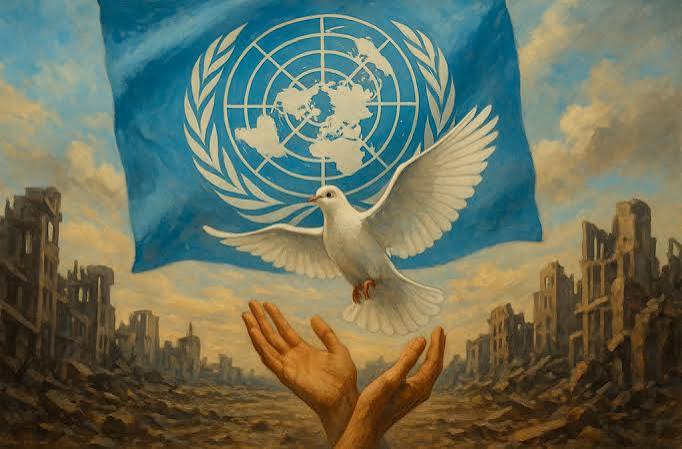
Tag: United Nations

  • The Birth of the United Nations: A Hope for Global Peace

    The Birth of the United Nations: A Hope for Global Peace

    On June 26, 1945, in the San Francisco Opera House, delegates from 50 nations put pen to paper and signed the United Nations Charter. The world was still smoldering from the ashes of World War II a conflict that had killed an estimated 60 to 80 million people and ended with the blinding flash of atomic bombs over Hiroshima and Nagasaki. The charter was not just a document; it was a promise, born from the wreckage of a failed League of Nations, that humanity would find a better way to settle its disputes.

    The road to that signing was long and winding, shaped by wartime alliances and the dogged vision of leaders who had witnessed two catastrophic global wars. This article traces that journey from the Atlantic Charter to the San Francisco Conference and examines how the United Nations came to embody both the hopes and the contradictions of a post-war world order.

    The League’s Ghost

    Before the United Nations, there was the League of Nations a grand experiment that began with high ideals after World War I but collapsed under the weight of its own weaknesses. It had no enforcement mechanism, no standing army, and the United States, its most powerful potential backer, never joined. When Japan invaded Manchuria in 1931, the League could only issue condemnations. When Italy marched into Ethiopia in 1935, its sanctions were toothless. When Hitler remilitarized the Rhineland in 1936, the League stood by, paralyzed.

    The lesson was clear: a peacekeeping body without teeth was a paper tiger. As World War II erupted in 1939, it became brutally apparent that the next attempt at global governance would need to be stronger and more inclusive.

    Wartime Blueprints

    The planning for a new world order began even as the bombs fell. In August 1941, President Franklin D. Roosevelt and British Prime Minister Winston Churchill met aboard a warship in the North Atlantic and issued the Atlantic Charter a joint declaration that outlined goals for a post-war world, including disarmament of aggressors and a “permanent system of general security.”

    By January 1942, 26 Allied nations signed the Declaration by United Nations, pledging to fight the Axis powers and affirming the Atlantic Charter’s principles. It was in that declaration that Roosevelt first coined the term “United Nations” a phrase that would come to define a global institution.

    The blueprint took shape at the Dumbarton Oaks Conference in Washington, D.C., in the autumn of 1944. Representatives from the U.S., the UK, the USSR, and China drafted proposals for the new organization’s structure, including a Security Council with five permanent members each holding veto power. Then, in February 1945, at the Yalta Conference, Roosevelt, Churchill, and Stalin finalized the voting procedures and set a date for a formal conference in San Francisco.

    San Francisco: The World Gathers

    When delegates assembled in San Francisco on April 25, 1945, the world had changed. Roosevelt had died just two weeks earlier, and Germany’s surrender was only days away. The conference carried an air of urgency a sense that the world was holding its breath.

    Fifty nations sent 850 delegates, and more than 2,500 journalists covered every twist and turn. The smaller nations particularly those from Latin America and the Middle East pushed back against the dominance of the Big Five. They demanded stronger human rights language and a greater role for the General Assembly. Their insistence led to the inclusion of the Trusteeship Council and a more robust commitment to decolonization.

    After two months of intense negotiation, the Charter was unanimously adopted on June 25, 1945. The next day, delegates signed it in the Herbst Theatre, the same venue where the conference had opened. Poland, absent at the signing, would add its name on October 15, bringing the original membership to 51.

    A Charter of Contradictions

    The United Nations Charter, drafted by South African statesman Jan Smuts, opens with the stirring words: “We the peoples of the United Nations determined to save succeeding generations from the scourge of war.” Article 1 lays out the organization’s core purposes: to maintain international peace and security, develop friendly relations among nations, achieve international cooperation in solving economic, social, cultural, and humanitarian problems, and to be a center for harmonizing the actions of nations.

    But the Charter also enshrined a fundamental tension. The Security Council’s five permanent members — the U.S., the UK, the USSR, France, and China — each hold veto power, a provision that gave the great powers a privileged position. Smaller nations, who had hoped for a more democratic structure, had to settle for a General Assembly where every nation had one vote, but where resolutions carried no binding force.

    The First Steps

    The Charter entered into force on October 24, 1945, after the five permanent members and a majority of other signatories ratified it. That date is now celebrated as United Nations Day.

    The first General Assembly opened on January 10, 1946, at Central Hall, Westminster, in London. Fifty-one member states were represented. The Security Council held its first meeting a week later, on January 17. The UN initially operated from temporary quarters — first in London, then at the Sperry Gyroscope plant in Lake Success, New York — until its permanent headquarters on the East River in Manhattan was completed in 1952.

    The League of Nations, meanwhile, formally dissolved itself on April 18, 1946, at its final session in Geneva, transferring its assets and functions to its successor. The old order was gone. The new one had begun.

    A Hope, Not a Guarantee

    The United Nations was born with a heavy burden: to prevent another world war. Its first decades were marked by the Cold War, colonial wars, and regional conflicts — but the UN has also facilitated peacekeeping missions, brokered ceasefires, and provided humanitarian relief to millions. The Charter’s promise of collective security has never been fully realized, but the organization has evolved, expanding to 193 member states and taking on issues its founders never imagined, from climate change to global health.

    The birth of the UN was a hope — a fragile and imperfect one, but a hope nonetheless. As the world continues to grapple with conflict and division, that founding vision remains a touchstone, a reminder that even in the darkest hours, nations can come together to build something better.

    The United Nations was not a clean slate; it was a response to catastrophe, built on the lessons of a failed League and the ashes of war. Its creation in 1945 represented a collective leap of faith — that diplomacy could outpace destruction, and that the nations of the world could cooperate to secure peace. That hope endures, even as the organization continues to face the hard realities of a fractured world.

    Summary

    • The UN Charter was signed on June 26, 1945, by 50 nations at the San Francisco Conference; Poland later signed, making 51 original members.
    • The Charter came into force on October 24, 1945, after ratification by the five permanent Security Council members and a majority of signatories.
    • The UN replaced the League of Nations, which failed to prevent World War II due to lack of enforcement and U.S. absence.
    • Key wartime milestones: Atlantic Charter (1941), Declaration by United Nations (1942), Moscow Conference (1943), Dumbarton Oaks (1944), Yalta (1945).
    • The San Francisco Conference (April–June 1945) involved 850 delegates from 50 nations, with smaller nations pushing for human rights and decolonization.

    FAQ

    Q: When was the United Nations founded?
    A: The UN was founded on October 24, 1945, when the Charter came into force after ratification by the five permanent members and a majority of other signatories.

    Q: What was the League of Nations, and why did it fail?
    A: The League was a post-World War I organization created to maintain peace. It failed because it lacked enforcement power, had no standing military, and the U.S. never joined, making it unable to prevent Japanese, Italian, and German aggression in the 1930s.

    Q: Who coined the term “United Nations”?
    A: U.S. President Franklin D. Roosevelt coined the term in the Declaration by United Nations on January 1, 1942.

    Q: What is the role of the Security Council?
    A: The Security Council is responsible for maintaining international peace and security. It has five permanent members (U.S., UK, USSR/Russia, France, China) with veto power, plus ten rotating non-permanent members.

    Q: Where was the UN’s first meeting held?
    A: The first General Assembly opened on January 10, 1946, at Central Hall, Westminster, London. The UN later moved to temporary quarters in Lake Success, New York, before its permanent headquarters was completed in 1952.
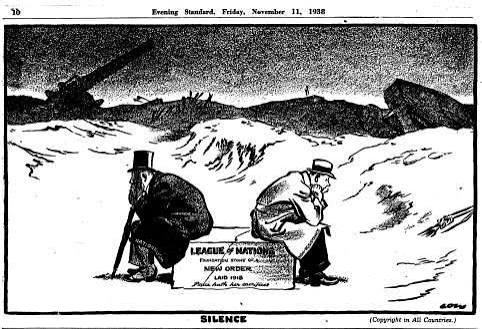
  • The League of Nations: A Promise Broken by Its Own Members

    The League of Nations: A Promise Broken by Its Own Members

    On a crisp January morning in 1920, delegates from 42 nations gathered in Geneva, Switzerland, to inaugurate the world’s first permanent peacekeeping body. The League of Nations was born out of the ashes of World War I, a war that had killed over 16 million people and left Europe in ruins. Its founding covenant, embedded in the Treaty of Versailles, was a bold promise: never again would the world descend into such catastrophic conflict. The League would resolve disputes, disarm aggressors, and protect the weak.

    But within two decades, that promise lay in tatters. The League failed to stop Japanese aggression in Manchuria, Italian conquest of Ethiopia, and German remilitarization of the Rhineland. By 1939, it was a powerless bystander to the outbreak of World War II. The story of the League is not just a chronicle of institutional weakness; it is a cautionary tale about the limits of international cooperation when great powers refuse to lead.

    Birth of an Ideal

    The League’s intellectual roots stretched back to philosopher Immanuel Kant’s 1795 essay Perpetual Peace and the Concert of Europe that followed Napoleon’s defeat. But it was World War I that turned these ideas into a political reality. As the war dragged on, President Woodrow Wilson championed the cause, and in January 1918, his Fourteen Points called for a ‘general association of nations’ to guarantee political independence and territorial integrity. The British League of Nations Union and South African statesman Jan Smuts added their weight, and by the Paris Peace Conference in 1919, the Covenant was drafted in weeks.

    The structure was ambitious. The Assembly gave every member an equal vote. The Council had permanent seats for Britain, France, Italy, and Japan, plus rotating non-permanent members. The Secretariat, led by Sir Eric Drummond, provided day-to-day administration. The Permanent Court of International Justice opened in The Hague in 1922. The International Labour Organization, a semi-autonomous agency, aimed to improve working conditions globally.

    Yet the Covenant’s heart was collective security, outlined in Articles 10–16. Members pledged to respect each other’s territorial integrity and to respond to aggression with economic sanctions or military force. It was a revolutionary concept: aggression against one would be met by all.

    The Fatal Absence

    From the start, the League was crippled by the absence of its most powerful champion. The U.S. Senate, led by Henry Cabot Lodge, refused to ratify the Treaty of Versailles in 1919 and 1920. Lodge and his allies feared that Article X would drag America into foreign wars without congressional approval. President Wilson campaigned futilely for ratification, but the Senate voted no. The United States never joined.

    Without American participation, the League lacked military and economic heft. Britain and France, war-weary and financially strained, were reluctant to enforce sanctions against major powers. The League’s only real strength was moral suasion, and that proved insufficient against determined aggressors.

    Successes That Foreshadowed the UN

    Despite its eventual collapse, the League did achieve tangible successes, especially in the 1920s. It resolved the Åland Islands dispute between Finland and Sweden in 1921, peacefully settling a territorial conflict. In 1926, it mediated the Mosul question between Turkey and Iraq, and in 1934, it handled the Leticia dispute between Colombia and Peru.

    The League also pioneered humanitarian work. Fridtjof Nansen, a Norwegian explorer and diplomat, devised a passport system for stateless refugees in 1922, helping hundreds of thousands of displaced people. The League’s Health Organization fought epidemics like typhus and malaria, laying groundwork for the World Health Organization. It addressed drug trafficking, white slavery, and child labor, and it oversaw a mandates system to administer former German and Ottoman territories—though critics later dismissed this as colonialism in disguise.

    These successes, however, were local and administrative. They did not touch the core issue of great-power aggression.

    Cracks in the Edifice

    The 1930s brought the Great Depression, which fueled nationalism and militarism. The League’s first major test came in 1931, when Japan invaded Manchuria. China appealed to the League, which dispatched the Lytton Commission. The commission condemned Japan’s aggression, but no sanctions followed. Japan simply withdrew from the League in 1933. The message was clear: the League would not act against a major power.

    The second blow came in 1935, when Italy invaded Ethiopia. The League imposed partial sanctions, but oil was excluded—a fatal omission. Meanwhile, British and French foreign ministers secretly negotiated the Hoare-Laval Pact, which would have given Italy two-thirds of Ethiopia. The plan leaked, causing outrage, but the damage was done. Ethiopia was annexed, and the League’s credibility collapsed.

    Germany, now under Hitler, remilitarized the Rhineland in 1936, violating the Treaty of Versailles. The League took no action. The Spanish Civil War from 1936 to 1939 saw the Non-Intervention Committee fail to stop foreign intervention. When Germany annexed Austria in 1938 and the Sudetenland later that year, the League was bypassed entirely. By the time Germany invaded Poland in 1939, the League was effectively defunct.

    The Final Curtain

    The League held its last assembly on April 18, 1946, and formally dissolved the next day. Its assets and functions were transferred to the United Nations, founded in October 1945. The League’s legacy is ambiguous. It failed at its primary mission, yet it established the model for the UN and other international bodies. Its successes in health, labor, and refugee work were seeds that grew into specialized agencies.

    But the League’s failure offers a stark lesson: international institutions are only as strong as their member states’ willingness to act. The absence of the United States, the hesitancy of Britain and France, and the rise of totalitarian regimes combined to doom the experiment. As the UN faces its own challenges, the League’s story remains a warning that peace is not guaranteed by treaties alone—it requires constant vigilance and commitment.

    The League of Nations was not a failure of ideals but a failure of execution. It was a promise made by the world’s leaders to prevent another war, and it was broken not by its institutions but by the nations that created it. Its memory serves as a reminder that peace is a fragile achievement, requiring the active participation of the powerful. The League’s ghost still haunts Geneva, urging us to learn from its mistakes.

    Summary

    • The League of Nations was founded on January 10, 1920, as part of the Treaty of Versailles, with 42 original members.
    • It had both successes (e.g., Åland Islands, refugee work) and failures (Manchuria, Ethiopia).
    • The failure of the U.S. to join is considered a fatal flaw, weakening the League’s power.
    • The League dissolved on April 18-19, 1946, and its assets were transferred to the United Nations.
    • Its legacy includes establishing the model for the UN and specialized agencies like the ILO and WHO.

    FAQ

    Q: Why did the League of Nations fail?
    A: The League failed due to a combination of factors: the absence of the United States, the reluctance of Britain and France to enforce sanctions, the rise of aggressive totalitarian regimes, and the League’s lack of military enforcement power.

    Q: What were the League’s main successes?
    A: The League successfully resolved several territorial disputes, including the Åland Islands and Mosul. It also pioneered refugee assistance, health programs, and labor standards, which later influenced the UN.

    Q: How did the United States’ failure to join affect the League?
    A: The U.S. refusal to join deprived the League of its most powerful member, reducing its credibility and military and economic influence, making it harder to enforce collective security.

    Q: What happened at the last assembly of the League?
    A: The League’s last assembly was held on April 18, 1946, where it formally dissolved itself, and its functions and assets were transferred to the newly created United Nations.

    Q: What is the League’s legacy today?
    A: The League’s legacy is twofold: it is a cautionary tale of international failure, but it also established the framework for the UN and specialized agencies like the ILO and WHO, and its humanitarian work continues to inspire.