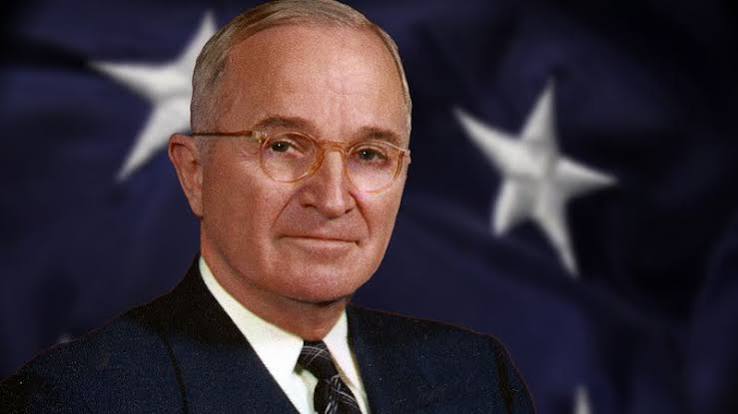
On April 12, 1945, Harry S. Truman had been Vice President for just 82 days when Franklin D. Roosevelt died. He was thrust into the presidency at the most critical moment in modern history: World War II was still raging, the atomic bomb was a secret he knew nothing about, and the global order was about to be reshaped. Truman, a plain-spoken farmer and haberdasher from Missouri with no college degree, became the man who would make decisions that defined the second half of the 20th century.
His presidency was a whirlwind of monumental choices: dropping the atomic bomb, rebuilding Europe, containing communism, desegregating the military, and fighting a war in Korea. He was deeply controversial in his time, with approval ratings that plunged to 22%, and yet historians consistently rank him among the top ten presidents. How did this ‘accidental president’ become a defining figure of the Cold War era? The answer lies in his character a man who accepted responsibility, made tough calls, and famously kept a sign on his desk that read: ‘The Buck Stops Here.’
The Making of a President: From Farm to Senate
Harry S. Truman was born on May 8, 1884, in Lamar, Missouri. The ‘S’ in his name was a compromise between his grandfathers, Anderson Shipp Truman and Solomon Young it didn’t stand for a middle name, a quirk that reflected his humble, pragmatic upbringing. He grew up on a farm, never attended college (the only 20th-century president without a degree), and worked as a bank clerk, farmer, and then a haberdasher. His clothing store went bankrupt, leaving him with debts he spent years repaying. This experience of failure and personal responsibility shaped his later worldview.
His political career began in local administration as a county judge in Jackson County, where he was known for honest, efficient governance. He moved to the U.S. Senate in 1935, but it was the Truman Committee that brought him national fame. During World War II, he chaired this committee that investigated waste and corruption in defense spending, saving an estimated $15 billion and earning a reputation for no-nonsense integrity. That reputation made him an attractive running mate for FDR in 1944, chosen to balance the ticket and replace the controversial Henry Wallace. Truman was kept in the dark about the Manhattan Project he only learned of the atomic bomb after becoming president.
When Roosevelt died, Truman was stunned. His first words to reporters were: ‘I felt like the moon, the stars, and all the planets had fallen on me.’ Yet within months, he would make some of the most consequential decisions in human history.
The Atomic Bomb: A Decision That Ended a War and Haunted History
In August 1945, Truman authorized the use of atomic bombs on Hiroshima and Nagasaki. Japan surrendered shortly after. The decision remains the most debated of his presidency. Truman and his contemporaries argued that the bomb saved hundreds of thousands of American and Japanese lives by avoiding an invasion of Japan. The projected casualties for an invasion were staggering estimates ran into the millions. Truman saw the bomb as a military weapon to end a brutal war, and he never expressed public regret.
Later critics have questioned whether Japan was already near surrender, whether the bomb was partly intended to intimidate the Soviet Union, and whether targeting civilians was morally defensible. Historians remain divided. What is clear is that Truman faced an impossible choice and made a decisive one. As he later wrote: ‘I knew what I was doing when I stopped the war that would have killed half a million boys on both sides.’ The bombings killed an estimated 200,000 people, mostly civilians, but the war ended within days. Truman’s decision set a precedent for nuclear deterrence that defined the Cold War.
Architect of the Cold War: Containment, Marshall Plan, and NATO
Truman’s response to Soviet expansionism was swift and assertive. In 1947, he announced the Truman Doctrine, pledging to support free peoples resisting communist subjugation initially in Greece and Turkey, but it became the foundation of U.S. containment policy. That same year, Secretary of State George Marshall proposed the European Recovery Program, better known as the Marshall Plan, which poured over $13 billion into rebuilding Western Europe. The plan was a stunning success: by 1952, European industrial output was 35% above pre-war levels, and the economic recovery helped stabilize democratic governments.
In 1948, the Soviet Union blockaded Berlin, cutting off all land routes to the western sectors of the city. Truman refused to abandon the city, launching the Berlin Airlift. For 15 months, American and British planes delivered food, fuel, and supplies averaging 8,000 tons per day until the blockade was lifted. This bold move demonstrated Truman’s resolve to stand up to Soviet pressure without resorting to war. In 1949, he signed the North Atlantic Treaty, creating NATO, the first peacetime military alliance in U.S. history. These actions collectively built the framework for winning the Cold War, though they also committed the U.S. to a global interventionist posture that would later escalate in Vietnam.
Civil Rights: A Reluctant Reformer Who Changed the Military
Truman’s record on civil rights is a study in contradiction. He grew up in segregated Missouri, and his early language reflected the racism of his era. Yet as president, he took landmark steps toward equality. In 1946, he appointed a commission on civil rights, which issued a report that called for ending segregation and lynching. In 1948, he issued Executive Order 9981, desegregating the armed forces a move that overrode military leadership and set a precedent for federal action on civil rights. He also ordered fair employment practices in the federal government and proposed anti-lynching, anti-poll tax, and fair employment legislation, though Congress blocked most of it.
The military desegregation was transformative. It integrated 1.2 million Black soldiers and sailors into units with whites, a precursor to the broader civil rights movement of the 1950s and 1960s. Truman’s motives were both moral and political—he needed Black voters to win the 1948 election, and he saw the contradiction in fighting a war against tyranny while maintaining segregation at home. His actions were progressive for the time, but they were also cautious and limited. He never supported a comprehensive civil rights bill, and his administration did little to dismantle segregation in the South. Nevertheless, his executive orders were a turning point, and they helped pave the way for later legislation.
The 1948 Upset: Defying the Polls and the Press
Truman’s 1948 reelection campaign was a masterclass in political grit. Virtually every poll predicted a loss to Republican Thomas Dewey. The Chicago Tribune even printed an early edition with the headline ‘DEWEY DEFEATS TRUMAN’ before the results were final. Truman, undeterred, mounted a ‘whistle-stop’ campaign, traveling over 31,000 miles by train, giving hundreds of speeches from the back platform. He attacked the ‘do-nothing’ Republican Congress, which had passed the Taft-Hartley Act over his veto—a law that restricted union power and which Truman saw as a betrayal of working people. He won with 303 electoral votes to Dewey’s 189, a stunning upset that proved his connection with ordinary Americans.
His victory was also a triumph for the New Deal coalition. He ran on the ‘Fair Deal,’ an extension of FDR’s legacy that included national health insurance, federal aid to education, and expanded Social Security. While much of the Fair Deal was blocked by Congress, Truman did secure increases in the minimum wage, expanded Social Security coverage, and a housing program. His domestic legacy was a mixed bag, but it kept the liberal flame alive during a conservative era.
The Korean War and the ‘Truman Doctrine’ in Action
When North Korea invaded South Korea in June 1950, Truman moved quickly, calling for UN intervention. He did so without prior Congressional approval, setting a precedent for presidential war powers. The UN forces, led by General Douglas MacArthur, initially repelled the invasion and pushed into North Korea. But when China intervened in November 1950, the war turned into a bloody stalemate. MacArthur wanted to expand the war into China, possibly using nuclear weapons. Truman, fearing a wider conflict, fired him in April 1951. The decision was deeply unpopular but upheld the principle of civilian control over the military. The war dragged on until an armistice in 1953, after Truman left office, leaving the Korean Peninsula divided—a conflict that remains unresolved today.
The Korean War was a turning point. It solidified the U.S. role as a global police officer and led to a massive military buildup, but it also exposed the limits of containment. The war cost over 36,000 American lives and billions of dollars, and Truman’s approval ratings plummeted to 22%. Yet his decision to fire MacArthur was widely supported by legal scholars and later historians, who saw it as a defense of democratic governance. The war also shaped U.S. policy in Asia for decades, including the Vietnam War, which Truman’s successor Eisenhower initiated.
The Steel Seizure and the Limits of Presidential Power
Truman’s domestic policies were often met with fierce resistance. In 1952, facing a steel strike that threatened the Korean War effort, he seized the steel mills to keep them operating. The Supreme Court ruled this unconstitutional in Youngstown Sheet & Tube v. Sawyer, a landmark case that limited presidential powers. Truman accepted the ruling, though he grumbled that the steel companies were ‘bigger than the government.’ This episode highlighted his willingness to push the boundaries of executive authority, but also his respect for the rule of law. It remains a key case in constitutional law, illustrating the checks and balances that define American governance.
The Legacy: ‘The Buck Stops Here’
Truman left office in 1953, unpopular but undeterred. He retired to Independence, Missouri, where he wrote his memoirs and established the Truman Presidential Library—the first under the 1955 Presidential Libraries Act. He lived to see the civil rights movement and the Vietnam War, and he defended his decisions until his death in 1972 at age 88. In retrospect, historians have reevaluated him as a ‘near-great’ president, ranking him in the top tier. His blunt, decisive style and his willingness to accept responsibility—embodied by his famous motto ‘The Buck Stops Here’—have become symbolic of presidential leadership.
Truman’s presidency was a crucible of the 20th century. He made the atomic bomb decision, built the Cold War institutions, desegregated the military, and fired a general. He was often criticized as being impulsive or crude, but his actions were grounded in a simple, stubborn American pragmatism. As he once said: ‘I am not a leader. I am a moderate man, trying to do the right thing.’ That attempt, in the face of unprecedented challenges, is what defines his legacy.
Harry S. Truman rose from a Missouri farm to the highest office at the most dangerous moment in history. He was an accidental president who became a decisive leader, shaping the postwar world through the atomic bomb, the Truman Doctrine, the Marshall Plan, NATO, and the desegregation of the military. His decisions were often controversial, but his willingness to bear the burden of responsibility—to let the buck stop with him—set a standard for presidential leadership. In a time of crisis, he provided the resolve that defined an era.
Summary
- Accidental president: Truman served only 82 days as VP before FDR’s death, inheriting the presidency during WWII.
- Atomic bomb decision: Authorized the bombings of Hiroshima and Nagasaki in 1945, ending the war but sparking enduring debate.
- Cold War architect: Created the Truman Doctrine, Marshall Plan, and NATO, establishing containment policy that won the Cold War.
- Civil rights steps: Desegregated the military with Executive Order 9981, a landmark move for racial equality.
- 1948 election upset: Defeated Thomas Dewey despite all polls, cementing his reputation as a fighter.
FAQ
Q: Why is Harry S. Truman’s middle initial ‘S’?
A: The ‘S’ doesn’t stand for a middle name. It was a compromise between his grandfathers, Anderson Shipp Truman and Solomon Young.
Q: What was the Truman Doctrine?
A: A 1947 policy pledging U.S. support to free peoples resisting communist subjugation, initially for Greece and Turkey, and later the foundation of containment.
Q: How did Truman desegregate the military?
A: He issued Executive Order 9981 in 1948, which mandated equality of treatment and opportunity in the armed forces, leading to full integration.
Q: Why did Truman fire General MacArthur?
A: MacArthur wanted to expand the Korean War into China, possibly using nuclear weapons. Truman fired him to maintain civilian control over the military and avoid a wider conflict.
Q: What was the ‘Fair Deal’?
A: Truman’s domestic agenda, extending the New Deal with proposals for national health insurance, federal aid to education, and expanded social security. Much was blocked by Congress, but some parts passed.