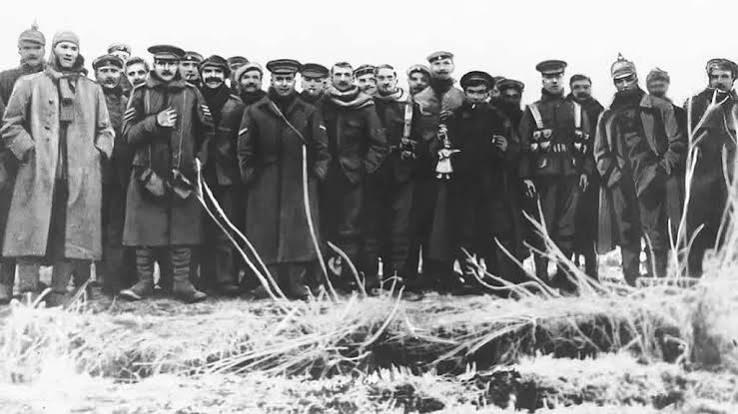
On Christmas Eve 1914, along a 500-mile stretch of mud-soaked trenches in Belgium and France, something extraordinary happened. Soldiers who had been trying to kill each other for months began singing carols, exchanging gifts, and even playing football. The Christmas Truce of 1914 remains one of the most remarkable moments of World War I—a spontaneous outbreak of humanity in the midst of industrial slaughter.
This is the story of how that truce came about, what it meant to the men who took part, and why it has never been forgotten, even as the war ground on for four more brutal years.
The Road to Christmas
By December 1914, the war had already proven itself a catastrophe. The swift offensive that leaders on both sides had promised was long gone. After the First Battle of Ypres in October and November, where British and German forces each suffered tens of thousands of casualties, the opposing armies had dug in. The trenches stretched from the North Sea to Switzerland, and in many places, the front lines were only 30 to 100 meters apart.
Life in those trenches was miserable. Soldiers endured freezing temperatures, relentless rain, and mud that could swallow a man. Rats scurried through dugouts, and frostbite was a constant threat. The constant fear of snipers and artillery took a psychological toll. Yet proximity also meant that soldiers on both sides could hear each other. They could hear the Christmas carols drifting across the wire.
The First Signs
On Christmas Eve, the weather began to clear, and the frost set in. Along parts of the British sector near Ypres, German soldiers began decorating their trenches with small Christmas trees, lit with candles. The glowing lights were a strange, beautiful sight in the desolate landscape. Then, the singing started.
German voices carried ‘Stille Nacht’ (Silent Night) across the lines. British troops responded with ‘The First Noel’ and other carols. The singing was not coordinated, but it created a fragile bridge. Men who had been shooting at each other hours earlier were now harmonizing across the mud.
Accounts from letters home describe the wonder of that night. One British soldier wrote that he heard the Germans singing and thought it was ‘the most beautiful thing I have ever heard.’ Another described the surreal experience of seeing his enemy emerge from the trenches, unarmed, under a white flag.
The Truce Spreads
The truce was not universal. It was strongest in the British sector, where roughly two-thirds of the line saw some form of ceasefire. French and Belgian units were far less likely to participate. For them, the Germans were occupiers of their homeland, and the resentment was too deep. But where it happened, it was powerful.
In the days around Christmas, soldiers from both sides met in No Man’s Land. They shook hands, exchanged cigarettes, food, buttons, and souvenirs. They helped each other bury their dead. In some places, they even set up makeshift barbershops. The dead were the most pressing concern—bodies had been rotting in No Man’s Land for weeks, and the truce allowed for proper burials, with joint services and prayers.
The most famous image of the truce is the football match. Contemporary letters and diaries mention kickabouts with improvised balls—bundles of straw, empty tins, or even a real football if one was available. No official match with a score was ever recorded. The accounts are fragmented and contradictory, but the spirit is clear: men desperate for a taste of normalcy, even for a few hours.
The Commanders’ Response
Senior officers on both sides were appalled. They saw fraternization as a direct threat to discipline and fighting spirit. They feared that if soldiers saw their enemies as human, they would refuse to fight at all. Orders were issued immediately after the truce, forbidding any further contact with the enemy. Units that had participated were rotated to different sectors to prevent familiarity from building.
Some soldiers were punished, though the penalties were generally light—reprimands or extra duties rather than courts-martial. The high commands did not want to acknowledge that their men had engaged in such behavior, so they tried to suppress the stories. But the soldiers themselves wrote home, and the news spread.
The Legacy
The Christmas Truce of 1914 has taken on a mythic quality. For many, it represents a moment when shared humanity triumphed over the insanity of war. For others, it is a reminder of what was lost—the war continued for four more years, killing millions, and the truce was never repeated on the same scale.
Historians debate its meaning. Some see it as a spontaneous, genuine expression of peace. Others point to more pragmatic motives: the need to bury the dead, the desire to repair trenches, the sheer exhaustion of both sides. And some argue that the truce was an exception that proves the rule—that the ‘live and let live’ system of tacit non-aggression in quiet sectors was common, but the Christmas truce was unique in its scale and visibility.
What is not in dispute is the number: around 100,000 soldiers participated in some form of informal ceasefire. That is a staggering figure, and it speaks to a deep, shared desire for a pause in the killing.
The truce also had a darker side. It raised hopes that the war might end soon, hopes that were cruelly dashed. When the fighting resumed, it was with renewed ferocity. The men who shook hands in No Man’s Land would go on to fight at the Somme, at Verdun, at Passchendaele. Many of them would die.
A Final Scene
One of the most poignant accounts from the truce comes from a Scottish soldier who, on Christmas Day, traded a plum pudding for a German helmet. The German soldier gave him his helmet and asked for a photograph. They posed together, arms around each other’s shoulders, grinning at the camera. The photograph was later published in a newspaper. The Scottish soldier was killed in action in 1916.
The Christmas Truce of 1914 was a brief, fragile moment of peace in a war that would last four more years and claim over 15 million lives. It did not stop the war, nor did it change its outcome. But it proved that even in the darkest of times, the human spirit can find a way to connect. And that is why, more than a century later, we still remember it.
The Christmas Truce of 1914 remains a powerful symbol of peace and humanity in the midst of war. It was not universal, it was not sanctioned, and it did not last. But for one brief moment, along a stretch of the Western Front, soldiers chose to stop fighting and celebrate Christmas together. Their story reminds us that even in the most brutal of circumstances, compassion can prevail—even if only for a day.
Summary
- The Christmas Truce of 1914 was an unofficial ceasefire along parts of the Western Front, involving about 100,000 soldiers.
- It was strongest in the British sector, with French and Belgian units participating less due to German occupation of their territories.
- Soldiers exchanged gifts, sang carols, buried their dead, and played informal football matches.
- Senior commanders opposed the truce and issued orders preventing its recurrence.
- The truce has been romanticized but was localized and did not stop the war, which continued for four more years.
FAQ
Q: Was the Christmas Truce universal?
A: No. It occurred along roughly two-thirds of the British-held sector of the Western Front, but was much rarer in French and Belgian sectors, where fighting continued.
Q: Did a football match really happen?
A: Yes, but not as an organized match with a score. Soldiers played informal kickabouts with improvised balls, as mentioned in contemporary letters and diaries.
Q: How did commanders react?
A: They were opposed and issued orders forbidding fraternization. Some soldiers were punished, but lightly, and units were rotated to prevent familiarity.
Q: Why did French and Belgian soldiers participate less?
A: Because German troops occupied their countries, making the war a matter of invasion and occupation, which created deep resentment against fraternization.
Q: Did the truce happen again in later years?
A: Not on the same scale. Sporadic fraternization continued into early 1915, but high command orders and increased hostility prevented a repeat on Christmas 1915 and beyond.