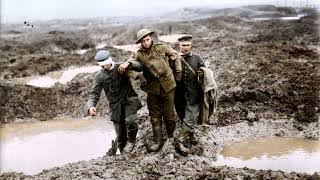
By 1917, the Western Front stretched 475 miles from the North Sea to the Swiss border, a scar across Europe that would hold for years. Within that line, soldiers carved out a world of mud, rats, and constant fear—a world that produced its own kind of horror, from trench foot to shell shock. This is the story of that world, told through the daily grind of the men who lived it.
A City Underground
The trench system was not a single ditch but a sprawling network. An estimated 35,000 miles of trenches crisscrossed the Western Front, with front-line, support, and reserve lines connected by zigzag communication trenches. The fire trench faced the enemy, its sandbagged parapet offering a slim shield against bullets. Behind it, support and reserve trenches sat 70 to 100 yards back, housing reinforcements and supplies. Dugouts—some shallow, some deep—provided shelter from shells and a place to sleep, though many were vulnerable to direct hits.
Soldiers lived in these cramped, damp spaces for days at a time. A typical rotation sent men to the front for four to six days, then back to support, then reserve, then rest areas behind the lines. But even in “rest,” there was little rest: fatigues, repairs, and drills filled the hours.
The Mud That Swallowed Men
Flanders’ clay-heavy soil turned to glue with the first rain. A single storm could leave trenches waist-deep in water, and the mud was more than an inconvenience—it was a killer. At Passchendaele in 1917, men and horses drowned in shell craters filled with liquid mud. Artillery shells that hit the muck often failed to explode, while soldiers struggled to move, their boots sucked down with each step.
Trench foot, a non-freezing cold injury, became epidemic. In the winter of 1914–15 alone, over 20,000 British soldiers were treated for it. The condition—swollen, numb, decaying tissue—often led to amputation. Soldiers tried to ward it off by drying their feet and changing socks, but in the waterlogged trenches, such efforts were rarely enough.
Rats and Lice: The Constant Companions
Brown rats, Rattus norvegicus, thrived in the trenches. They fed on corpses, food scraps, and horse carcasses, growing to the size of cats, soldiers claimed. Millions of rats infested the front lines, and men killed them with shovels, bayonets, and even trained dogs—but the numbers were overwhelming. One soldier wrote of rats running over his face at night, their claws scratching against his skin.
Lice were just as pervasive. They caused “trench fever,” a relapsing illness that added fever and pain to the misery. The daily ritual of “chatting”—searching clothing for lice—was a constant, futile battle.
The Invisible Wound: Shell Shock
The term “shell shock” emerged during the war to describe the tremors, paralysis, mutism, and nightmares that struck soldiers without physical injury. The British Army recorded around 80,000 cases, and in 1916, shell shock accounted for about 40% of casualties in some front-line units. Treatments ranged from rest and tonics to electroshock and hypnosis—often with little understanding of the condition.
Many shell-shocked men were branded cowards or malingerers. Some faced courts-martial and execution for desertion; the British executed 306 soldiers, several of whom likely suffered from shell shock. The legacy of shell shock helped shape modern military psychiatry, but for the men who endured it, the war never ended.
A Day in the Trenches
Life followed a grim rhythm. “Stand-to” at dawn and dusk meant manning the fire step, bayonets fixed, watching for attack. Days were spent inspecting, repairing, and hauling supplies. Nights were for work—repairing wire, patrolling No Man’s Land, or raiding enemy trenches.
Food was cold and monotonous: bully beef, hard biscuits, jam, and tea. Fresh food was a luxury, often arriving in parcels from home. Sleep came in shifts, in wet clothes, in cramped dugouts. Chronic exhaustion was universal.
The Human Toll
The trenches were a machine designed to grind men down—body and mind. The mud, the rats, the lice, the fear—they all combined into a daily endurance test. The men who survived carried the scars, visible and invisible. Shell shock and trench foot were just the names for the damage; the reality was a generation changed forever.
The trenches of World War I were more than a military strategy; they were a world unto themselves, a place where the human spirit was tested to its limits. The mud, the vermin, and the psychological wounds left an indelible mark on all who passed through. Understanding that world is not just about remembering the past—it’s about honoring the endurance of those who lived it.
Summary
- The Western Front spanned 475 miles, with 35,000 miles of trenches by 1917.
- Trench foot affected over 20,000 British soldiers in the winter of 1914–15 alone.
- Brown rats and lice were ubiquitous, causing disease and constant torment.
- Shell shock affected an estimated 80,000 British soldiers, yet many were treated as cowards.
- Daily life was a cycle of stand-to, hard labor, and sleep deprivation, all under the threat of death.
FAQ
Q: What was the typical depth and width of a trench?
A: Trenches were usually 6–8 feet deep and 3–5 feet wide, with duckboards on the floor to keep men above water.
Q: How did soldiers deal with rats?
A: They used shovels, bayonets, and dogs to kill rats, and tried traps and poison—but the rat population was so vast that these efforts had little impact.
Q: What were the symptoms of shell shock?
A: Symptoms included tremors, paralysis, mutism, nightmares, anxiety, and dissociation. It was not a formal diagnosis at the time.
Q: How long did soldiers spend in the front line?
A: Typically 4–6 days, after which they rotated to support and reserve lines, then to rest areas, though the cycle repeated continuously.
Q: What caused trench foot?
A: Prolonged exposure to wet, cold conditions caused swelling, numbness, and tissue decay, often leading to amputation.