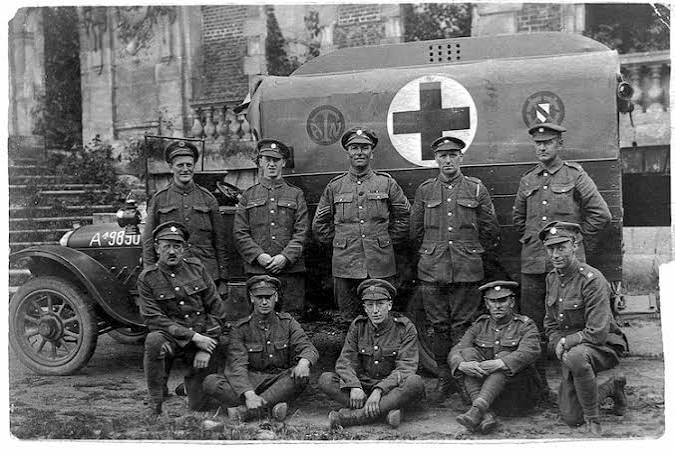
On July 1, 1916, the first day of the Battle of the Somme, British forces suffered over 57,000 casualties—the bloodiest day in British military history. The wounded came in waves, often with limbs torn by shrapnel, faces shattered by machine-gun fire, and bodies contaminated by the filth of the trenches. The existing medical system, designed for an earlier era of warfare, was overwhelmed within hours.
Yet out of this catastrophe emerged a new kind of medicine. The war forced innovation at a pace peacetime would never have allowed. From the formalization of triage to the birth of plastic surgery, the lessons learned on the Western Front and beyond reshaped how we treat trauma, infection, and psychological injury—and their impact is still felt in every emergency room today.
The Surgeon Closes In: Mobile Units
Surgeons realized that time was the enemy. The French developed the autochir, a mobile surgical hospital that could be moved close to the front lines. The British and Americans followed with casualty clearing stations, which brought surgical teams within a few miles of the trenches. This reduced the time between injury and surgery from days to hours, dramatically improving survival rates for abdominal and chest wounds that had previously been almost always fatal.
Wound Care: The Debridement Revolution
The war taught surgeons that antiseptics alone were not enough. The standard practice became debridement—surgically cutting away all dead and contaminated tissue—followed by delayed primary closure. Wounds were left open to drain for several days before being closed. This approach, though painful and labor-intensive, reduced the incidence of gas gangrene and sepsis. It remains a fundamental principle in trauma surgery today.
Blood Transfusion: From Risk to Routine
Before WWI, blood transfusions were rare and often fatal due to incompatible blood types. The earlier work of Karl Landsteiner on blood typing, combined with the discovery of sodium citrate as an anticoagulant, made safe indirect transfusions possible. By 1917, the British Expeditionary Force had mobile blood transfusion teams. This innovation meant that soldiers who would have bled to death could be resuscitated and taken to surgery. The principles of blood banking and transfusion established during the war became standard in civilian medicine.
Faces Rebuilt: The Birth of Plastic Surgery
Trench warfare produced a devastating new type of injury: facial mutilation. Shrapnel and machine-gun fire tore away jaws, noses, and cheeks. These soldiers survived but faced lives of isolation and horror. New Zealand-born surgeon Harold Gillies established a dedicated hospital at Sidcup, England, where he performed over 11,000 operations. He developed techniques for rebuilding faces using skin grafts and bone transplants, many of which are still in use today. Gillies is considered the father of plastic surgery.
X-Rays at the Front: Marie Curie’s Petites Curies
Marie Curie, already famous for her work on radioactivity, recognized that X-rays could help surgeons locate bullets and shrapnel before operating. She developed mobile X-ray units, nicknamed “petites Curies,” which were driven to field hospitals. These units allowed surgeons to operate with precision, removing foreign objects with less tissue damage. Curie herself trained radiologists and drove ambulances to the front, bringing cutting-edge technology to the battlefield.
The Recognition of Shell Shock
The term “shell shock” entered medical vocabulary during WWI, describing the psychological collapse of soldiers under prolonged artillery bombardment. Initially, many commanders and doctors dismissed it as cowardice or malingering, fearing that evacuation would encourage others to fake symptoms. But the sheer number of cases—men who trembled uncontrollably, were paralyzed without physical cause, or lost their speech—forced the medical establishment to acknowledge combat-related psychological injury. Early psychiatric treatment programs were flawed, often using electric shock or hypnosis, but they laid the groundwork for modern combat psychiatry.
Nurses: The Backbone of Care
Over 20,000 British nurses served overseas, and their role expanded dramatically. Beyond basic care, they administered anesthesia, dressed wounds, and assisted in surgery. The war accelerated the professionalization of nursing, leading to formal training and credentials. Nurses like Edith Cavell, who helped soldiers escape occupied Belgium, became symbols of sacrifice and skill. The war demonstrated that nursing was not just compassion but a highly skilled profession essential to medical care.
Fighting Disease: Vaccination and Sanitation
Disease had killed more soldiers than bullets in previous wars. During WWI, mass vaccination campaigns against typhoid and tetanus were implemented. The U.S. Army’s typhoid vaccination program reduced typhoid deaths from 5,000 during the Spanish-American War to fewer than 100 in WWI. Lice control, sanitation measures, and mobile laboratories also helped prevent trench fever and other diseases. These public health measures were as important as surgery in keeping soldiers alive.
The Great War was a crucible that forged modern medicine. The innovations—triage, debridement, blood transfusion, plastic surgery, mobile X-rays, psychiatric care, professional nursing, and mass vaccination—were born of necessity and refined under fire. They transformed military medicine and, in the decades after the war, seeped into civilian practice, saving millions of lives. The next time you see an emergency room triage team, a trauma surgeon cleaning a wound, or a face transplant, you are seeing the legacy of those who fought and healed in the trenches.
Summary
- WWI’s casualty scale forced a dramatic overhaul of military medicine, reducing mortality among the wounded from ~14% (Civil War) to under 8%.
- Triage was formalized to prioritize surgical resources for the most savable patients.
- Mobile surgical units and casualty clearing stations shortened the time from injury to surgery, saving lives.
- Debridement and delayed primary closure became standard wound care, reducing infections.
- Blood typing and anticoagulant-citrate made safe transfusions possible, leading to mobile transfusion teams.
- Plastic surgery emerged to rebuild shattered faces, with Harold Gillies pioneering techniques used today.
- Marie Curie’s mobile X-ray units brought radiology to the front, aiding surgical precision.
- “Shell shock” forced recognition of psychological trauma, laying groundwork for combat psychiatry.
- Nursing became professionalized, with women taking on advanced roles.
- Mass vaccination against typhoid and tetanus dramatically reduced disease deaths.
FAQ
Q: What is triage and how did it start?
A: Triage is the sorting of patients by severity of injury to prioritize treatment. In WWI, French and British armies formalized it, categorizing the wounded as immediate, delayed, expectant, or walking. It became standard in emergency medicine.
Q: How did blood transfusion become safe during WWI?
A: Earlier work on blood typing by Karl Landsteiner, combined with sodium citrate as an anticoagulant, allowed blood to be stored and transfused safely. By 1917, mobile transfusion teams deployed near the front.
Q: What was the role of Marie Curie in WWI?
A: Marie Curie developed mobile X-ray units, called “petites Curies,” that brought radiology to field hospitals. She also trained radiologists and personally drove ambulances to the front, helping locate bullets and shrapnel in wounded soldiers.
Q: How did WWI change plastic surgery?
A: Facial injuries from trench warfare led to pioneering reconstructive surgery. Harold Gillies established a dedicated hospital at Sidcup, performing over 11,000 operations and developing techniques still used in plastic surgery today.
Q: What was “shell shock” and how was it treated?
A: Shell shock was a term for psychological trauma caused by the horrors of trench warfare. Initially dismissed as cowardice, the huge number of cases forced recognition of combat-related PTSD. Early treatments were flawed but led to modern psychiatric care for veterans.