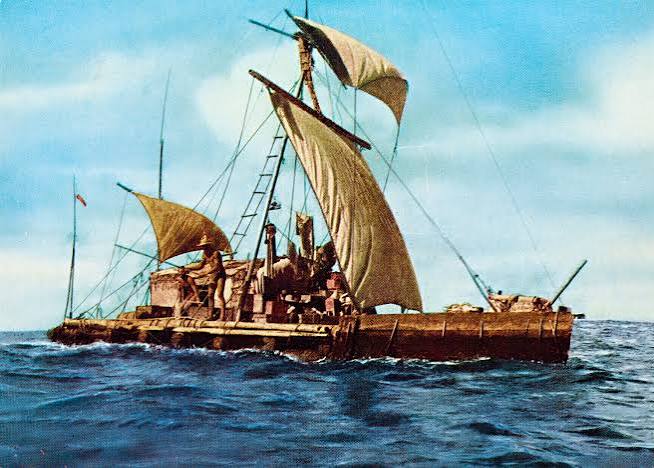
On August 7, 1947, a balsa wood raft named Kon-Tiki crunched onto a coral reef in the Tuamotu Islands, ending a 101-day, 4,300-nautical-mile drift across the Pacific. Six men stumbled ashore, sunburned and exhausted, but alive. Their journey from Peru had been dismissed as suicidal by experts yet it succeeded.
Thor Heyerdahl’s expedition wasn’t just an adventure. It was an experiment designed to answer a provocative question: Could ancient South Americans have sailed to Polynesia on primitive rafts? The voyage didn’t settle the debate, but it forced scientists to rethink what was possible on the open ocean, and it sparked a new field of experimental archaeology.
Why the Kon-Tiki Still Matters
The Kon-Tiki expedition was more than a stunt. It was a bold challenge to the scientific establishment, driven by curiosity and a willingness to test ideas in the most direct way possible. Heyerdahl and his crew risked their lives to answer a question about human history and in doing so, they captured the world’s imagination.
The voyage reminds us that our ancestors were more capable than we often give them credit for. If a handful of men on a balsa raft could cross the Pacific, what might ancient sailors have achieved? The Kon-Tiki didn’t close the book on Pacific settlement; it opened a new chapter, one that continues to inspire research and adventure today.
The Kon-Tiki raft now rests in a museum, but its story sails on. It stands as a monument to human daring and a reminder that sometimes the best way to test an idea is to go out and live it. Whether or not ancient Peruvians ever made that journey, the raft proved that they could have and that, in itself, changed how we think about the past.
Summary
- In 1947, Thor Heyerdahl and five crew members sailed a balsa raft from Peru to Polynesia in 101 days, covering 4,300 nautical miles.
- The raft was built using only ancient techniques and materials, with no metal fasteners or modern equipment.
- Heyerdahl aimed to show that South Americans could have settled Polynesia—not to prove they did.
- The voyage succeeded in proving feasibility, but genetic and archaeological evidence still points to Southeast Asia as the primary origin of Polynesians.
- The expedition helped launch experimental archaeology and sparked ongoing research into possible trans-Pacific contacts, such as the spread of the sweet potato.
FAQ
Q: Was the Kon-Tiki voyage successful?
A: Yes. All six crew members survived, and the raft completed a 101-day, 4,300-mile journey from Peru to the Tuamotu Islands. It proved that a balsa raft could make the crossing.
Q: Did the Kon-Tiki prove Heyerdahl’s theory?
A: No. It proved that such a voyage was physically possible, but it did not prove that South Americans actually settled Polynesia. Mainstream science still holds that Polynesia was settled from Southeast Asia, though some contact with South America is now considered likely.
Q: What happened to the original Kon-Tiki raft?
A: The raft was recovered from Raroia Atoll and is now displayed at the Kon-Tiki Museum in Oslo, Norway.
Q: Who were the crew members?
A: The crew was led by Thor Heyerdahl (Norway) and included Herman Watzinger (Sweden), Erik Hesselberg (Norway), Knut Haugland (Norway), Torstein Raaby (Norway), and Bengt Danielsson (Sweden).
Q: Why did Heyerdahl name the raft Kon-Tiki?
A: He named it after the Inca sun god Viracocha, whom he believed was known as “Kon-Tiki” in ancient Peruvian legend.