Tag: theremin

  • The Vacuum Tube That Sang: How the Theremin’s Eerie Tones Shaped Electronic Music and Film Scores

    The Vacuum Tube That Sang: How the Theremin’s Eerie Tones Shaped Electronic Music and Film Scores

    Imagine an instrument you play without touching. No keys, no strings, no bow. Just your hands moving through the air, shaping sound from invisible fields. That’s the theremin, invented in 1920 by Russian physicist Léon Theremin. Its sound—a wavering, ethereal wail—has haunted film scores and inspired electronic music for a century.

    But the theremin is more than a curiosity. It emerged from early radio engineering, using vacuum tubes and the heterodyne principle to turn capacitance changes into music. The same technology that made it sing also made it a tool for espionage. From Carnegie Hall concerts to Cold War listening bugs, the theremin’s story weaves science, music, and history into a single, strange thread.

    The Instrument That Senses Your Hands

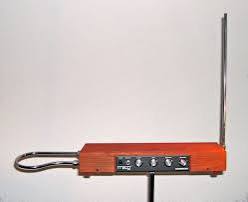
    A theremin looks like a wooden box with two antennas. One, a vertical rod, controls pitch. The other, a horizontal loop, controls volume. You play by moving your hands near these antennas—closer to the pitch antenna raises the frequency, closer to the volume antenna softens the sound. No contact needed.

    How does it work? Inside, two high-frequency radio oscillators hum at slightly different frequencies. This is the heterodyne principle: when two frequencies mix, they produce a beat frequency equal to their difference. If one oscillator runs at 500,000 Hz and the other at 500,500 Hz, the difference is 500 Hz—an audible tone. Your hand acts as a capacitor, changing the electric field around the antenna. This alters one oscillator’s frequency, sliding the pitch up or down.

    The original design used vacuum tubes, the same thermionic valves that powered early radios. In 1920, Léon Theremin was working on proximity sensors for the Soviet military when he noticed the pitch changes caused by his hand’s position. He realized he’d stumbled onto a musical instrument.

    From Lenin’s Lessons to Carnegie Hall

    Theremin demonstrated his invention—initially called the Termenvox or etherophone—to Lenin in 1922. The Soviet leader was reportedly fascinated and took lessons, though his musical career didn’t last. By 1928, Theremin had moved to the United States, patented his instrument, and launched commercial production with RCA. The RCA Model A sold poorly—around 500 units—but the theremin found its audience in concert halls.

    In 1929, Clara Rockmore gave a landmark performance at Carnegie Hall. A Lithuanian-American violinist, Rockmore developed a precise technique using finger positioning rather than whole-hand movements. Her control turned the theremin’s notoriously slippery pitch into a expressive voice, capable of phrasing that rivaled a singer’s.

    The theremin arrived during a period of intense musical experimentation. Futurists wanted to break from tradition, atonal composers sought new harmonic languages, and everyone looked for sounds beyond the orchestra. The theremin delivered something genuinely new: a glissando-heavy, vibrato-rich tone that was both human—like a voice or string—and alien. It was the first electronic instrument to achieve international fame.

    Eerie Sounds for Dark States of Mind

    The theremin’s cinematic career began in the 1940s, when composer Miklós Rózsa used it to score psychological turmoil. In Spellbound (1945), the theremin represents the protagonist’s obsessive, guilt-ridden mind. In The Lost Weekend (1945), it voices the agony of alcoholism. In The Red House (1947), it underscores a dark secret. Rózsa chose the theremin for its ability to convey the intangible—madness, intoxication, the supernatural.

    Why does it sound eerie? The theremin produces continuous pitch, sliding between notes without discrete steps. This is uncommon in Western music, which typically uses fixed pitches. Our ears, trained to expect steps, perceive the gliding as unsettling. Combine that with its unstable intonation and rich vibrato, and you get a sound that feels out of control. It’s the sonic equivalent of a nervous tremor.

    This sonic shorthand stuck. From there, the theremin appeared in sci-fi and horror films throughout the 1950s and beyond. Its sound became shorthand for the otherworldly, even when audiences didn’t know what instrument they were hearing.

    A Spy in the Orchestra

    Léon Theremin’s life took a strange turn in 1938. He returned to the Soviet Union under murky circumstances—likely forced repatriation by the NKVD. Instead of performing, he worked in a sharashka, a prison laboratory for scientists, developing espionage technology.

    His most famous creation was the Great Seal bug, also called “The Thing.” Hidden inside a carved wooden seal of the United States, it was a passive listening device that hung in the U.S. Ambassador’s Moscow residence from 1945 to 1952. It used a variant of the heterodyne principle: external radio waves struck the device, which modulated them with nearby audio, allowing Soviet agents to eavesdrop. The bug wasn’t discovered until 1952, and it’s now considered a precursor to RFID technology.

    The same physics that made music also made espionage possible. The capacitance-sensing principle behind the theremin is now everywhere—from smartphone proximity sensors to gesture-controlled devices. Theremin’s accidental instrument was a bridge between early radio and modern touchless tech.

    The Legacy: Electronic Music and Beyond

    The theremin’s influence on electronic music is foundational. It proved that music could be synthesized from pure electronics, without acoustic sources. This paved the way for synthesizers, which emerged decades later. The theremin also inspired other early electronic instruments like the Ondes Martenot (1928) and the Trautonium (1930), but it was the first to capture the public imagination.

    After Theremin’s death in 1993, interest surged. His grand-niece Lydia Kavina carried on the performing tradition, teaching a new generation. Today, you’ll hear theremins in pop songs, film scores, and experimental music. Bands like the Pixies and Portishead have used it; composers like Howard Shore have scored films with it.

    The theremin’s eerie voice remains instantly recognizable, a century after its invention. It’s a reminder that technology and art often arrive in the same package. A Soviet physicist built a device to sense proximity; he ended up creating the first electronic instrument. And when that instrument sang, it sang of things beyond words—obsession, mystery, and the unknown.

    The theremin is more than a novelty or a horror movie cliché. It’s a testament to how a single scientific principle—heterodyning—can produce both music and surveillance. Its inventor lived a life stranger than fiction, from Lenin’s lessons to Cold War espionage. And its sound, once heard, is never forgotten. Next time you hear that eerie wail in a film, remember: you’re listening to a vacuum tube, a capacitance field, and a century of imagination.

    Summary

    • The theremin (1920) is the first fully electronic musical instrument, played without physical contact by moving hands near two antennas.
    • It works via heterodyning: two high-frequency oscillators create an audible difference frequency, altered by the hand’s capacitance.
    • Clara Rockmore’s virtuosity defined its expressive potential in classical repertoire.
    • Miklós Rózsa’s 1940s film scores established the theremin as shorthand for psychological states and the supernatural.
    • Léon Theremin also invented espionage devices, including the Great Seal bug, linking the instrument’s science to Cold War history.

    FAQ

    Q: How does a theremin produce sound without being touched?
    A: The theremin uses two high-frequency radio oscillators. The difference between their frequencies produces an audible tone. Your hand’s capacitance changes one oscillator’s frequency, altering the pitch. Volume is controlled similarly by a second antenna.

    Q: Why does the theremin sound so eerie?
    A: Its continuous glissando—sliding between pitches without discrete steps—is unusual in Western music. Combined with wobbly intonation, it creates an unsettling, otherworldly effect.

    Q: Who was Clara Rockmore?
    A: She was a Lithuanian-American violinist who became the theremin’s greatest classical performer. Her precise finger technique allowed expressive playing that defined the instrument’s potential.

    Q: How is the theremin connected to espionage?
    A: Inventor Léon Theremin created the Great Seal bug, a covert listening device that used heterodyne principles. It hung in the U.S. Ambassador’s residence for seven years before being discovered.

    Q: Is the theremin still used in music today?
    A: Yes. It appears in film scores, pop songs, and experimental music. Many modern synthesizers and touchless sensing technologies trace their lineage to its principles.


  • The Theremin: How a Soviet Spy’s Invention Became the Soundtrack of Science Fiction and Psychedelia

    The Theremin: How a Soviet Spy’s Invention Became the Soundtrack of Science Fiction and Psychedelia

    Imagine an instrument you play without touching. Your hands hover in the air, shaping sound from invisible fields. It wails like a human voice, glides like a bird, and sends chills down the spine. This is the theremin, invented in 1920 by a Russian physicist who would later build a bug for the Kremlin. Its eerie tone became the voice of alien visitors in 1950s cinema and the psychedelic buzz of 1960s rock. But the story behind it is stranger than any sci-fi plot.

    Léon Theremin didn’t set out to create a spy gadget. He wanted to measure gas density, but stumbled onto a way to make music from radio waves. Yet his later espionage work would forever color how the world heard his invention. The same technology that produced celestial melodies also hid a covert listening device. That irony turned the theremin into a perfect metaphor for the Cold War: beautiful, mysterious, and just a little threatening.

    A Musical Accident Born from Radio Waves

    In 1919, a young physicist named Lev Termen was working on proximity sensors for the Soviet military. He noticed that moving his hand near a circuit changed its frequency, producing a whistle. Instead of dismissing it as noise, he tuned it into music. By 1920, he had a working prototype: a box with two antennas. One controlled pitch, the other volume. Players move their hands through the air, and the instrument sings.

    The principle is called heterodyning. Two high-frequency radio oscillators create an audible beat frequency. Your hand’s capacitance—its ability to store electrical charge—shifts that frequency. The result is a sound that slides between notes with seamless glides. No keys, no strings, no contact. Just you and the electromagnetic field.

    Termen, now known as Léon Theremin, showed his invention to Vladimir Lenin in 1922. The Soviet leader was reportedly delighted and even took lessons. Lenin sent Theremin on a world tour to showcase Soviet ingenuity. In 1927, he arrived in the United States, where he patented his device in 1928 and licensed it to RCA. But RCA’s attempt to sell it as a home instrument flopped. It was too difficult to play well. Most people produced only wails and squeaks.

    The Spy Who Came in from the Cold

    Theremin’s American years were glamorous. He lived in a Greenwich Village studio, mingled with celebrities, and performed with the New York Philharmonic. But in 1938, he vanished. Accounts differ: some say he was kidnapped by Soviet agents, others that he returned voluntarily to escape debt. Either way, he ended up back in Moscow—not to applause, but to arrest. In 1939, he was sent to a sharashka, a secret prison lab where scientists worked under guard. The same system that built Soviet jet engines and the atomic bomb now held the inventor of the theremin.

    While in the sharashka, Theremin didn’t build musical instruments. He built espionage devices. In 1945, he created “The Thing,” a passive listening bug hidden in a wooden replica of the Great Seal of the United States. Soviet schoolchildren presented the seal to the US Ambassador in Moscow, who hung it in his office. It required no power source and transmitted conversations via a resonant cavity. American intelligence didn’t discover it until 1952. This is the “Soviet spy” connection that would retroactively taint the theremin’s innocent sound.

    Theremin’s espionage work was not the theremin itself—the instrument was never a secret listening device. But the timing mattered. As the Cold War escalated, Hollywood needed a sound for alien threats and psychological dread. The theremin’s wobbly, ethereal tone fit perfectly. The same man who made music for peace had also made tools for surveillance. That irony wasn’t lost on audiences who felt watched by an unseen enemy.

    The Sound of Science Fiction

    The theremin first crept into film through composer Miklós Rózsa, who used it in Alfred Hitchcock’s Spellbound (1945) to evoke madness. The performer was Clara Rockmore, a virtuoso who had trained as a violinist and became the theremin’s greatest classical player. Her precision gave the instrument legitimacy. But it was Bernard Herrmann’s score for The Day the Earth Stood Still (1951) that cemented the theremin as the voice of the unknown. Samuel Hoffman, a podiatrist by day and thereminist by night, played the haunting theme for the alien Klaatu. From then on, the theremin signaled “not of this world.” It appeared in sci-fi and horror films throughout the 1950s, from The Thing from Another World to It Came from Outer Space.

    Why did this instrument become shorthand for the alien? Its sound has no obvious source. It doesn’t mimic a familiar acoustic instrument—it sounds like a voice, but not a human one. It glides in ways no singer can sustain. In an era of atomic anxiety and UFO sightings, the theremin gave voice to the unknown. It was the sonic equivalent of a shadowy figure in a trench coat.

    Psychedelia and Rock ‘n’ Roll

    By the 1960s, the theremin had crossed over from movie scores to popular music. The Beach Boys used an Electro-Theremin—a box with a slide controller, not the original antenna version—on Good Vibrations (1966). The song’s woozy, oscillating hook captured the psychedelic mood of the era. Led Zeppelin’s Jimmy Page went further. He bought a real theremin and used it live, coaxing eerie screams from it during performances. On Whole Lotta Love (1969), the theremin’s wail became a centerpiece of the song’s psychedelic middle section.

    Why did the theremin fit psychedelia? The genre embraced altered states, cosmic exploration, and the breaking of boundaries. The theremin broke the boundary between performer and instrument. It produced sounds that seemed to come from nowhere, bending pitch and volume in ways that defied conventional music. For listeners on acid, the theremin’s glissandos felt like a trip through space. For rock stars seeking an otherworldly edge, it was the perfect prop—you didn’t even have to touch it to make it scream.

    A Technical Pioneer: Robert Moog and the Modern Theremin

    Long before he invented the synthesizer, Robert Moog was building theremins. As a teenager in the 1950s, he sold theremin kits through a mail-order business. His early work with heterodyning oscillators directly influenced his later synthesizer designs. Moog’s company, Moog Music, began producing the Etherwave theremin in the 1990s, bringing the instrument to a new generation. Modern digital theremins are more stable than the original vacuum-tube models, which were bulky and prone to drift. But the playing technique remains the same—hands in the air, coaxing sound from invisible fields.

    The theremin’s technical evolution mirrors its cultural journey. From a Soviet lab to American concert halls, from spy bugs to rock stages, it has always been an instrument of paradoxes. It is one of the first fully electronic instruments, yet it demands the most human of gestures—a delicate touch that never actually touches. That paradox is its enduring appeal.

    Clara Rockmore and the Female Virtuosos

    The theremin is unusual in that its performance interface is the human body itself. No keys, no strings, no reeds—just the capacitance of your hands. This made it uniquely accessible to women, who were often excluded from classical music’s male-dominated institutions. Clara Rockmore became the instrument’s greatest exponent, performing with orchestras and commissioning works from composers like Bohuslav Martinů. Lucie Bigelow Rosen, a wealthy patron, helped popularize the theremin in high society and performed at Carnegie Hall. Lydia Kavina, Theremin’s grand-niece, kept the instrument alive in Russia after his death, teaching a new generation of players.

    Some scholars argue that the theremin offered women a rare space for musical agency. Because it required no physical contact, it sidestepped the gendered expectations of instrumental technique. A woman could play it with the same authority as a man, and the most celebrated players were women. This was a quiet revolution in a field that often overlooked female musicians.

    The Failed Instrument That Refused to Die

    RCA’s commercial failure in 1929 seemed to seal the theremin’s fate as a novelty. It was too hard to play, too eerie for most tastes, and too alien for mainstream music. Yet it kept resurfacing—in film scores, in psychedelic rock, in the hands of dedicated virtuosos. Robert Moog’s kits gave it a cult following. Modern artists like Carolina Eyck and Pamelia Stickney have pushed it into contemporary music. The theremin is no longer a one-hit wonder; it’s a niche instrument with a passionate community.

    Why has it persisted? Perhaps because it’s the only instrument that looks like magic. Watching a thereminist play—gliding hands, no contact, impossible sounds—is a performance in itself. It reminds us that music can come from anywhere, even from the air between our fingers. And that’s a lesson that never gets old.

    The theremin started as a Soviet physicist’s curiosity, became a Cold War spy’s footnote, and ended up as the soundtrack to our wildest imaginings. Its eerie voice still resonates in film, rock, and concert halls. Léon Theremin died in 1993, but his invention lives on—not as a spy gadget, but as a testament to human creativity’s strange and beautiful paths.

    Summary

    • The theremin was invented in 1920 by Russian physicist Léon Theremin, who later built a covert listening device for Soviet intelligence.
    • It is played without physical contact, using hand movements to control pitch and volume via radio oscillators.
    • Its eerie sound became iconic in sci-fi films like The Day the Earth Stood Still and in psychedelic rock like Led Zeppelin’s Whole Lotta Love.
    • Clara Rockmore and other female virtuosos elevated the theremin as a serious concert instrument.
    • Robert Moog built theremins as a teenager, which influenced his later synthesizer work.

    FAQ

    Q: How does a theremin produce sound without being touched?
    A: The theremin uses two high-frequency radio oscillators. The difference between their frequencies creates an audible beat. When you move your hand near the pitch antenna, your hand’s capacitance changes one oscillator’s frequency, altering the pitch. The volume antenna controls amplitude similarly.

    Q: Was the theremin actually used as a spy device?
    A: No, the theremin itself was not a spy device. However, its inventor, Léon Theremin, developed a passive listening bug called “The Thing” in 1945, which was hidden in a wooden seal and used to eavesdrop on the US Ambassador.

    Q: Why did the theremin become associated with science fiction?
    A: Its ethereal, gliding sound was unlike any traditional instrument, making it perfect for evoking the unknown and alien. Composers like Miklós Rózsa and Bernard Herrmann used it in films like Spellbound and The Day the Earth Stood Still.

    Q: Can I learn to play the theremin easily?
    A: The theremin is notoriously difficult to play well because pitch control requires precise hand movements with no physical reference. However, modern digital theremins are more stable, and with practice, it’s possible to produce melodic lines.

    Q: What’s the difference between a theremin and an Electro-Theremin?
    A: An original theremin uses antennas and hand capacitance to control sound without contact. An Electro-Theremin, used by the Beach Boys on Good Vibrations, has a slide controller for pitch and a knob for volume, so it’s played with physical touch.

  • The Theremin: The Haunting Instrument You Play Without Touching

    The Theremin: The Haunting Instrument You Play Without Touching

    Theremin - WikipediaImagine an instrument that responds to the air around your hands, producing ethereal sounds without a single touch. That’s the theremin, invented a century ago by a Russian physicist who had no idea his experimental device would become a musical icon.

    From Lenin’s fascination to Cold War espionage, from sci-fi soundtracks to indie rock, the theremin’s story is as strange and surprising as its sound. Here’s how a failed proximity sensor became the only instrument you play without touching.

    The Accidental Birth of an Instrument

    In 1919, Lev Termen, a young Russian physicist, was working on a proximity sensor for the Soviet government. He noticed that moving his hand near the device changed its audible frequency, and he realized he could control pitch and volume with just his hands. By 1920, he had built a working prototype and demonstrated it in Moscow. Lenin was reportedly so taken with the instrument that he took lessons himself.

    Termen, who later Westernized his name to Léon Theremin, patented his invention in the U.S. in 1928. The theremin uses two high-frequency oscillators: one fixed, one variable. The difference between their frequencies produces an audible tone. Your hand’s position near the vertical antenna changes the capacitance, altering pitch; the loop antenna controls volume. The result is a continuous, gliding sound that can be eerily beautiful or disconcerting.

    A Star in America, Then a Disappearing Act

    Termen toured Europe and the U.S. in the 1920s, dazzling audiences with his new instrument. In 1929, RCA licensed his design and produced the first commercial theremin, the RCA Theremin. About 500 units were made, but it was expensive (around $175, equivalent to $3,000 today) and notoriously difficult to play. With the Great Depression looming, sales flopped, and RCA discontinued the model.

    Termen remained a celebrity in New York, socializing with artists and intellectuals. But in 1938, he was abducted by Soviet secret police and returned to the USSR. He spent years in a sharashka, a secret research facility, working on espionage technology—including the Buran eavesdropping device, a precursor to modern bugging devices. The West assumed he was dead, but he had actually been ‘rehabilitated’ in the 1960s and later taught and built theremins in Moscow.

    The Theremin’s Second Act: Film and Rock

    After the war, the theremin found a niche in Hollywood. Its otherworldly sound became shorthand for alien invasion and psychological tension. You can hear it in Spellbound (1945), The Day the Earth Stood Still (1951), and The Thing from Another World (1951).

    The instrument also influenced popular music, though sometimes indirectly. The Beach Boys’ ‘Good Vibrations’ used an Electro-Theremin, a similar but distinct instrument. Led Zeppelin’s ‘Whole Lotta Love’ featured theremin-like effects. In the 1990s, bands like Portishead and Radiohead brought the theremin into alternative rock.

    The Virtuosos Who Made It Sing

    Clara Rockmore, a classically trained violinist, became the theremin’s greatest performer. She met Termen in the 1920s and began playing the instrument professionally. Her technique, honed over decades, demonstrated that the theremin could be expressive and precise, not just a novelty. She performed with orchestras and recorded albums, earning the instrument artistic credibility.

    Modern players continue her legacy. Lydia Kavina, Rockmore’s grandniece, is a renowned thereminist and composer. Carolina Eyck, a contemporary virtuoso, has written a method book that has become the standard for learning the instrument. Pamelia Stickney brings the theremin into jazz and experimental music.

    Why the Theremin Is Harder Than It Looks

    Playing the theremin requires extreme precision. Since pitch is continuous, there are no frets or keys to guide you. You must rely on muscle memory and ear training to hit the right notes. The instrument is monophonic, playing one note at a time. Its range is typically four to five octaves, depending on the model.

    Robert Moog, the synthesizer pioneer, built theremins as a teenager in the 1950s. His early work on the theremin directly influenced his development of the Moog synthesizer. Today, Moog Music produces the Etherwave theremin, which has made the instrument accessible to a new generation of players.

    The Theremin in the Digital Age

    The theremin has found a new audience online. Viral videos show players like Carolina Eyck performing everything from classical pieces to pop songs. Maker communities build their own theremins from kits, and the instrument’s strange interface makes it a favorite for experimental musicians.

    Its influence even extends to pop culture: the theremin appears in countless film scores, TV shows, and video games, always evoking a sense of mystery or otherworldliness. But for all its quirks, the theremin remains a serious instrument, capable of profound musical expression.

    The theremin is a century old, yet it still sounds like the future. Its invention was accidental, its history is full of intrigue, and its difficulty is legendary. But those who master it—from Clara Rockmore to modern virtuosos—prove that music can be made from nothing but air and electromagnetic fields. The theremin isn’t just an instrument; it’s a testament to human creativity and the strange paths innovation can take.

    Summary

    • The theremin is the only instrument played without physical contact, using two antennas to control pitch and volume.
    • Invented by Léon Theremin in 1919-1920, it was initially a Soviet proximity sensor and later patented in the U.S. in 1928.
    • After commercial failure in the 1930s, it found a second life in film scores and rock music, and influenced the development of the synthesizer.
    • Clara Rockmore and modern players like Carolina Eyck have elevated the theremin to a serious concert instrument.
    • The theremin’s difficulty and unique sound have made it a cult favorite in the digital age.

    FAQ

    Q: How does a theremin work?
    A: The theremin has two antennas: one for pitch, one for volume. Your hand’s position near each antenna changes the capacitance, which alters the frequency of an oscillator. The difference between this and a fixed oscillator produces the audible tone.

    Q: Is the theremin hard to play?
    A: Yes, extremely. Since there are no physical frets or keys, you must rely on precise muscle memory and ear training. Even professional players spend years perfecting their technique.

    Q: What does a theremin sound like?
    A: It produces a continuous, gliding, ethereal sound—often described as ‘singing’ or ‘haunting.’ It can be eerie or beautiful depending on the player’s skill and the musical context.

    Q: Why is the theremin associated with sci-fi movies?
    A: Its otherworldly sound became a cliché for alien and psychological themes in 1950s films like The Day the Earth Stood Still and Spellbound. This association has persisted in pop culture.

    Q: Who are some famous theremin players?
    A: Clara Rockmore, Lydia Kavina, Carolina Eyck, and Pamelia Stickney are among the most renowned. Robert Moog, the synthesizer pioneer, also built and played theremins.

  • The Theremin’s Secret History: From Soviet Spycraft to Synth Pioneer

    The Theremin’s Secret History: From Soviet Spycraft to Synth Pioneer

    In 1920, a young Russian physicist named Lev Termen walked into a laboratory in Petrograd and built a machine that played music without being touched. He called it the etherphone. Within a decade, it would be the first electronic instrument sold to the public, the eerie voice of Hollywood science fiction, and a direct ancestor of the synthesizer in your laptop. But the theremin’s story is stranger than the sound it makes.

    Termen—who later styled himself Léon Theremin—was not just an inventor. He was a spy, a prisoner, and a pioneer of surveillance technology. His most famous creation was a musical instrument. His most important one, to the Soviet state, was a listening device that eavesdropped on the U.S. ambassador for seven years. Both came from the same research. The theremin’s untold history is a tangle of music, espionage, and Cold War intrigue that explains how a failed commercial product became the seed of modern electronic music and touch-sensitive technology.

    A Musician’s Radio Experiment

    Theremin was a cellist and a physicist, a combination that made him uniquely suited to hear music in radio interference. In 1919, he was working on proximity sensors for the Soviet military, using radio-frequency oscillators that produced a constant tone. When he moved his hand near the antenna, the pitch changed. Instead of filing it as a quirk, he built a version with two antennas—one for pitch, one for volume—and an amplifier. The result was an instrument that responded to the capacitance of the human body. No strings, no keys, no contact.

    He demonstrated it publicly in October 1920 at the Physico-Technical Institute in Petrograd. The audience included Vladimir Lenin, who was reportedly so impressed that he commissioned 600 instruments for Soviet propaganda purposes and took private lessons. For a few years, the theremin—or Termenvox, as it was known—was a symbol of Soviet technological triumph. Then Stalin’s cultural conservatism turned against experimental music, and Theremin’s career took a darker turn.

    The American Interlude and the RCA Flop

    In 1927, Theremin left the Soviet Union for a European tour, performing in Berlin, Paris, and London. He arrived in the United States in 1928, patented his instrument, and licensed production to RCA. The company began selling the RCA Theremin in 1929, hoping to tap into the craze for all things electronic. It was a commercial disaster—only about 500 units sold. The instrument was hard to play, required precise hand control, and sounded like nothing else on the radio. Most buyers gave up quickly.

    But the theremin found a niche in the hands of a few dedicated performers. Clara Rockmore, a Lithuanian-born violin prodigy who switched to theremin in the 1930s, became its greatest virtuoso. Her 1977 album The Art of the Theremin remains the definitive classical recording. Lucie Bigelow Rosen, an American socialite, funded Theremin’s work and performed herself. Samuel Hoffman, a physician, played the theremin on classic film scores, giving it the wailing, sci-fi sound you hear in movies like The Day the Earth Stood Still (1951).

    Composers took notice. Edgard Varèse wrote Ecuatorial for it in 1934. Bohuslav Martinů composed the Fantasia for Theremin, Oboe, String Quartet and Piano in 1944. The instrument was never mainstream, but it was never forgotten.

    The Kidnapping and the Bug

    In 1938, as political tensions rose, Theremin was kidnapped from his New York apartment by Soviet NKVD agents and returned to the USSR. He disappeared from public life, presumed dead. In reality, he was sent to a sharashka—a prison research laboratory—where he continued to work on military technology. The theremin’s technical principles, the heterodyne oscillators and capacitance sensing, proved useful for something far more secretive.

    In 1945, Theremin invented “The Thing,” a passive eavesdropping device that was hidden inside a carved wooden seal of the Great Seal of the United States. It was presented as a gift to U.S. Ambassador Averell Harriman and hung in his Moscow residence for seven years before being discovered. The device had no power source of its own—it was activated by radio waves beamed at it from outside, and it transmitted conversations back to Soviet agents. It is considered the first bugging device used by the Soviets against the United States, and it was a direct outgrowth of Theremin’s theremin research.

    The story of the bug was declassified in the 1960s, but Theremin himself remained in the USSR, working on other projects. He invented the Terpsitone, an instrument controlled by dance movements, and the Rhythmicon with composer Henry Cowell, an early rhythm machine. But he was effectively erased from Western history until 1967, when a New York Times profile by Harold Schonberg revealed that he was alive and working in Moscow.

    The Legacy: From Theremin to Moog to Touchscreens

    The theremin’s most lasting influence may be on the technology you use every day. In the 1950s, a young American engineer named Robert Moog started building theremins as a hobby. His first commercial product was a theremin kit, and the experience led him to develop the Moog synthesizer, which revolutionized music in the 1960s and beyond. The theremin is the direct ancestor of the synthesizer—the first mass-produced electronic instrument, and the template for electronic music as a genre.

    But the capacitance principle that makes the theremin work is also at the heart of modern touchscreens, motion detectors, and gesture-control interfaces. When you swipe your phone or wave at a smart device, you’re using the same physics that Theremin stumbled on in 1920. The instrument was a byproduct of military research, and so was the technology that now connects us.

    The theremin itself never became a household instrument, but it never disappeared. It appears in modern music, from the Beach Boys’ “Good Vibrations” to the soundtrack of Stranger Things. Its eerie, sliding tones remain the shorthand for mystery and otherworldliness. And the story of its inventor—the musician-spy who built a listening device from the same circuits that made music—reminds us that technology is never neutral. The theremin was a musical instrument and a spy tool, a symbol of Soviet ambition and a casualty of Stalinist repression. It changed music, but it also changed espionage, and that double life is the untold story worth remembering.

    The theremin’s legacy is not just a weird sound from old sci-fi movies. It is a direct link between the laboratory and the concert hall, between espionage and music, between a Soviet inventor and the smartphone in your pocket. Léon Theremin’s life was a Cold War thriller, and his invention—born of radio research and military secrecy—became the seed of electronic music and touch technology. The next time you hear that eerie slide, or swipe a screen, you’re touching history.

    Summary

    • Invented in 1920 by Russian physicist Léon Theremin, the instrument was the first to be played without physical contact.
    • Theremin was kidnapped by Soviet agents in 1938 and later invented ‘The Thing,’ a covert listening device used to spy on the U.S. ambassador.
    • The theremin inspired Robert Moog to build synthesizers, making it a direct ancestor of modern electronic music.
    • Its capacitance principle is now used in touchscreens and motion-sensing technology.
    • Key performers like Clara Rockmore kept the instrument alive, and composers like Varèse and Martinů wrote for it.

    FAQ

    Q: How does a theremin work?
    A: It uses two radio-frequency oscillators that create a beat frequency. The player’s hands act as capacitors, changing the pitch and volume without touching the instrument.

    Q: Why was the theremin a commercial failure?
    A: It was extremely difficult to play, required precise hand control, and had a sound that was unfamiliar to most listeners. RCA sold only about 500 units in 1929.

    Q: What is ‘The Thing’ bug?
    A: It was a passive eavesdropping device invented by Léon Theremin in 1945, hidden in a wooden seal given to the U.S. ambassador. It operated without a power source, activated by external radio waves.

    Q: How did the theremin influence modern music technology?
    A: Robert Moog built theremins before creating the Moog synthesizer, and the theremin is considered the first mass-produced electronic instrument, paving the way for electronic music.

    Q: Who was Clara Rockmore?
    A: She was the theremin’s greatest virtuoso, a Lithuanian-born musician who worked with Theremin in the 1930s and recorded the definitive classical album The Art of the Theremin in 1977.