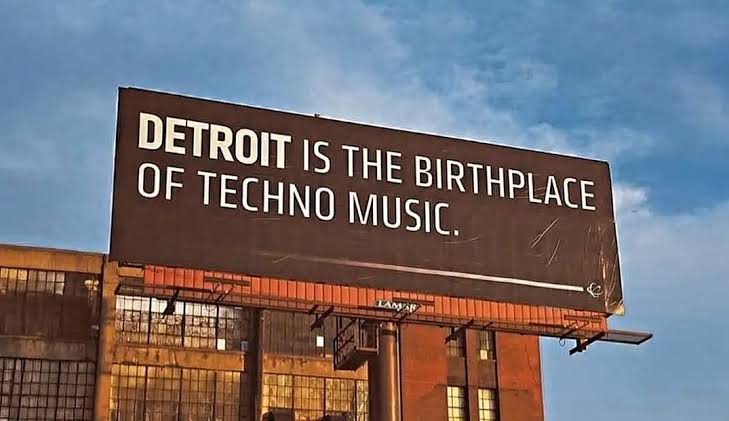
In the mid-1980s, in a city scarred by industrial decay, a small group of Black American teenagers began crafting a sound that would echo across decades and continents. Their name for it ‘techno’ came from a futuristic book, but its pulse was rooted in the Motor City’s machines, funk, and a vision of a world yet to come.
Today, techno is a global phenomenon, with festivals in Berlin, Tokyo, and São Paulo drawing hundreds of thousands. But its journey from Detroit’s abandoned warehouses to the world’s biggest stages is a story of innovation, migration, and the unexpected power of a beat.
The Belleville Three and the Birth of a Sound
In the early 1980s, Juan Atkins, Derrick May, and Kevin Saunderson were students at Belleville High School, a suburban Detroit school that would become the unlikely cradle of a musical revolution. They were obsessed with the futuristic sounds of Kraftwerk and the cosmic funk of Parliament-Funkadelic. They were also kids of the Motor City, a place where the auto industry’s collapse had left a ghostly landscape of shuttered factories.
Atkins, the eldest and most visionary, began experimenting with synthesizers and drum machines. His project Cybotron, with Richard Davis, released “Clear” in 1983—a track that many point to as the first techno record, even though the genre didn’t have a name yet. Atkins later coined “techno” after reading Alvin Toffler’s Future Shock, which spoke of “techno-rebels” who use technology to subvert and create.
May and Saunderson followed suit, producing tracks that were raw, mechanical, yet suffused with soul. May called techno “George Clinton and Kraftwerk stuck in an elevator,” capturing its hybrid nature. Their music wasn’t an escape from Detroit’s reality; it was a reflection of it—the clang of machinery, the emptiness of the streets, but also the hope of a new beginning.
From Detroit to the World: The European Bridge
For a few years, techno was a local phenomenon, played at parties and on the radio by DJs like The Electrifying Mojo. But in 1987, a wave of British DJs began importing Detroit tracks to the UK, where they were spun alongside Chicago house in the acid house scene. The response was explosive.
In 1988, Neil Rushton compiled Techno! The New Dance Sound of Detroit, a UK compilation that formally introduced the genre name to a global audience. That same year, Derrick May’s “Strings of Life” and Kevin Saunderson’s “Big Fun” (under the name Inner City) stormed the UK charts, becoming anthems of the Second Summer of Love.
Meanwhile, in Germany, the fall of the Berlin Wall in 1989 opened up vast, abandoned industrial spaces in the East. Techno, with its cold, mechanical beats, became the soundtrack of reunification. The Love Parade began in 1989, and by the mid-1990s, Berlin was the techno capital of the world, home to legendary clubs like Berghain.
The Sound of a City in Ruins
Techno’s aesthetic was a direct response to Detroit’s post-industrial decline. The city, once the powerhouse of American manufacturing, had become a symbol of urban decay. Unemployment soared, and neighborhoods were left with empty lots and crumbling buildings.
This environment shaped the music’s mood: cold, repetitive, and precise, mirroring the assembly lines that had once defined the city. But it also reflected the Afrofuturist vision of artists like George Clinton, who imagined a black future beyond the confines of the present. Techno was both a lament and a celebration—a way to dance in the ruins and dream of a better world.
The “Belleville Three” narrative, however, has been critiqued for overlooking other early pioneers like Eddie Fowlkes, Blake Baxter, and James Pennington, who were also instrumental in shaping the sound. The movement was broader than three individuals, but their story remains the most compelling entry point.
The Second Wave: Expanding the Sound
As techno spread globally, a second wave of Detroit producers took it in new directions. Jeff Mills brought a hypnotic, percussive intensity; Carl Craig infused it with melody and depth; and Richie Hawtin, though Canadian, became a key figure in Detroit’s scene, pushing techno into minimalism.
These artists, along with the labels they founded—Metroplex, Transmat, and KMS—cemented techno’s reputation as a serious art form. They also faced a paradox: while European audiences embraced techno, American radio and clubs largely ignored it, preferring house or hip-hop. Techno remained underground in the US for years, a testament to its creators’ vision and resilience.
Techno’s Legacy and Global Reach
Today, techno is a global industry, with festivals like Movement in Detroit (founded in 2000) and Berlin’s Love Parade attracting millions. Its influence extends beyond music into fashion, art, and technology. But its roots remain in that small group of Black teenagers from Belleville who imagined a future—and built it, one beat at a time.
Techno’s story is not just about music; it’s about how a marginalized community used technology to create something new and transformative. It’s a reminder that the most innovative art often emerges from the most challenging circumstances.
Conclusion
From the ruins of Detroit to the halls of Berghain, techno has proven that a sound born in a struggling city can resonate with the entire world. Its creators—Atkins, May, Saunderson, and countless others—didn’t just make dance music; they made a statement about resilience, imagination, and the power of rhythm. As long as there are machines and dreams, techno will keep moving.
- Techno was born in Detroit in the mid-1980s, created by Juan Atkins, Derrick May, and Kevin Saunderson—the “Belleville Three.”
- The term “techno” was coined by Atkins, inspired by Alvin Toffler’s Future Shock.
- Key tracks include Cybotron’s “Clear” (1983), Derrick May’s “Strings of Life” (1987), and Inner City’s “Big Fun” (1988).
- Techno’s sound reflects Detroit’s post-industrial decay and Afrofuturist themes.
- It found global fame through UK DJs and the German techno scene after the fall of the Berlin Wall.
Q: Who are the Belleville Three?
A: Juan Atkins, Derrick May, and Kevin Saunderson, who met at Belleville High School and are credited with founding techno.
Q: What was the first techno record?
A: “Clear” by Cybotron (1983), a project by Juan Atkins and Richard Davis, is often cited as the first.
Q: Why did techno become popular in Europe before the US?
A: British DJs imported Detroit tracks in the late 1980s, and German audiences embraced techno after the fall of the Berlin Wall, while US radio and clubs favored other genres.
Q: How did Detroit’s decline influence techno’s sound?
A: The city’s industrial decay and abandoned factories inspired the cold, mechanical, and repetitive beats that characterize techno.
Q: What is the significance of the Music Institute?
A: It was a short-lived Detroit nightclub (1988–1989) where May and others DJed, becoming a template for future techno clubs.
Techno’s journey from a few teenagers messing with synths in a Detroit suburb to a global soundtrack of liberation is a story of creativity against the odds. It shows how a local scene can become a world movement, and how a beat can carry the weight of a city’s history.
Summary
- Techno was born in Detroit in the mid-1980s, created by Juan Atkins, Derrick May, and Kevin Saunderson—the “Belleville Three.”
- The term “techno” was coined by Atkins, inspired by Alvin Toffler’s Future Shock.
- Key tracks include Cybotron’s “Clear” (1983), Derrick May’s “Strings of Life” (1987), and Inner City’s “Big Fun” (1988).
- Techno’s sound reflects Detroit’s post-industrial decay and Afrofuturist themes.
- It found global fame through UK DJs and the German techno scene after the fall of the Berlin Wall.
FAQ
Q: Who are the Belleville Three?
A: Juan Atkins, Derrick May, and Kevin Saunderson, who met at Belleville High School and are credited with founding techno.
Q: What was the first techno record?
A: “Clear” by Cybotron (1983), a project by Juan Atkins and Richard Davis, is often cited as the first.
Q: Why did techno become popular in Europe before the US?
A: British DJs imported Detroit tracks in the late 1980s, and German audiences embraced techno after the fall of the Berlin Wall, while US radio and clubs favored other genres.
Q: How did Detroit’s decline influence techno’s sound?
A: The city’s industrial decay and abandoned factories inspired the cold, mechanical, and repetitive beats that characterize techno.
Q: What is the significance of the Music Institute?
A: It was a short-lived Detroit nightclub (1988–1989) where May and others DJed, becoming a template for future techno clubs.