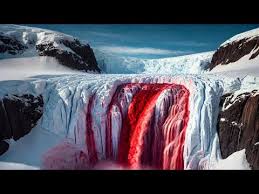
For over a century, the blood-red waterfall cascading from Taylor Glacier in Antarctica has puzzled scientists and captured imaginations. Known as Blood Falls, this five-story-tall crimson feature stains the ice with a striking hue, but its origin remained a mystery. Now, a new study offers a compelling answer: the brine feeding Blood Falls may be ancient seawater trapped millions of years ago when sea levels were higher. This discovery not only solves a long-standing geological puzzle but also provides a unique window into Earth’s climatic past and the potential for life in extreme environments.
A Century-Old Enigma
Blood Falls was discovered in 1911 by Griffith Taylor, a geologist on Robert Falcon Scott’s Terra Nova Expedition. Taylor, who also named the Dry Valleys, was the first to document the eerie red waterfall. For decades, scientists debated its source, with theories ranging from iron-oxidizing bacteria to algae or simply iron minerals from bedrock. It wasn’t until the late 20th century that researchers confirmed the red color comes from iron-rich brine that oxidizes (rusts) upon contact with air. But the ultimate origin of the brine remained elusive.
The New Study: A Marine Origin
The new study, published in a peer-reviewed journal, suggests that the brine feeding Blood Falls originated from seawater trapped in a basin or fjord millions of years ago. During the Miocene epoch (about 14–20 million years ago), sea levels were significantly higher—up to 30–60 meters above present levels. At that time, marine embayments may have extended into the McMurdo Dry Valleys, where Taylor Glacier now flows.
As sea levels dropped, the trapped seawater became isolated. Through a process called cryoconcentration, freezing concentrated the salts, leaving behind a hypersaline brine that remains liquid even at subzero temperatures due to its high salinity. This brine now discharges slowly through fractures in the glacier, emerging at the surface as Blood Falls.
Geochemical Fingerprints
The study likely used isotopic signatures—such as oxygen-18, deuterium, and strontium—to fingerprint the brine’s source. These geochemical tracers can distinguish between marine water, meteoric water (from precipitation), and ancient lake water. The results point to a marine origin, ruling out subglacial meltwater as the primary source. This is a significant finding because it ties the brine to a specific paleoclimatic period, offering insights into past Antarctic ice sheet dynamics and sea-level sensitivity.
Implications for Life and Astrobiology
Blood Falls is not just a geological curiosity; it’s a hotspot for microbial life. A landmark 2015 study by Lanoil et al. found a viable microbial ecosystem in the brine, with bacteria surviving without sunlight or oxygen, using sulfate and iron as electron acceptors. If the brine is indeed ancient seawater, these microbes may be descendants of marine organisms trapped for millions of years—a ‘time capsule’ ecosystem.
This makes Blood Falls a key analog for life on icy moons like Europa and Enceladus, which harbor subsurface oceans. Understanding the origin of the brine helps astrobiologists interpret potential biosignatures in such environments. If life can persist in a subglacial brine for millions of years, it bodes well for the possibility of life in similar extraterrestrial settings.
Addressing Misconceptions
Despite its name, Blood Falls is not a waterfall of blood. The red color is purely chemical—iron oxidation—not biological. The brine is also very cold, around −5°C to −10°C, and remains liquid due to its salinity, not geothermal heat. The discharge is intermittent and slow, often described as a ‘trickle’ or ‘seep’ rather than a vigorous waterfall. And importantly, the new study suggests the brine was emplaced in the subglacial basin beneath the glacier, not that seawater is frozen inside the glacier itself. The glacier later overrode the basin, and the brine now seeps out through fractures.
A Window into the Past
The origin of Blood Falls’ brine has broader implications for understanding Antarctica’s climatic history. The Miocene was a period of warmer conditions and higher sea levels, and the presence of marine brine in the Dry Valleys suggests that the East Antarctic Ice Sheet was more dynamic than previously thought. This has implications for predicting future sea-level rise in a warming world.
While the new study provides strong evidence for a marine origin, some researchers may argue that the brine could still be derived from subglacial meltwater that interacted with marine sediments. The distinction matters for interpreting the age and isolation of the brine. Nevertheless, the study marks a significant step forward in solving a century-old mystery.
The discovery that Blood Falls’ brine may be ancient seawater trapped millions of years ago not only solves a geological puzzle but also enriches our understanding of life’s resilience and Earth’s climatic history. As research continues, Blood Falls remains a captivating reminder of the hidden wonders beneath Antarctica’s ice.
Summary
- Blood Falls is a blood-red waterfall in Antarctica, colored by iron-rich brine that oxidizes on contact with air.
- A new study suggests the brine originated from seawater trapped in a basin or fjord millions of years ago when sea levels were higher.
- The brine was concentrated by freezing (cryoconcentration) and remains liquid due to its high salinity.
- Geochemical tracers point to a marine origin, ruling out subglacial meltwater as the primary source.
- The brine hosts a viable microbial ecosystem, making Blood Falls a key analog for life on icy moons.
FAQ
Q: What is Blood Falls?
A: Blood Falls is a five-story-tall, blood-red waterfall flowing from Taylor Glacier in Antarctica. The red color comes from iron-rich brine that oxidizes (rusts) upon contact with air.
Q: How did the brine form?
A: The brine likely originated from seawater trapped in a basin or fjord millions of years ago when sea levels were higher. As sea levels dropped, the seawater became isolated and concentrated by freezing, leaving a hypersaline brine that remains liquid at subzero temperatures.
Q: Is the water hot?
A: No, the brine is very cold, around −5°C to −10°C. It remains liquid due to its high salinity, not geothermal heat.
Q: Does Blood Falls flow continuously?
A: No, the discharge is intermittent and slow, often described as a ‘trickle’ or ‘seep’ rather than a vigorous waterfall.
Q: Why is Blood Falls important for astrobiology?
A: The brine hosts a viable microbial ecosystem that survives without sunlight or oxygen, making it a terrestrial analog for subsurface oceans on icy moons like Europa and Enceladus. Understanding its origin helps scientists interpret potential biosignatures in such environments.