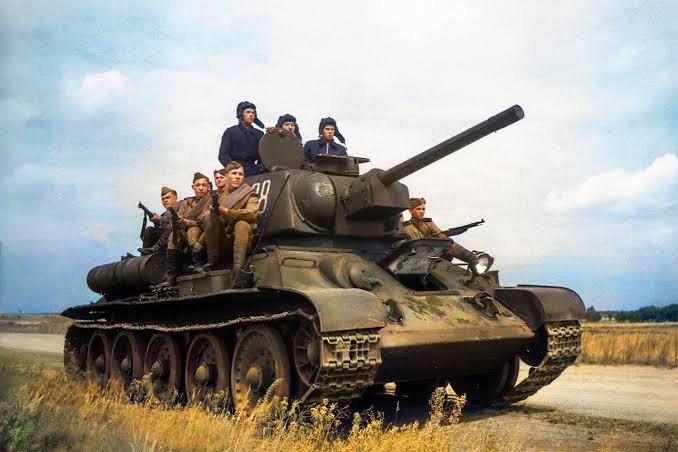
In the summer of 1941, German panzer crews advancing through the Ukrainian steppes encountered a sight that unsettled even the most battle-hardened veterans. A squat, green tank, its armor angled like a diamond, shrugged off shells that should have killed it and kept coming. This was the T-34, a machine that would redefine armored warfare and help turn the tide on the Eastern Front.
The T-34 was not the most powerful tank of World War II, nor the most heavily armored. But it was the right tank at the right time a synthesis of mobility, protection, and firepower that could be produced in staggering numbers. Against the technically impressive but often over-engineered German panzers, the T-34’s simplicity and ruggedness proved decisive.
The Shock of 1941
When Germany launched Operation Barbarossa in June 1941, its intelligence estimated the Soviet Union had about 10,000 tanks. In reality, the Red Army possessed over 23,000, including roughly 1,000 T-34s and KV-1 heavy tanks. These new Soviet tanks were a revelation. The T-34’s 45mm of sloped armor, angled at 60 degrees, provided the equivalent of 90mm of vertical protection enough to resist the standard German anti-tank guns of the time. German infantry anti-tank rounds bounced off, earning the T-34 the nickname “the invincible tank” among bewildered soldiers.
The T-34’s 76.2mm gun could penetrate the armor of any German tank in 1941, including the Panzer III and IV. Its wide tracks and powerful diesel engine allowed it to traverse mud and snow that bogged down German vehicles. The psychological impact was immediate. German officers reported “T-34 shock” (T-34-Schreck), a term that captured the demoralizing effect of encountering a tank that seemed to outclass their own.
Yet the T-34 was far from perfect. Early models lacked radios, forcing crews to communicate with flags. The two-man turret meant the commander had to load the gun, a serious tactical disadvantage. Poor optics made target acquisition difficult. These weaknesses, combined with poorly trained crews and disastrous Soviet tactics, resulted in horrific losses. In 1941, the Red Army lost thousands of tanks, often to mechanical breakdown or fuel shortage as much as to enemy fire.
The Design That Changed the War
The T-34’s design was the work of Mikhail Koshkin, an engineer at the Kharkiv Locomotive Factory. Koshkin and his team combined several innovative ideas into a single, coherent package. The Christie suspension, licensed from American designer J. Walter Christie, gave the T-34 outstanding cross-country mobility. The sloped armor, though not new, was applied more effectively than in any previous tank. The V-2 diesel engine, a 12-cylinder powerplant producing 500 horsepower, offered a range of 400 kilometers on roads double that of most German tanks—and was less likely to catch fire than gasoline engines.
Perhaps most importantly, the T-34 was designed for mass production. Its hull was cast and welded from simple, flat armor plates. The engine was robust and easy to maintain. When German forces threatened Kharkiv in late 1941, entire factories were dismantled and moved east of the Ural Mountains. Workers in Chelyabinsk, Nizhny Tagil, and Omsk resumed production within months, often working in unheated buildings in subzero temperatures. This logistical miracle meant that Soviet factories could churn out T-34s faster than the Germans could destroy them.
In 1942, Soviet industry produced approximately 24,000 T-34s. German tank production for all types that year was about 9,300. This disparity was the core of the T-34’s strategic impact. The Wehrmacht could win battles, but it could not survive a war of attrition. The T-34 was cheap, reliable, and available in numbers that overwhelmed German defenses.
The T-34 vs. the Panzer
German tanks were, in many ways, superior on a one-on-one basis. The Panzer III and IV were well-armed and well-protected for their time, and by 1943, the introduction of the Tiger I and Panther raised the bar further. The Tiger’s 88mm gun could destroy a T-34 at ranges beyond 2,000 meters, while its 100mm frontal armor was nearly impenetrable to the T-34’s 76mm gun. The Panther, with its long 75mm cannon and sloped armor, was arguably the best tank of the war in terms of firepower and protection.
But these tanks were expensive and complex. The Tiger weighed 57 tons, consumed vast amounts of fuel, and required extensive maintenance. Production of the Tiger never exceeded 1,347 units total. The Panther, though more numerous at about 6,000 units, suffered from mechanical breakdowns and engine fires. German tanks were also built to a high standard, which meant they took longer to produce and were harder to repair in the field.
The T-34, by contrast, was a study in pragmatism. It was less comfortable, less accurate, and less survivable in a direct duel. But it was available. When a German tank was knocked out, it stayed knocked out. When a T-34 was destroyed, another was often already rolling off the production line. Soviet losses in 1941–42 were staggering—some estimates put the ratio at 4:1 or worse but the Red Army could absorb those losses. The Wehrmacht could not.
The T-34/85: Restoring the Balance
By 1943, the appearance of the Tiger and Panther rendered the T-34’s 76mm gun obsolete. The Soviet response was the T-34/85, which mounted an 85mm gun derived from an anti-aircraft weapon. The new turret, larger and with a three-man crew, allowed the commander to focus on commanding rather than loading. The 85mm gun could penetrate the Tiger’s frontal armor at combat ranges, though the Tiger retained an advantage at long distances.
The T-34/85 entered production in late 1943 and quickly became the standard Soviet tank. It retained the same hull and engine as its predecessor, so production lines were not disrupted. By 1945, it was the most numerous tank in the Red Army, and it continued to serve in Soviet and allied armies for decades after the war.
The T-34’s influence extended far beyond World War II. Its design principles—sloped armor, diesel engine, Christie suspension—were adopted by post-war Soviet tanks like the T-54/55, which became the most-produced tank in history. Western designers also took note; the British Centurion and the German Leopard 1 incorporated lessons learned from the T-34’s success.
The Human Cost
Behind the statistics of production and loss are the men who crewed these machines. Soviet tank crews were often rushed through training, sometimes in just a few weeks. In the chaotic early years, many went into battle with little more than a basic understanding of their vehicle. The lack of radios meant that coordinated attacks were nearly impossible. The two-man turret of the T-34/76 forced the commander to double as loader, slowing the rate of fire and distracting him from observing the battlefield.
Despite these handicaps, skilled crews achieved remarkable results. Dmitry Lavrinenko, the top Soviet tank ace, destroyed 58 German tanks in a T-34 before his death in 1941. Aleksandr Burda, another ace, used the T-34’s mobility to outmaneuver and destroy enemy armor. These men proved that in the right hands, the T-34 could match any tank in the world.
But the cost was immense. Soviet tank crews suffered casualties that dwarfed those of their German counterparts, especially in the first two years of the war. The T-34’s armor, while effective against early German guns, was vulnerable to the Tiger’s 88mm and the Panther’s long 75mm. Crews had little protection if the tank caught fire; the ammunition stowage was poorly protected, and the diesel fuel, while less flammable than gasoline, could still ignite.
The Verdict
Was the T-34 truly superior to the German panzer? The answer depends on the measure. In a duel between individual vehicles, a Tiger or Panther would usually win. But war is not fought by individual vehicles; it is fought by armies, economies, and industrial capacities. The T-34 was designed not to win every engagement but to win the war. It was simple enough to be built by thousands of semi-skilled workers, reliable enough to operate in the brutal conditions of the Eastern Front, and cheap enough to be mass-produced. That combination proved decisive.
The T-34’s legacy is not one of technological brilliance but of pragmatic engineering. It was a tank that could be built in the snow, driven by a farmer turned soldier, and repaired with basic tools. It was a tank that, in the hands of a determined crew, could outfight and outlast the finest panzers Germany could produce. And it was a tank that, in the end, helped win the largest land war in history.
The T-34 was not the most sophisticated tank of World War II, but it was the most effective. Its design philosophy—simplicity, reliability, and mass production—outmatched the German approach of building smaller numbers of highly advanced machines. The T-34’s story is a reminder that in war, victory often goes not to the most brilliant weapon, but to the one that can be produced in the greatest numbers and used by ordinary soldiers to achieve extraordinary results.
Summary
- The T-34 combined sloped armor, a diesel engine, and Christie suspension into a design that was both mobile and well-protected for its era.
- German intelligence underestimated Soviet tank numbers by more than half, leading to the “T-34 shock” in 1941.
- Soviet factories produced about 24,000 T-34s in 1942 alone, while German tank production was only about 9,300 units.
- The T-34/85, introduced in 1943, restored parity against the Tiger and Panther with its 85mm gun.
- The T-34’s legacy influenced post-war tank design worldwide, including the T-54/55 and Western tanks like the Leopard 1.
FAQ
Q: Was the T-34 better than the German Tiger and Panther tanks?
A: In a one-on-one duel, the Tiger or Panther usually had the advantage in firepower and armor. However, the T-34 was produced in much larger numbers, was more reliable, and was easier to maintain, which gave the Soviet Union a strategic advantage that outweighed individual tank superiority.
Q: How many T-34 tanks were built?
A: Over 84,000 T-34s were produced in all variants from 1940 to 1958, making it the second-most-produced tank in history after the T-54/55.
Q: What made the T-34’s armor so effective?
A: The T-34’s 45mm armor was sloped at a 60-degree angle, which increased its effective thickness to about 90mm. This slope also caused incoming shells to deflect, especially when combined with the tank’s speed and maneuverability.
Q: Why did Soviet tank crews suffer such high casualties?
A: Early T-34s lacked radios, had poor optics, and used a two-man turret, which made coordination and situational awareness difficult. Additionally, many crews were rushed through training, and the tank’s ammunition storage was not well protected, leading to catastrophic fires when hit.
Q: What was the “T-34 shock”?
A: “T-34 shock” (T-34-Schreck) was a term used by German forces to describe the psychological impact of encountering the T-34 in 1941. German anti-tank guns and tank guns often failed to penetrate its armor, while the T-34’s gun could destroy German tanks with ease, demoralizing crews and commanders.