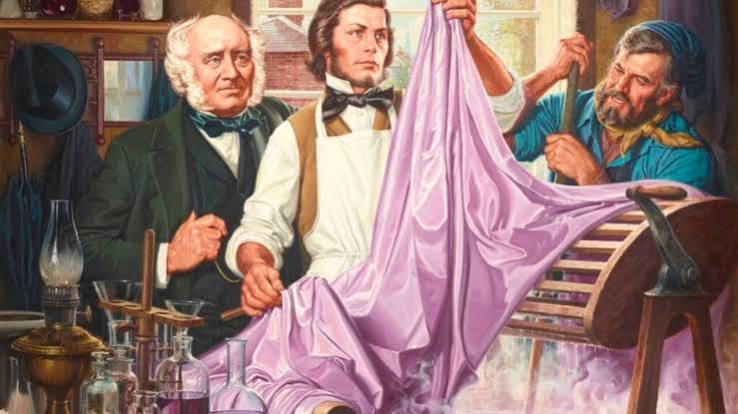
In 1856, an 18-year-old chemist named William Henry Perkin was trying to make quinine, a malaria treatment, from coal tar in his home lab. Instead, he got a black sludge that turned alcohol a brilliant purple. That sludge would become mauveine the first synthetic dye and it didn’t just change fashion; it kicked off the entire synthetic organic chemistry industry, leading to everything from synthetic perfumes to modern pharmaceuticals. This is the story of how a failed experiment painted the world in new colors and reshaped science, industry, and society.
The State of Color Before 1856
Before Perkin’s discovery, every color in every fabric came from nature. Indigo came from plants, madder from roots, and Tyrian purple from sea snails so rare that a single ounce could cost a fortune—literally, it was reserved for emperors and kings. Natural dyes were expensive, faded quickly, and varied wildly in shade depending on the season or soil where the source plant grew. The booming textile industry of the Industrial Revolution desperately needed something better: a cheap, consistent, colorfast dye that could be made in bulk.
A Teenager’s Failed Chemistry Experiment
Perkin was a prodigy. At 15, he enrolled at the Royal College of Chemistry in London, where he studied under August Wilhelm von Hofmann, a German chemist who had discovered how to derive aniline from coal tar. Coal tar was the gooey waste product of gas lighting—a stinky nuisance that cities didn’t know what to do with. Hofmann suggested that Perkin try to synthesize quinine, an antimalarial drug that was expensive and in high demand because of British colonies in tropical regions.
The prevailing theory—the “radical theory”—wrongly suggested that oxidizing a compound called allyltoluidine would yield quinine. Perkin followed the recipe, but instead of quinine, he got a dark, tarlike mess. Most young chemists would have tossed it out. But Perkin, curious, decided to test it in alcohol. The result was a stunning purple liquid. He immediately recognized that this color could be valuable as a dye—perhaps even more valuable than the quinine he’d been chasing.
From Sludge to Fashion Sensation
Perkin patented his discovery in August 1856 (British Patent No. 1984) and, with his family’s support, built a factory in Greenford Green, near London, to produce the dye at scale. By 1857, mauve was on the market. The name came from the French word for the mallow flower, which has a similar hue. At first, the dye was a hard sell—textile makers were skeptical. But in 1858, Queen Victoria wore a mauve silk gown to her daughter’s wedding, and suddenly everyone wanted mauve. “Mauve mania” swept Europe, and Perkin’s purple became a symbol of the modern age.
The Science of Serendipity
Perkin’s discovery is a textbook example of serendipity in science, but it wasn’t just luck. As Louis Pasteur famously said, “Chance favors the prepared mind.” Perkin had the training to understand what he was seeing and the entrepreneurial instinct to turn a mistake into a product. This accident also launched the field of synthetic organic chemistry. Perkin went on to synthesize coumarin, the first synthetic perfume, in 1868, and he developed a way to make alizarin, the red dye from madder, in 1869—a process that wiped out the natural madder industry.
Interestingly, the exact chemical structure of mauveine wasn’t fully understood for over a century. In 1994, researchers at the University of Wales (Swansea) used modern analytical techniques to reveal that Perkin’s mauve was actually a mixture of several related compounds, not a single pure substance. That discovery doesn’t diminish his achievement—it just shows how complex his “simple” dye really was.
The Birth of an Industry—and Its Migration to Germany
Perkin’s success proved that chemistry could be profitable, and the synthetic dye industry was born in Britain. But it didn’t stay there long. German companies like BASF, Bayer, and Hoechst invested heavily in dye research, and by the 1880s, Germany dominated the global market. This wasn’t just about color; those dye companies later pivoted to pharmaceuticals, and many early drugs—including aspirin and sulfa drugs—were derived from dye compounds. So Perkin’s accidental purple helped birth the modern pharmaceutical industry.
Perkin himself sold his factory in 1873 and retired from manufacturing to focus on pure research. Some historians see that as a missed opportunity for Britain, which lost its lead in chemical innovation to Germany. But Perkin’s decision also highlights a key shift: chemistry was becoming a field where academic research and industrial application were deeply intertwined.
What Mauve Taught Us
The accidental discovery of mauve shows how a single moment of insight, combined with hard work, can change the world. Perkin didn’t set out to revolutionize color—he was chasing a malaria cure. But his willingness to investigate the unexpected turned a failure into a triumph that democratized color, made textiles more affordable, and laid the groundwork for entire industries. The next time you see a bright, lasting color on a shirt or a bottle of perfume, you can thank the 18-year-old who saw a purple miracle in a pile of coal tar sludge.
Perkin’s mauve was more than a fashion trend; it was a chemical key that unlocked a new world of synthetic materials. From dyes to drugs to plastics, the chain of discovery that began with that 1856 mistake still runs through our lives today. It’s a reminder that the next big breakthrough might come from a failed experiment—if you’re prepared to see it.
Summary
- In 1856, 18-year-old William Henry Perkin accidentally created the first synthetic dye while trying to make quinine.
- The dye, mauveine or mauve, was made from coal tar, a waste product of gas lighting.
- Perkin patented it and built a factory, and the color became a sensation after Queen Victoria wore it.
- The discovery launched synthetic organic chemistry and led to synthetic perfumes, alizarin, and ultimately the German dye and pharmaceutical industries.
- Modern analysis showed mauveine was a mixture of compounds, but its impact remains clear.
FAQ
Q: Why was quinine synthesis important in 1856?
A: Quinine was the main treatment for malaria, which was a major health problem in British colonies. It was expensive and hard to get, so chemists wanted to make it synthetically.
Q: What exactly is coal tar, and why was it relevant?
A: Coal tar was a smelly byproduct of gas lighting. It was mostly waste, but chemists like Perkin knew it contained valuable compounds like aniline, which could be used to make new materials.
Q: Was Perkin the first to discover a synthetic dye?
A: He was the first to discover a synthetic dye that could be produced and sold commercially. His patent and factory made it practical, not just a laboratory curiosity.
Q: How did mauve become so popular?
A: Queen Victoria wore a mauve silk gown to her daughter’s wedding in 1858, sparking a fashion craze. The color was new, vibrant, and more affordable than natural purple dyes.
Q: What happened to the synthetic dye industry after Perkin?
A: It grew rapidly but shifted to Germany, where companies like BASF and Bayer dominated. That German lead later helped them dominate pharmaceuticals, since many early drugs came from dye research.