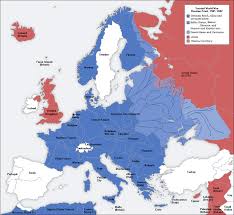
In 1940, after the fall of France, the map of Europe turned almost entirely gray with Axis occupation. Yet three small western nations Switzerland, Sweden, and Spain remained unoccupied, their flags flying over capitals that never saw a single German tank. Their neutrality, however, was not a quiet absence from the war. It was a high-wire act, a daily negotiation with survival, and a moral tightrope that each nation crossed differently.
This is the story of how these countries fed their people, armed their borders, and wrestled with their consciences while the world burned around them. It is a story of ration books and refugee lines, of secret railway carriages and wolfram mines, and of the painful compromises that kept them out of the war but not untouched by it.
Switzerland: The Armed Hedgehog
When German forces swept through the Low Countries and into France in May 1940, Switzerland found itself completely surrounded by the Axis. The Swiss response was swift and defiant. General Henri Guisan, the commander-in-chief, ordered the mobilization of up to 850,000 soldiers roughly 20% of the entire population. Every able-bodied man had a rifle and a place in the line.
But Guisan had a plan that was less about holding the border and more about making conquest futile. From 1940 onward, the Swiss army withdrew into the Réduit, a fortified redoubt deep in the Alps. The lowlands, where most of the population and industry lived, would be ceded to an invader. But the mountains would become a fortress, with tunnels, bunkers, and artillery hidden in the rock. Any invader would pay a terrible price for the lowlands and still face an unbreakable core. The strategy was simple: make Switzerland too expensive to take.
Life on the home front was a lesson in scarcity. Food, clothing, and fuel were rationed using a points system. Every family received a booklet of coupons, and every purchase—bread, butter, shoes, coal—required points. The government, under agronomist Friedrich Wahlen, launched a crash program to make the country self-sufficient. Every patch of arable land was pressed into service: parks became potato fields, and flower beds gave way to cabbage. By 1943, Swiss farmers were producing about 60% of the nation’s food, a remarkable feat for a country that had imported heavily before the war.
Yet the Swiss also made a devil’s bargain. Encircled by the Axis, they had to trade with Germany to survive. They imported coal and food, and in return, they sold precision instruments, machine tools, and armaments. Swiss banks, through a plan negotiated by diplomat Paul Walen, bought gold from the Reichsbank—much of it looted from occupied countries. This trade kept the Swiss economy afloat but also kept the German war machine running. It was a moral stain that would haunt the country for decades.
The refugee question was equally fraught. Switzerland officially admitted around 300,000 refugees during the war, including interned soldiers and civilians. But the policy was painfully restrictive. Between 1942 and 1943, Swiss border guards turned away tens of thousands of Jewish refugees, often sending them back to almost certain death in occupied France. It was only in 1944, as the war turned, that the doors opened wider. The Swiss also interned about 100,000 foreign soldiers—mostly Allied and Italian—who had crossed the border. These men were housed in camps and often put to work on roads and farms.
Sweden: The Pragmatic Neutral
Sweden’s neutrality was of a different sort. While Switzerland was physically surrounded, Sweden had a coastline and a long border with German-occupied Norway. It also had something Germany desperately needed: iron ore. From the mines of Kiruna in the far north, Sweden supplied about 75% of Germany’s iron ore during the war. This was not a trivial export; it was the backbone of the German arms industry.
In exchange, Sweden allowed German troops and war materiel to transit its railways. This “permittenttrafik” was a massive concession. Over the course of the war, up to two million German soldiers passed through Sweden on their way to and from Norway and Finland. The most glaring breach came in 1941, when a fully armed German division—the Engelbrecht Division—was allowed to travel from Norway to Finland through Swedish territory. This move caused a domestic political crisis, known as the “Midnight Crisis,” and revealed how far Sweden was willing to bend to German pressure.
But the Swedish government, led by Prime Minister Per Albin Hansson, was playing a longer game. They believed that a too-close alliance with the Allies would invite invasion, and a too-close alliance with Germany would make them a target. So they made concessions, but they also quietly prepared. Defense spending skyrocketed from about 4% to 25% of GDP. The military was modernized, and plans were drawn up for a possible German attack.
On the home front, life was a study in rationing. Coffee, sugar, gasoline, and tires were all rationed. A bland “mixed bread” made from rye and other grains was mandated to stretch wheat supplies. The black market flourished, and many Swedes grew vegetables in their gardens. Yet the country was not starving, and the economy remained functional.
The turn came after the German defeat at Stalingrad in 1943. Sweden began to tilt toward the Allies. The troop transits stopped. Swedish airfields were opened to Allied airmen in need of emergency landing. And the refugee policy changed dramatically. Sweden accepted around 200,000 refugees in total, including 8,000 Danish Jews who were smuggled across the Øresund in October 1943, and about 30,000 Norwegian resistance members and Jews. It also took in 30,000 Baltic conscripts from the German army. In 1945, Count Folke Bernadotte’s “White Buses” operation rescued 15,000 to 20,000 prisoners from German concentration camps. It was a humanitarian record that helped balance the earlier, darker compromises.
Spain: The Hungry Neutral
Spain had just emerged from its own civil war, a brutal conflict that left the country in ruins when World War II began. The economy was shattered. Wheat production had fallen to about 30% of pre-war levels. The 1940s became known as “los años del hambre”—the years of hunger. Bread, oil, and other staples were rationed from 1939, and the rationing did not end until 1952. For many Spaniards, the war years were a daily struggle against starvation.
Franco’s regime was ideologically aligned with the Axis. He had come to power with German and Italian help, and he owed them a debt. But he was also a pragmatist. In October 1940, he met Hitler at Hendaye, on the French-Spanish border. Franco demanded Gibraltar, French Morocco, and massive food aid as the price for entering the war. Hitler balked at the demands, and the meeting ended without a deal. Spain would remain officially “non-belligerent”—not neutral, but not at war.
Still, Spain found ways to support the Axis without formally joining. The most famous was the Blue Division, some 47,000 Spanish volunteers who fought on the Eastern Front against the Soviet Union from 1941 to 1943. These men were officially volunteers, not state forces, but they were a clear signal of Franco’s sympathies. They were eventually withdrawn as the war turned.
Spain also traded with both sides. The most critical export was tungsten, or wolfram, a metal essential for armor-piercing shells. Germany bought Spanish tungsten until 1944, when Allied pressure—the “wolfram crisis”—forced a cutoff. In return, Spain received German arms and technology. Spanish ports quietly served as resupply points for German U-boats, and Spanish intelligence cooperated with the Abwehr.
On the refugee front, Spain was inconsistent. It allowed perhaps 20,000 to 30,000 Jewish refugees to transit through the country, often via the Pyrenees route. But the policy was erratic, sometimes depending on bribes or the whim of a local official. Some were saved; others were turned back. Spain also accepted thousands of Allied airmen who crash-landed on Spanish soil, most of whom were repatriated.
For ordinary Spaniards, the war was less about politics and more about survival. The black market was rampant, and hunger was a constant companion. And yet, compared to the occupied nations of Europe, Spain had a measure of freedom. There was no Gestapo, no forced labor, no deportations. The price was a regime that would remain in power for decades, its economy stunted by isolation and its politics frozen in the shadow of civil war.
What Neutrality Meant
These three countries were not passive bystanders. They were active participants in a war they officially avoided. Their neutrality was a constantly negotiated position, shaped by geography, economics, and the shifting fortunes of battle. Switzerland had to balance its armed defiance with trade with the Axis. Sweden had to balance its iron ore exports with its growing humanitarian role. Spain had to balance its Axis sympathies with the desperate needs of its own people.
In the end, all three survived the war without invasion. But the survival came at a cost. They made moral compromises, some of which would take decades to confront. And they proved that neutrality was never a comfortable middle ground—it was a tightrope walk, where one misstep could mean destruction, and where the safety of the nation often came at the expense of others.
The neutrality of Switzerland, Sweden, and Spain during World War II was not a simple refusal to take sides. It was a series of high-stakes calculations, each nation trading with the devil to keep its people alive. They emerged from the war with their flags intact, but the war left its mark on all of them—in the ration books, the refugee policies, and the quiet compromises that history would later judge.
Summary
- Switzerland mobilized 20% of its population and retreated to an alpine redoubt, but traded with Germany and turned away many Jewish refugees.
- Sweden supplied 75% of Germany’s iron ore and allowed troop transits, but later shifted to the Allies and rescued thousands of concentration camp prisoners.
- Spain, devastated by civil war, remained officially non-belligerent, sent volunteers to the Eastern Front, and traded tungsten to Germany while its people starved.
- All three countries maintained official neutrality but made pragmatic concessions that kept them out of the war while deeply involving them in it.
FAQ
Q: Why didn’t Germany invade Switzerland?
A: The Swiss Réduit strategy made conquest prohibitively costly, and Switzerland’s trade with Germany was more valuable than its occupation.
Q: How many refugees did Switzerland accept?
A: About 300,000 total, but tens of thousands of Jewish refugees were turned away at the border in 1942–1943.
Q: What was the ‘Midnight Crisis’?
A: In 1941, Sweden allowed a fully armed German division to transit its territory, causing a political crisis that highlighted Sweden’s concessions to Germany.
Q: Did Spain fight in World War II?
A: Spain sent volunteers (the Blue Division) to fight on the Eastern Front, but the state never formally entered the war.
Q: What were ‘los años del hambre’?
A: The ‘years of hunger’ in Spain during the 1940s, when food rationing and economic collapse led to widespread starvation.