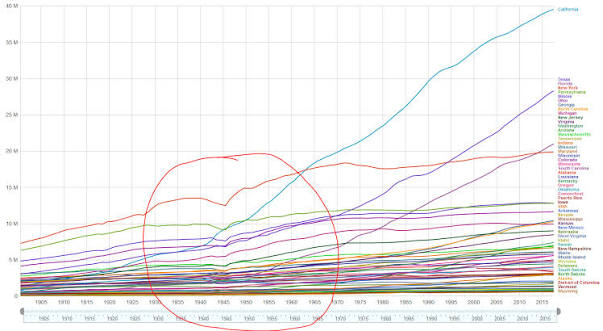
In 1940, one in ten Americans was unemployed, and the country’s industrial heartland was the Northeast and Midwest. By 1945, the map of where Americans lived had been redrawn. The war had set in motion the largest internal migration in U.S. history 15 million people crossed state lines, roughly one in ten Americans and the direction was unmistakably south and west.
The Pre-War Map
Before Pearl Harbor, the United States was a different country. The South was poor, agricultural, and segregated. The West was sparsely populated, dependent on timber, mining, and farming. The Great Depression still lingered, with unemployment hovering around 15 percent. The classic Great Migration of African Americans from the rural South to Northern cities had already been underway for three decades, but the West Coast had relatively small Black populations Los Angeles counted just 75,000 Black residents in 1940.
The War as Catalyst
The attack on Pearl Harbor on December 7, 1941, changed everything. The federal government mobilized for war, and the War Production Board began directing contracts to locations with available labor, land, and power. Defense spending during WWII reached roughly $300 billion in 1940s dollars, and about 70 percent of war contracts went to just a handful of states: California, Washington, Texas, New York, and Michigan.
California alone received about 10 percent of all prime war supply contracts. Los Angeles County received more war contracts than any single state except California itself. The aircraft industry in Southern California Lockheed, Douglas, North American became a magnet for workers. Shipbuilding boomed in the Pacific Northwest, in Portland, Seattle, and Vancouver. Military bases sprouted across the South and West, chosen for year-round flying weather and cheap land San Diego, Norfolk, San Antonio, Phoenix, and inland California cities like Riverside and Fresno.
The Westward Surge
The result was explosive growth. California gained nearly 2 million residents between 1940 and 1945, making it the fastest-growing state in the nation. Sunbelt cities—Los Angeles, San Diego, Phoenix, Houston, Dallas, Atlanta, Miami—saw their populations soar. Meanwhile, rural areas and the Rust Belt stagnated or declined as workers left for defense jobs.
This was not just a continuation of earlier trends; it was a distinct, war-driven phenomenon. The federal government was, in effect, moving the population. The Pacific Coast transformed from a resource-extractive periphery into a manufacturing powerhouse.
The Second Great Migration
The war also marked the beginning of the second wave of the Great Migration, when African Americans left the South in even larger numbers than before. During the 1940s alone, about 1.5 million Black Americans left the South, many drawn to West Coast defense plants like the Kaiser Shipyards in Richmond, California, and aircraft factories in Los Angeles, where labor shortages were acute.
But the war was not a haven of racial equality. Black migrants faced discrimination in housing, unions, and the military itself, which remained segregated until 1948. Race riots erupted in 1943 in Detroit, Harlem, and Los Angeles—the Zoot Suit Riots. The experience gave rise to the “Double V” campaign: victory abroad against fascism, victory at home against racism. The political base for the Civil Rights Movement was being built, as Black voters in Northern and Western cities gained influence.
The White Migrant Experience
Millions of white Southerners, many from Appalachia and the rural South, also moved to defense plants in the Midwest and West. The “Okies” and “Arkies” of the Dust Bowl era continued their westward trek, now finding work in California’s war industries. They too faced stigma, labeled “hillbillies” and often settling in segregated white working-class neighborhoods.
The Post-War Legacy
The shift did not end in 1945. Cold War defense spending kept the Sunbelt booming. The GI Bill of 1944 subsidized housing and education, disproportionately benefiting veterans who settled in the South and West. The interstate highway system, air conditioning, and suburbanization further entrenched the region’s rise. By 1960, California had surpassed New York as the most populous state—a position it held until 2020.
World War II was not just a conflict fought overseas; it was a domestic revolution. The federal government’s wartime spending—directed to the coasts and the South—permanently reoriented the nation’s economy and population. The 15 million Americans who moved during the war years carried the country’s center of gravity with them, and the Sunbelt’s dominance today is a direct legacy of the choices made in 1941.
Summary
- WWII triggered the largest internal migration in American history: 15 million people moved across state lines between 1940 and 1945.
- California gained ~2 million residents, becoming the fastest-growing state, driven by aircraft manufacturing and shipbuilding.
- The South and West received the bulk of $300 billion in defense spending, with ~70% of war contracts going to just a handful of states.
- The war marked the beginning of the Second Great Migration, as 1.5 million African Americans left the South during the 1940s, many heading west.
- The GI Bill and Cold War spending extended the shift, cementing the Sunbelt’s rise and California’s status as the most populous state by 1960.
FAQ
Q: How many Americans moved during WWII?
A: Roughly 15 million Americans moved across state lines during the war years (1940–1945), about one in ten of the population.
Q: Why did the population shift south and west?
A: The federal government directed defense contracts and military bases to the South and West due to available labor, land, climate, and power resources. California alone received ~10% of all prime war supply contracts.
Q: What was the Second Great Migration?
A: The Second Great Migration (1940–1970) was the larger, more westward-oriented wave of African American migration from the South. During the 1940s alone, ~1.5 million Black Americans left the South, many for West Coast defense jobs.
Q: Did the migration end after the war?
A: No. The GI Bill, Cold War defense spending, and later the interstate highway system and air conditioning continued to attract people to the Sunbelt. California surpassed New York as the most populous state in 1960.
Q: What were the social impacts of the migration?
A: The migration created both economic opportunity and racial tension. Discrimination in housing and jobs persisted, leading to race riots in 1943. It also built a political base for the Civil Rights Movement.