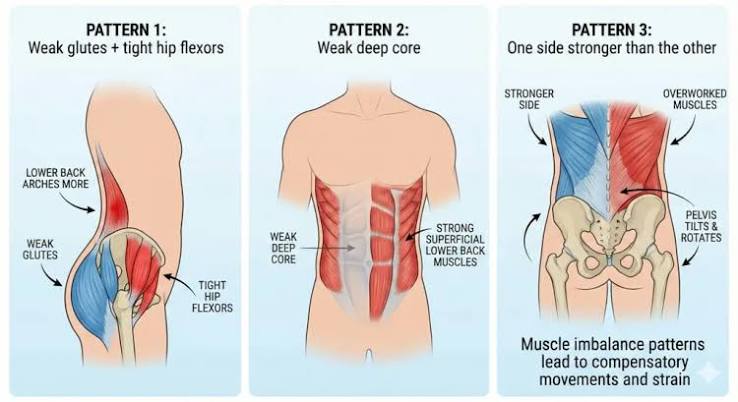
You’ve likely seen the headline: “Stretch this one muscle to fix all back pain.” It’s an appealing promise—a single, simple solution to a condition that affects an estimated 60–80% of people at some point in their lives. The muscle in question is usually the psoas, a deep hip flexor that connects your spine to your leg. But can it really be that simple?
No. And the reasons why reveal a lot about how back pain works—and how to actually find relief.
The Anatomy of the Claim
The psoas major is a unique muscle. It originates from the vertebrae in your lower back (T12–L5), passes through the pelvis, and attaches to the top of your thigh bone. It’s the only muscle that directly connects your spine to your leg, making it a key player in posture, walking, and stability.
When the psoas is tight, it can tilt your pelvis forward, increasing the arch in your lower back. That position, called anterior pelvic tilt, can strain the lumbar spine and contribute to pain. So the logic behind the stretch makes sense: loosen the psoas, reduce the tilt, and the pain should ease.
But here’s the catch: not all back pain comes from a tight psoas. In fact, most back pain is “non-specific,” meaning doctors can’t pinpoint a single anatomical cause. The American College of Physicians and NICE guidelines emphasize that exercise, education, and staying active are the most effective approaches—not stretching one muscle.
Why the “One Muscle” Narrative Persists
Simplification sells. In a world of information overload, “stretch one muscle, fix your back” is a compelling hook. It offers agency and hope. And the psoas has a plausible biomechanical story, which makes it an easy target for fitness influencers and even some well-meaning physical therapists.
But the evidence doesn’t support the silver bullet. A 2017 Cochrane review found that exercise—including stretching—can reduce pain and improve function in chronic low back pain, but no single exercise outperforms the rest. A 2020 review in JOSPT showed that hip flexor stretching can improve hip extension and reduce anterior pelvic tilt, but the link to back pain relief is inconsistent.
The Real Culprits: Weakness, Not Just Tightness
Many people with back pain have weak glutes and core muscles, not just tight hip flexors. When those muscles are weak, the lower back overworks, leading to strain. Stretching a tight psoas won’t fix weak glutes. In fact, over-focusing on flexibility can lead to “stretch addiction,” where you neglect the strengthening work that often brings more lasting relief.
Consider the gluteus maximus—the largest muscle in your body. When it’s underactive, your back muscles have to compensate. Some practitioners argue that strengthening the glutes is more crucial than stretching the psoas. Similarly, the diaphragm, which controls breathing and intra-abdominal pressure, is often overlooked. It’s a core stabilizer that influences spinal support.
When Stretching the Psoas Actually Helps
For a specific subset of people, psoas stretching is genuinely beneficial. If you have confirmed hip flexor tightness and an anterior pelvic tilt—assessed by a physical therapist using something like the Thomas test—then targeted stretches can provide relief.
But for others, stretching the psoas could be counterproductive. If your pain comes from a disc problem, facet joint dysfunction, or hypermobility, aggressive stretching may worsen symptoms. A tight psoas might be a symptom of poor movement patterns, not the root cause.
The Multifactorial Nature of Back Pain
Back pain is biopsychosocial. Stress, sleep quality, beliefs about pain, and activity levels all play a role. A 2020 global study found that low back pain is the leading cause of years lived with disability. That’s a huge problem with many inputs, and no single stretch is going to solve it.
If you’re in pain, don’t chase a magic bullet. Instead, work with a professional to identify what’s actually going on. A balanced approach—stretching tight muscles, strengthening weak ones, staying active, and managing stress—is far more likely to help than any single “fix.”
The idea that one muscle stretch can fix all back pain is a myth. But that doesn’t mean stretching the psoas is useless. For some people, it’s a valuable piece of the puzzle. The key is to stop looking for a single answer and start addressing the whole picture: strength, mobility, movement patterns, and lifestyle. Your back will thank you.
Summary
- Back pain is multifactorial; no single muscle stretch can fix all cases.
- The psoas is a key hip flexor, but tightness is just one possible contributor.
- Most back pain is non-specific, and guidelines recommend a broad approach of exercise and education.
- Stretching alone won’t fix weak glutes or core; strengthening is often more beneficial.
- Proper assessment by a professional can determine if psoas stretching is right for you.
FAQ
Q: Can stretching the psoas help with back pain?
A: Yes, for some people with confirmed hip flexor tightness and anterior pelvic tilt, it can provide relief. But it’s not a universal fix.
Q: What’s the best stretch for back pain?
A: There is no single best stretch. A combination of stretching, strengthening, aerobic exercise, and education is most effective, according to clinical guidelines.
Q: Why do so many people recommend the psoas stretch?
A: Because it has a plausible biomechanical link to back pain, and it’s an easy message to sell. But evidence doesn’t support it as a cure-all.
Q: How do I know if my psoas is tight?
A: A physical therapist can assess this with tests like the Thomas test. Signs include an increased arch in your lower back and tightness in the front of your hip after sitting.
Q: What should I do instead of just stretching?
A: Focus on a balanced routine: strengthen your glutes and core, stretch tight muscles, stay active, and manage stress. Consult a professional for a personalized plan.