Nvidia has been the undisputed king of the AI boom, its market cap briefly touching $3 trillion in June 2024. But beneath the surface, a wave of selling has been building—not from retail traders, but from some of the world’s most sophisticated institutional investors. The second-quarter 13F filings, released in August, revealed that Bridgewater Associates, D. E. Shaw, Citadel, and even Soros Fund Management all trimmed or exited their Nvidia positions. This isn’t a story of panic, but of quiet, calculated moves based on data that goes beyond stock price.
Why would funds that rode Nvidia’s 200% rally in 2023 and another 150% surge in early 2024 suddenly hit the sell button? The answer lies in a mix of valuation metrics, portfolio risk management, and a subtle but telling shift in market dynamics. It’s a reminder that even the hottest stock can lose its luster when the numbers start to whisper caution.
The 13F Filings: A Mixed Picture
The most tangible evidence of institutional selling comes from the mandatory 13F filings for the quarter ending June 30, 2024. These documents, which reveal the holdings of large money managers, showed a clear pattern of profit-taking at several marquee funds:
- Bridgewater Associates: Sold roughly 4.8 million shares, cutting its stake by over 80%.
- D. E. Shaw: Reduced its Nvidia position by about a third.
- Citadel Advisors: Trimmed by 9%.
- Soros Fund Management: Exited entirely, selling its remaining shares.
But it’s not a universal exodus. Renaissance Technologies, the quant powerhouse, actually increased its stake. This isn’t a coordinated dump; it’s a rotation. Some funds are locking in massive gains, while others see opportunity in the AI trade’s continued momentum.
The insider selling story adds another layer. CEO Jensen Huang sold over $700 million worth of Nvidia stock in the first half of 2024, including $294 million in June alone. CFO Colette Kress and EVP Ajay Puri also offloaded shares. These sales were pre-arranged through 10b5-1 plans, which schedule trades months in advance to avoid insider trading accusations. Still, the sheer dollar volume makes headlines and feeds retail anxiety, even though Huang’s remaining stake is worth tens of billions.
The Data That Spooked the Quants
For funds like Bridgewater, the sell decision often comes down to portfolio math, not company fundamentals. Bridgewater is famous for its risk parity approach, which balances assets based on their volatility and correlation. Nvidia’s stock is a volatility monster—its daily swings can be several times that of the S&P 500. After the stock’s surge to $3 trillion, Nvidia’s weight in risk-parity portfolios likely became outsized relative to its risk contribution.
In plain terms, holding too much Nvidia would blow up the portfolio’s risk budget. The data they saw wasn’t a red flag on Nvidia’s business; it was a red flag on their own portfolio’s variance. Selling a chunk of Nvidia was a way to bring risk back to target levels, not a bet against AI.
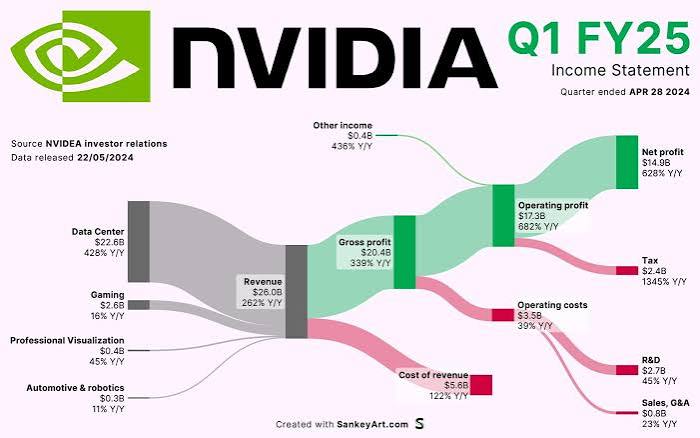
This dynamic is amplified by Nvidia’s valuation. As of late 2024, the stock trades around 30–35 times forward earnings and roughly 20 times sales. That’s a premium to the S&P 500, which trades around 20 times earnings. For a company growing as fast as Nvidia, such multiples might be justified, but they leave little room for error. If growth slows even slightly, the stock could get hit hard.
The Customer Concentration Problem
Another piece of data that gives long-term investors pause is Nvidia’s customer concentration. A large chunk of its revenue comes from a handful of hyperscalers—Microsoft, Meta, Amazon, and Google. These tech giants are spending billions on Nvidia’s H100 and H200 GPUs to train large language models, but they’re also developing their own custom silicon (like Google’s TPU). If any of them decide to slow AI spending or shift to in-house chips, Nvidia’s growth rate would decelerate sharply.
This isn’t a near-term threat, but it’s a structural risk that some funds are starting to price in. The AI capex cycle is enormous, but it’s not guaranteed to last forever. Morgan Stanley and other bearish analysts have drawn parallels to the fiber-optic bubble of 2000, when companies overbuilt infrastructure that eventually became a glut. Bulls at Goldman Sachs argue AI is still in its early innings, but the debate itself adds to the uncertainty.
A Broader Market Shift
Since July 2024, Nvidia’s stock has been consolidating—trading sideways—while other sectors like financials, utilities, and small caps have rallied. This is a classic sign of capital rotation. After a massive run-up in AI leaders, fund managers are taking profits and moving into laggards. It’s not a vote of no-confidence in Nvidia, but a rebalancing of portfolios to capture gains elsewhere.
This rotation is partly driven by macro expectations. In late 2024, markets began pricing in a potential soft landing or even a mild recession. If the economy slows, enterprise IT spending—a key driver of Nvidia’s data center revenue—could come under pressure. Nvidia is a cyclical stock in tech clothing, and cyclical stocks often get sold first when the economic outlook dims.
The Bottom Line
The selling of Nvidia stock by institutional investors is not a sign that the AI bubble is bursting. It’s a rational response to data: portfolio risk models flagging excessive volatility, valuation metrics stretched to historic highs, and a customer base that holds significant bargaining power. For retail investors, the lesson isn’t to panic-sell, but to understand that even the best companies can see their stocks stall when big money decides to take profits. The question isn’t whether Nvidia’s technology will dominate—it likely will. The question is at what price that dominance is worth paying for.
Nvidia’s stock isn’t falling off a cliff; it’s being trimmed by institutions that know when to say when. The data they saw—risk budgets, customer concentration, and valuation extremes—are all signals that the easy money in AI has been made. That doesn’t mean Nvidia can’t go higher, but it does mean the ride will be bumpier. For investors, the takeaway is to watch the fundamentals, not just the headlines, and to remember that even the most brilliant companies can be overpriced.
Summary
- Institutional selling is real but not universal: Bridgewater, D. E. Shaw, and Citadel trimmed Nvidia stakes in Q2 2024, but Renaissance Technologies increased its position.
- Insider sales are pre-scheduled: CEO Jensen Huang’s $700M+ sales in early 2024 were via 10b5-1 plans, yet they still weigh on sentiment.
- Valuation and risk metrics drive decisions: Nvidia’s forward P/E of ~30x and price-to-sales of ~20x are rich, and its volatility can blow up risk-parity portfolios.
- Customer concentration is a structural risk: Heavy reliance on a few hyperscalers like Microsoft and Meta means any slowdown in their AI spending could hurt Nvidia.
- Capital is rotating: Nvidia’s sideways move since July 2024, while other sectors rally, suggests profit-taking and a shift to laggards.
FAQ
Q: Are institutional investors abandoning Nvidia entirely?
A: No. The selling is selective. While some funds like Soros exited completely, others like Renaissance Technologies added to their positions. It’s a rotation, not a mass exodus.
Q: Why do insiders sell if they believe in the company?
A: Insider sales, like Jensen Huang’s, are usually pre-arranged through 10b5-1 plans to avoid accusations of insider trading. They represent a small fraction of the executive’s total holdings and are often for personal financial planning.
Q: What is risk parity and why does it matter for Nvidia?
A: Risk parity is an investment strategy that balances a portfolio based on risk, not just dollar amounts. Nvidia’s high volatility means it consumes a large ‘risk budget,’ so when its price rises, funds may sell to keep portfolio risk in check.
Q: Should retail investors be worried about Nvidia’s customer concentration?
A: It’s a risk to monitor. If major customers like Microsoft or Meta build their own AI chips or cut spending, Nvidia’s growth would slow. But for now, demand for Nvidia’s GPUs remains extremely strong.
Q: Is Nvidia in a bubble?
A: Opinions are split. Some analysts compare the AI capex cycle to the dot-com fiber bubble, while others see AI as a long-term growth story. The stock’s premium valuation leaves little room for error, so a slowdown could lead to a sharp correction.