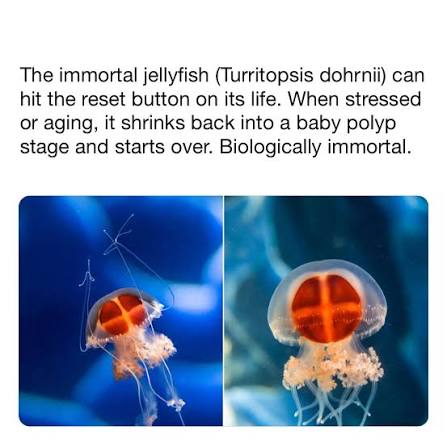
In the late 1980s, a German marine biology student named Christian Sommer was watching a batch of jellyfish in his lab. Most of them were doing what jellyfish do: swimming, eating, and eventually dying after reproducing. But one species, barely the size of a pinky nail, did something no one expected. Instead of dying, it shrank back into its juvenile polyp stage, essentially reversing its development. That species, now known as Turritopsis dohrnii, has been dubbed the ‘immortal jellyfish’—and its trick has fascinated biologists ever since.
This tiny creature, about 4.5 millimeters across, can cheat death in a way that no other multi-celled animal can. It doesn’t just slow aging; it turns back the clock entirely. When stressed, it transforms its mature cells into a younger state, rebuilding its body from scratch. This ability, called transdifferentiation, has profound implications for our understanding of aging, stem cells, and even regenerative medicine.
In this article, we’ll explore how the immortal jellyfish pulls off this remarkable feat, why it matters beyond the realm of jellyfish, and what scientists hope to learn from it.
A Life Cycle That Goes in Reverse
Most jellyfish follow a predictable script. A fertilized egg becomes a planula larva, which settles on the seafloor and grows into a polyp—a sessile, tube-like creature that buds off tiny medusae. These medusae grow into the familiar bell-shaped jellyfish that swim freely, reproduce, and then die within weeks or months.
Turritopsis dohrnii follows this script—until it doesn’t. When the medusa faces stress, whether it’s starvation, physical injury, or a sudden change in water temperature or salinity, it doesn’t just die. Instead, it sinks to the bottom, its tentacles and bell begin to degrade, and its cells reorganize into a cyst-like blob. Within days, that blob develops into a new polyp, which can then bud off fresh medusae. This isn’t a one-time trick; the jellyfish can cycle through this process repeatedly, effectively resetting its biological clock indefinitely.
This reversal is not the same as simply living a long time. Some animals, like certain tortoises and whales, exhibit ‘negligible senescence’—they age so slowly that they seem to defy time. But T. dohrnii goes further: it actively reverses its development, turning an adult body back into a juvenile one. It’s as if a butterfly could transform back into a caterpillar and then into a butterfly again, over and over.
The Cellular Magic: Transdifferentiation
How does a jellyfish accomplish this feat? The key is a process called transdifferentiation, where a mature, specialized cell transforms directly into a different cell type without going through a stem-cell intermediate.
In most animals, once a cell becomes a muscle cell or a nerve cell, it stays that way. But in T. dohrnii, cells from the bell, tentacles, and other tissues ‘forget’ their identity and revert to a more flexible state. They then reorganize into the different cell types needed for a polyp.
This is a stark contrast to how our own bodies repair damage. When we get a cut, our skin cells divide to fill the gap, but they don’t turn into liver cells or brain cells. The jellyfish’s ability to reprogram its cells is a form of cellular plasticity that goes far beyond what we see in humans.
Transdifferentiation isn’t unique to the immortal jellyfish—salamanders can regenerate limbs, and planarian flatworms can regrow their entire bodies from small fragments. But those animals still age. T. dohrnii is the only known metazoan that can reverse its developmental trajectory entirely.
The Genetic Blueprint: What the Genome Reveals
In 2022, a Chinese research team sequenced the genome of T. dohrnii and published their findings in the Proceedings of the National Academy of Sciences. The results offered a molecular glimpse into the jellyfish’s superpower.
The genome shows expansions in genes related to DNA repair, telomere maintenance, and cell-cycle regulation. Telomeres are the protective caps at the ends of chromosomes; in most animals, they shorten with each cell division, acting as a biological clock. In T. dohrnii, however, telomere length is maintained during reversal, suggesting that the jellyfish has evolved mechanisms to protect its genetic material from the wear and tear of aging.
The study also highlighted the role of the PI3K/Akt signaling pathway and FoxO transcription factors—molecules that are implicated in longevity and stress resistance across many species, including humans. These pathways help cells respond to stress and may be crucial for triggering the reversal process.
Why Does It Matter for Human Biology?
You might be wondering: if a jellyfish can live forever, what does that mean for us? The honest answer is that we can’t simply copy its tricks to make humans immortal. We’re vastly more complex, and our cells are far more specialized. But studying the jellyfish can still teach us valuable lessons about aging and regeneration.
One area of interest is regenerative medicine. If we can understand how T. dohrnii‘s cells reprogram themselves, we might learn how to coax human cells into repairing damaged tissues without introducing artificial stem cells. For example, instead of growing new heart cells in a lab and transplanting them, we might one day be able to trigger the heart’s own cells to transform and repair the damage.
Another area is aging research. By studying how the jellyfish avoids senescence, scientists hope to identify molecular pathways that could be targeted to slow aging in humans. The PI3K/Akt and FoxO pathways are already known to influence lifespan in other organisms, and the jellyfish’s genome provides a natural experiment in how those pathways can be finely tuned.
It’s important to be clear: the immortal jellyfish is not truly immortal. It can still die from predation, disease, or catastrophic environmental changes. Its ‘immortality’ is really an ability to avoid aging and reset its life cycle when conditions are unfavorable. That’s a remarkable adaptation, but it’s not invincibility.
An Invasive Hitchhiker
The immortal jellyfish has a second claim to fame: it’s a global traveler. Originally described from the Mediterranean Sea, it has since been found in waters around Japan, Panama, Florida, Spain, and the Atlantic coast of Panama. It’s considered a cosmopolitan species, and it likely spreads by hitchhiking in ship ballast water—the water that ships take on board to maintain stability and then release at their next port.
This raises ecological concerns. Because T. dohrnii can reset its life cycle, it might be able to survive harsh conditions that would kill other jellyfish, potentially allowing it to establish populations in new environments. While it’s not currently considered a major invasive threat, its resilience makes it a species worth watching.
The Bigger Picture: What ‘Immortality’ Means in Nature
The immortal jellyfish challenges our assumptions about aging and death. It shows that for at least one animal, the normal trajectory of life—from birth to maturity to death—is not inevitable. Instead, it’s a flexible process that can be reversed when the environment demands it.
This has broader implications for evolutionary biology. The ability to revert to a polyp stage is likely an adaptation to unpredictable environments. When conditions are favorable, the jellyfish reproduces sexually, creating genetic diversity. When conditions turn sour, it can revert to its polyp stage, effectively hitting the pause button until things improve. This strategy trades reproductive output for persistence, allowing the jellyfish to wait out bad times.
Understanding how T. dohrnii manages this balancing act could help scientists think about how organisms adapt to changing environments, including the challenges posed by climate change.
What’s Next for Research?
Scientists are still unraveling the jellyfish’s secrets. The 2022 genome sequencing was a major step, but many questions remain. For instance, what exactly triggers the reversal process at the molecular level? How do cells coordinate the complex reorganization required to build a new polyp? And can we apply these insights to human health?
As research progresses, the immortal jellyfish will likely continue to inspire breakthroughs in regenerative medicine and aging research. It’s a tiny creature with a big lesson: life’s rules are more flexible than we once thought.
The immortal jellyfish is a reminder that nature often defies our expectations. A creature smaller than a pinky nail has mastered a trick that has eluded every other multi-celled animal: the ability to reset its life cycle and avoid aging. While it won’t grant us immortality, its biology offers a window into the processes of cellular reprogramming and stress resistance that could one day transform medicine. So the next time you hear about a jellyfish that can live forever, remember that the real story is even more fascinating—it’s about the remarkable plasticity of life itself.
Summary
- Turritopsis dohrnii, the immortal jellyfish, can revert from its adult medusa stage back to its juvenile polyp stage when stressed.
- This reversal is made possible by transdifferentiation, where mature cells transform directly into different cell types without a stem-cell intermediate.
- The jellyfish’s genome shows expansions in genes related to DNA repair, telomere maintenance, and cell-cycle regulation, offering clues to its longevity.
- While not truly immortal, it avoids senescence and can reset its life cycle indefinitely, but it can still die from predation or disease.
- Studying this jellyfish may inform regenerative medicine and aging research, particularly through the PI3K/Akt and FoxO pathways.
FAQ
Q: Is the immortal jellyfish truly immortal?
A: No, it can still die from predation, disease, or environmental catastrophes. Its ‘immortality’ refers to its ability to avoid aging and revert to a juvenile stage, effectively resetting its life cycle.
Q: How does the immortal jellyfish reverse its development?
A: Through a process called transdifferentiation, where mature cells from the medusa’s body transform directly into different cell types, allowing it to reorganize into a polyp.
Q: What triggers the reversal?
A: Stressful conditions such as starvation, physical injury, temperature shock, or changes in salinity can induce the medusa to revert to the polyp stage.
Q: Can humans benefit from the jellyfish’s ability?
A: While we can’t become immortal, studying the jellyfish’s cellular reprogramming may inform regenerative medicine, helping us develop ways to repair damaged tissues without artificial stem cells.
Q: Where can the immortal jellyfish be found?
A: It lives in temperate and tropical waters worldwide, including the Mediterranean Sea, Japan, Panama, Florida, and Spain, often spreading via ship ballast water.