Tag: space exploration

  • The First Spacewalk: How Alexei Leonov’s 12 Minutes Nearly Ended in Disaster

    The First Spacewalk: How Alexei Leonov’s 12 Minutes Nearly Ended in Disaster

    On March 18, 1965, Alexei Leonov became the first human to float freely in space. The achievement lasted just over 12 minutes, but it nearly killed him. His spacesuit ballooned out of control, he couldn’t get back into the spacecraft, and he had to make a life-or-death decision without any guidance from Earth.

    This is the story of how a triumph of human ingenuity almost became a tragedy — and how Leonov’s quick thinking saved his own life and changed the course of space exploration forever.

    The Mission That Almost Didn’t Happen

    In the 1960s, the United States and the Soviet Union were locked in a fierce competition to dominate space. The Soviets had already launched the first satellite, Sputnik, and the first human, Yuri Gagarin. But the Americans were closing the gap with their Gemini program, which was designed to practice the techniques needed for a Moon landing — including walking in space.

    The Soviet leadership wanted to stay ahead. So they rushed a mission called Voskhod 2, using a spacecraft that was never designed for spacewalking. The original Vostok capsule held only one cosmonaut and had no airlock. To let Leonov out, engineers attached an inflatable fabric tube called the Volga to the hull. It folded up like an accordion for launch and expanded in orbit to create a small room that could be depressurized.

    Leonov and his commander, Pavel Belyayev, launched from Baikonur Cosmodrome on March 18, 1965. The spacecraft climbed to an altitude of about 500 kilometers — higher than any human had ever flown. The International Space Station orbits at roughly 400 kilometers, so Leonov was flying above even that.

    The Spacewalk: 12 Minutes of Triumph and Terror

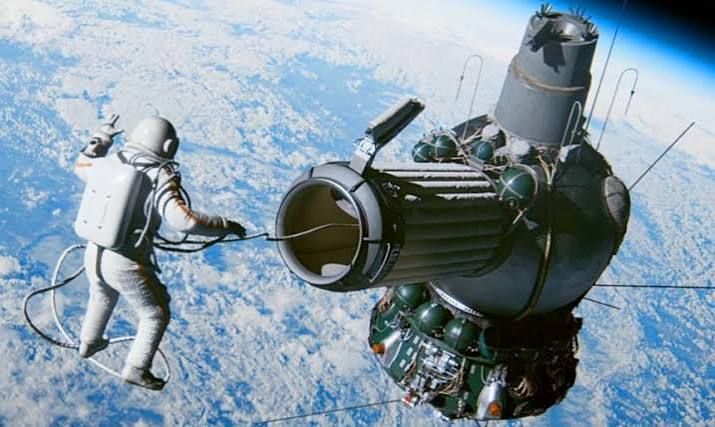
    At 11:34 AM Moscow time, Leonov opened the outer hatch of the airlock and stepped into the void. He was tethered to the spacecraft by a 5.35-meter line. For about 10 minutes, he floated in silence, looking down at Earth from a height of 500 kilometers. He later described the view as “indescribably beautiful.”

    But almost immediately, something went wrong.

    In the vacuum of space, the pressure inside his Berkut suit caused it to balloon like a beach ball. The suit was designed to be flexible, but at 0.4 atmospheres of pressure — higher than planned because engineers worried about suit stiffness — it expanded far beyond its intended size. Leonov’s arms pulled away from his body, his legs stiffened, and his boots no longer touched the lower part of the suit. He couldn’t bend his elbows or knees enough to operate the camera mounted on his chest or to control his movements.

    He was, in effect, trapped inside a rigid, inflated balloon.

    The Desperate Decision

    Leonov knew he had to get back inside the airlock, but he couldn’t fit through the 1.2-meter opening feet-first. He tried entering head-first, which was against protocol, but he still couldn’t squeeze through. His heart rate climbed to 143 beats per minute — some reports say it spiked to 190. He was sweating so profusely that his boots filled with perspiration.

    With no way to communicate with ground control — the Soviets had limited satellite coverage, and Leonov was out of contact during the spacewalk — he made a unilateral decision that would have been unthinkable under normal circumstances: he opened a valve in his suit to bleed off oxygen, reducing the pressure from 0.4 to about 0.27 atmospheres.

    This was a gamble. Lowering suit pressure too quickly could cause decompression sickness, or “the bends,” where nitrogen bubbles form in the blood and tissues, leading to joint pain, paralysis, or even death. It also meant his suit would provide less protection against the vacuum of space. But Leonov had no choice. He later said, “I knew I was risking my life, but I had to get back inside.”

    The pressure drop made the suit slightly more pliable. Leonov managed to squeeze through the airlock head-first, then had to turn around inside the narrow tube to close the outer hatch behind him — a maneuver that required him to twist his body in a space barely wider than his shoulders. He was exhausted, drenched in sweat, and his heart was pounding.

    The Ordeal Continues: Re-entry and Landing Problems

    Once inside the airlock, Leonov had to close the outer hatch and then open the inner hatch to re-enter the capsule. But the inner hatch jammed. He had to struggle to force it open, and when he finally tumbled back into the cabin, he was gasping for air.

    But the danger wasn’t over. The automatic system that was supposed to repressurize the cabin malfunctioned, flooding it with pure oxygen at dangerously high pressure — about 920 mm Hg, far above normal. In the pure oxygen environment, a single spark could have caused a fire that would have incinerated the crew. Belyayev quickly manually adjusted the pressure to safe levels.

    Later, the spacecraft’s automatic orientation system failed. The retrorockets that were supposed to slow the craft for re-entry fired at the wrong angle, sending the capsule tumbling. Belyayev had to perform the first-ever manual re-entry burn, using a backup system. Then, the service module failed to detach cleanly from the descent module, causing violent spinning during re-entry.

    The capsule eventually landed 386 kilometers off course, deep in the Ural Mountains, in a snow-covered forest. The crew had to wait two nights in freezing temperatures, surrounded by wolves, before rescuers on skis reached them. They were finally extracted by helicopter after a third day.

    Aftermath and Legacy

    Despite the near-disasters, Leonov and Belyayev survived. Leonov’s spacewalk lasted just 12 minutes and 9 seconds, but it proved that humans could survive and work outside a spacecraft — a critical step for future Moon landings and space stations.

    Leonov’s quick thinking and courage under pressure became legendary. He later wrote, “I could have died, but I didn’t. I knew that if I died, the Americans would say that the Soviets had faked the whole thing.” He went on to command the Soyuz 19 mission in 1975, which docked with an American Apollo spacecraft in the Apollo-Soyuz Test Project, symbolizing the end of the Space Race.

    The Voskhod 2 mission was a stark reminder of how dangerous early spaceflight was. The spacecraft was hastily modified, the suit was under-tested, and the margin for error was razor-thin. But it also showed the incredible resilience of the human spirit. Leonov faced impossible odds and made a split-second decision that saved his life — and in doing so, paved the way for every spacewalker who followed.

    Alexei Leonov’s 12-minute spacewalk was a triumph of courage over chaos. He faced a ballooning suit, a jammed hatch, and a malfunctioning spacecraft — yet he survived to tell the tale. His story reminds us that the greatest achievements in space exploration often come at the edge of disaster, and that human ingenuity and determination can overcome even the most terrifying obstacles.

    Summary

    • On March 18, 1965, Alexei Leonov made the first spacewalk, lasting just 12 minutes and 9 seconds.
    • His Berkut suit ballooned in the vacuum of space, making it impossible to move or re-enter the airlock.
    • Leonov risked decompression sickness by bleeding oxygen from his suit to reduce pressure.
    • The mission faced multiple failures after the spacewalk, including a pressurization malfunction, manual re-entry, and a landing 386 km off course.
    • Leonov’s quick thinking saved his life and proved that humans could survive outside a spacecraft.

    FAQ

    Q: How long was Alexei Leonov’s first spacewalk?
    A: The spacewalk lasted 12 minutes and 9 seconds, from hatch opening to closing.

    Q: Why did Leonov’s spacesuit balloon in space?
    A: The Berkut suit was pressurized to 0.4 atmospheres, and in the vacuum of space, the pressure inside caused the suit to expand far beyond its designed size, making it rigid and difficult to move.

    Q: What did Leonov do to get back into the spacecraft?
    A: He opened a valve to bleed oxygen from his suit, reducing the pressure to about 0.27 atmospheres, which allowed him to bend his limbs and squeeze through the airlock.

    Q: What other problems did the Voskhod 2 mission encounter?
    A: After the spacewalk, the cabin pressurization system malfunctioned, the automatic orientation failed, the service module didn’t detach cleanly, and the capsule landed far off course in the Ural Mountains.

    Q: Did Leonov survive the mission?
    A: Yes, Leonov and his commander Pavel Belyayev survived, despite spending two nights in freezing conditions before being rescued.
  • The Missions That Never Flew: What Cancelled Space Probes Teach Us About Ambition, Risk, and Persistence


    Every space mission that launches represents a victory over immense odds. But for every triumphant touchdown on Mars or flyby of Jupiter, there are ghost missions that never left the launchpad. These are the probes that were designed, partially built, and then cancelled due to budget cuts, political shifts, or technical overreach.

    Take the Jupiter Icy Moons Orbiter (JIMO), a nuclear-powered spacecraft that was meant to explore Europa, Ganymede, and Callisto. NASA spent about $400 million on it before cancelling in 2005. Or the Terrestrial Planet Finder, a telescope that would have directly imaged Earth-like exoplanets—indefinitely deferred in 2011. These projects represent billions of dollars and decades of human effort, with zero science return.

    But their lessons are far from zero. Cancelled missions often leave behind engineering breakthroughs, refined science questions, and cautionary tales about how to manage large projects. By examining why these missions died, we can understand the fragile ecosystem of space exploration—and how to make future missions survive the treacherous journey from concept to launchpad.

    The Anatomy of a Cancelled Mission

    To understand why missions get cancelled, you first need to know how they’re born. A space mission typically follows a lifecycle with distinct phases:

    1. Concept study (1–2 years): Scientists propose ideas, costs are rough, many candidates exist.
    2. Preliminary design (2–3 years): Teams develop competing designs, refine cost estimates.
    3. Detailed design (2–3 years): Hardware specifications are locked, engineering begins.
    4. Build and test (2–4 years): The most expensive phase, where actual flight hardware is constructed.
    5. Launch and operations: The mission finally flies.

    Cancellation risk is highest during phases 1 through 3. Why? Because costs are already visible and climbing, but the science payoff is still years away. Politicians and budget committees see money going out with no exciting images or data coming back. That’s the ‘valley of death’—the gap between a promising idea and a proven reality.

    The Usual Suspects: Why Missions Get Cancelled

    Budget Overruns on Other Projects

    One of the most common killers is the cost overrun of a sibling mission. The James Webb Space Telescope (JWST) is the poster child. Originally estimated at $1 billion, its price tag ballooned to nearly $10 billion. To pay for it, NASA deferred the Terrestrial Planet Finder indefinitely in 2011. In effect, one mission’s success starved another’s future.

    Shifting Political Priorities

    Presidential transitions bring new NASA administrators with new agendas. In 2017, the Asteroid Redirect Mission (ARM)—which aimed to capture an asteroid and move it into lunar orbit for study—was cancelled by the Trump administration, which preferred a direct return to the Moon. Similarly, JIMO was cancelled under George W. Bush’s ‘Vision for Space Exploration,’ which prioritized crewed missions to the Moon and Mars over robotic exploration.

    The Curse of the Flagship

    NASA’s ‘flagship’ missions—large, expensive, and politically visible—are prime targets for cancellation. They offer grand science but carry huge price tags. By contrast, smaller ‘Discovery’ missions like InSight (a Mars lander) are cheaper and more resilient. When budgets tighten, it’s the giants that fall.

    Case Study: JIMO—When Ambition Outruns Reality

    The Jupiter Icy Moons Orbiter was a bold concept: a spacecraft powered by a nuclear reactor, using electric propulsion to orbit three of Jupiter’s icy moons (Europa, Ganymede, and Callisto). The goal was to investigate whether these moons could harbor life in their subsurface oceans.

    But the project was over-ambitious from the start. It required developing a space-rated nuclear reactor, a new propulsion system, and radiation-hardened electronics—all at once. By 2005, after $400 million spent, NASA cancelled it, citing budget overruns and shifting priorities.

    However, JIMO’s legacy lives on. Its nuclear power research influenced NASA’s Kilopower project, which developed small nuclear reactors for space applications. The science questions it posed about icy moons were later addressed by the Europa Clipper mission, which launched in 2024 (though it’s not nuclear-powered).

    Case Study: Mars Surveyor 2001 Lander—The Zombie Mission

    Sometimes a cancelled mission doesn’t die; it becomes a zombie. The Mars Surveyor 2001 Lander was built and nearly complete when NASA cancelled it in 2000, following the failure of the Mars Climate Orbiter (which crashed due to a metric/imperial unit mix-up). The agency was in a conservative mood, so the lander never flew.

    But its instruments didn’t go to waste. The Mars Phoenix lander, which touched down on Mars in 2008, carried a version of the Surveyor’s robotic arm and other instruments. So while the original mission was cancelled, its components contributed to a successful mission eight years later.

    The Soviet Pattern: A Higher Cancellation Rate

    The Soviet Union had an even higher cancellation rate than the US, partly due to technical failures. The N1 rocket—designed to launch heavy payloads, including Mars missions—failed on all four test flights between 1969 and 1972. This grounded ambitious plans like the Mars 4NM and 5NM, which would have included a heavy rover and a sample-return mission.

    Soviet missions were also subject to internal political dynamics, which made approval and cancellation decisions more erratic. A mission might be approved one month, cancelled the next, then revived—leading to wasted effort and resources.

    The Cost of Not Launching

    Cancelled missions are not free. NASA has cancelled or indefinitely postponed roughly 15–20 major planetary missions since 1990. The money spent on these projects typically amounts to 10–30% of their full estimated lifecycle cost. For JIMO, that was $400 million with nothing to show for it in terms of science.

    But there are hidden benefits. Engineering prototypes and testbeds developed for cancelled missions often de-risk future projects. For example, the Terrestrial Planet Finder’s technology for blocking starlight (coronagraphs) is now being used in the Nancy Grace Roman Space Telescope, set to launch in the late 2020s. The science questions TPF would have answered are also being tackled by JWST and future observatories like HabEx.

    Lessons for the Future

    Keep Scope Realistic

    JIMO’s failure teaches us that trying to do too much in one mission can be fatal. NASA’s subsequent approach has been to break big goals into smaller, more achievable pieces. For example, instead of one nuclear-powered orbiter, the Europa Clipper uses conventional solar power and focuses on just one moon.

    Protect the Pipeline

    When a project like JWST overruns, it drains resources from other missions. The planetary science community has tried to mitigate this by creating a ‘decadal survey’ every 10 years, which sets priorities. Missions in the top tier are supposed to be protected, but mid-decade budget crises often force cuts anyway.

    Embrace the Zombie Phenomenon

    Cancelled missions don’t have to be wasted. By preserving their technology and science goals, future missions can absorb their legacy. The key is to maintain institutional memory and not throw away prototypes or designs.

    Political Resilience

    Missions that survive political transitions often have broad support from both parties and the scientific community. ARM was politically unpopular because it seemed to lack a clear scientific purpose. In contrast, the Europa Clipper has enjoyed bipartisan support, likely because its goal—searching for habitable environments—is compelling and widely accepted.

    The Human Element

    Behind every cancelled mission are scientists and engineers who devoted years to a project that never flew. They face a unique kind of grief—watching their work be shelved, not because of failure, but because of forces beyond their control. Yet many return to try again with new missions, carrying the lessons they learned.

    One such story is that of the Mars Surveyor 2001 Lander’s principal investigator, who later worked on Phoenix. When Phoenix landed successfully in 2008, it was a vindication—not of the original mission, but of the persistence of its team.

    Cancelled space probes are not just footnotes in history. They are case studies in the tension between ambition and reality, between scientific desire and political will. The billions spent on JIMO, TPF, and others are lost in terms of science return, but they are investments in understanding how to manage complex projects. The next time you hear about a mission that was cancelled, remember the lessons it leaves behind: keep scope realistic, protect the pipeline, and never underestimate the power of perseverance. The ghosts of these missions guide the ones that actually fly.

    Summary

    • Cancelled missions like JIMO and TPF cost billions but leave behind engineering and scientific legacies.
    • The main causes of cancellation are budget overruns on other projects, political shifts, and over-ambitious scope.
    • The ‘zombie’ phenomenon: cancelled missions’ components and science goals often fly on later missions (e.g., Mars Surveyor 2001 → Phoenix).
    • The Soviet Union had a higher cancellation rate due to technical failures and erratic political decisions.
    • Lessons for future missions: keep scope realistic, protect the mission pipeline, and ensure broad political support.

    FAQ

    Q: Why are space missions cancelled so often?
    A: Most cancellations happen because of budget constraints—either the mission itself overruns, or another mission (like JWST) eats up the budget. Political shifts and changes in NASA leadership also play a role.

    Q: What happens to the hardware of a cancelled mission?
    A: Sometimes the hardware is repurposed for other missions. For example, instruments from the cancelled Mars Surveyor 2001 Lander were flown on the Phoenix Mars lander.

    Q: Is there any benefit to a cancelled mission?
    A: Yes. Even cancelled missions produce valuable engineering designs, test data, and refined science questions. These can reduce risk and cost for future missions.

    Q: How much money is wasted on cancelled missions?
    A: Typically 10-30% of the full estimated lifecycle cost is spent before cancellation. For JIMO, that was about $400 million.

    Q: What can be done to prevent cancellations?
    A: Keeping mission scope realistic, securing broad political support, and ensuring stable funding are key. The decadal survey process helps set priorities, but it doesn’t guarantee protection.

  • President Honors Artemis II Crew with Congressional Space Medal of Honor

    President Honors Artemis II Crew with Congressional Space Medal of Honor

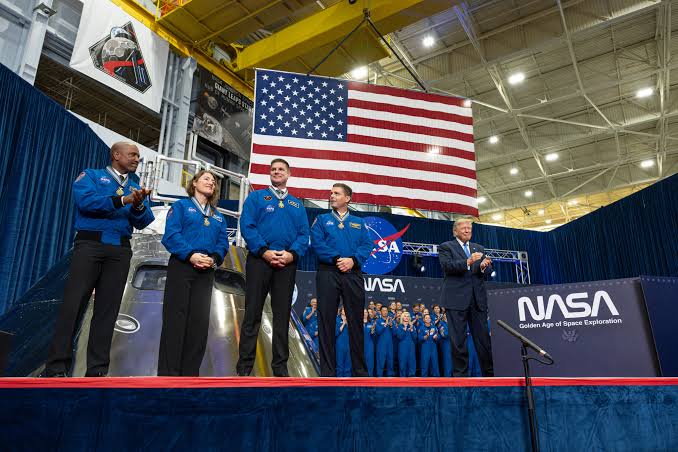
    On a Friday at NASA’s Johnson Space Center in Houston, President Donald J. Trump awarded the Congressional Space Medal of Honor to the four astronauts of the Artemis II mission the first crewed lunar flyby since 1972. The ceremony recognized not just a successful mission but a pivotal step in humanity’s return to deep space.

    The medal, the highest civilian space award in the U.S., is given by the President on behalf of Congress for exceptionally meritorious efforts in spaceflight. This year’s recipients Reid Wiseman, Victor Glover, Christina Koch, and Jeremy Hansen earned it by piloting the Orion spacecraft around the Moon and back, testing systems that will carry the next astronauts to land on the lunar surface.

    A Historic Mission, A Historic Honor

    Artemis II launched in November 2024, carrying four astronauts farther from Earth than any humans in over half a century. Over roughly 10 days, the crew orbited the Moon, tested Orion’s life support, navigation, and manual handling, and returned safely in December. It was the first crewed flight of NASA’s powerful Space Launch System (SLS) rocket and the Orion capsule.

    The mission broke new ground: Christina Koch became the first woman to travel to lunar vicinity, and Jeremy Hansen became the first Canadian. Victor Glover was the first Black astronaut to make the journey. Their safe return paved the way for Artemis III, which aims to land astronauts near the Moon’s south pole by mid-2027.

    What Is the Congressional Space Medal of Honor?

    Congress established this medal in 1969, shortly after the Apollo 11 moon landing, to recognize astronauts who go above and beyond in service to the nation and humanity. The President awards it on behalf of Congress. Past recipients include Neil Armstrong, Buzz Aldrin, John Glenn, Sally Ride, and the crews of Apollo 13 and the Space Shuttle Columbia.

    This year’s award is notable for two reasons. It is the first time the medal has been given to a non-U.S. citizen—Jeremy Hansen of the Canadian Space Agency—reflecting the growing international collaboration in space exploration. And it is the first time it has been awarded for a mission that didn’t land on the Moon or fly to orbit, but instead flew around it.

    The Crew: Who They Are and What They Did

    Reid Wiseman – Commander

    A U.S. Navy captain and former chief of the NASA Astronaut Office, Wiseman previously spent 165 days on the International Space Station in 2014. As Artemis II commander, he was responsible for the overall mission and the crew’s safety during the lunar flyby.

    Victor Glover – Pilot

    Glover, also a U.S. Navy captain, piloted SpaceX’s Crew-1 mission in 2020-2021, becoming the first Black astronaut to complete a long-duration ISS mission. On Artemis II, he served as pilot, manually flying the Orion spacecraft during key maneuvers—a critical test of human control in deep space.

    Christina Koch – Mission Specialist

    An electrical engineer, Koch holds the record for the longest single spaceflight by a woman at 328 days. She also participated in the first all-female spacewalk in 2019. On Artemis II, she monitored spacecraft systems and helped test radiation shielding and life support—data essential for future Mars missions.

    Jeremy Hansen – Mission Specialist

    A retired colonel in the Canadian Armed Forces, Hansen was selected as a CSA astronaut in 2009. He is the first Canadian to be assigned to a lunar mission. His role on Artemis II included testing Orion’s navigation and communication systems, and his participation highlights the Artemis Accords, an international agreement for peaceful space exploration signed by over 40 nations.

    Why This Award Matters

    The Congressional Space Medal of Honor is not given lightly. It recognizes contributions that “contribute to the welfare of the nation and humankind.” The Artemis II crew’s work fits that description: they validated the Orion spacecraft for human deep-space travel, proving that the vehicle can safely carry astronauts to the Moon and back.

    That validation is the cornerstone of NASA’s Artemis program, which aims to establish a sustainable human presence on the Moon and eventually send astronauts to Mars. Without the successful Artemis II mission, Artemis III’s landing attempt would be far riskier. The crew’s testing of manual control, life support, and radiation protection in the lunar environment provided the data engineers need to prepare for that next leap.

    The ceremony also carries political weight. President Trump chose to honor the crew at Johnson Space Center in Texas, a state with significant NASA facilities and a growing commercial space industry. The award underscores the administration’s support for Artemis, even as debates continue over NASA’s budget and the program’s cost overruns. But the medal itself is meant to be nonpartisan—a recognition of American leadership in space and the international partnerships that make such missions possible.

    A Personal Milestone for the Astronauts

    For each of the four astronauts, the medal is the capstone of years of training and a testament to their individual journeys. Koch’s presence on the mission inspires women and girls to pursue STEM careers; Glover’s role as a Black pilot continues the diversification of NASA’s astronaut corps; Hansen’s award strengthens Canada’s role in human spaceflight. Together, they represent the best of what space exploration can achieve when nations and individuals work toward a common goal.

    The Road Ahead

    Artemis II was a stepping stone. The next mission, Artemis III, will attempt the first crewed lunar landing since Apollo 17 in 1972. The crew of Artemis II has shown that Orion is ready for that challenge. Their medal is not just a reward for past achievement but a promise of what lies ahead—a future where humans walk on the Moon again, and eventually, set foot on Mars.

    The Congressional Space Medal of Honor awarded to the Artemis II crew is a well-deserved recognition of a mission that expanded human reach and set the stage for the next era of exploration. As the crew moves on to new roles, their achievement will inspire generations to look up and wonder what lies beyond.

    Summary

    • Artemis II was the first crewed lunar flyby since Apollo 17, lasting about 10 days in November-December 2024.
    • The crew included Reid Wiseman, Victor Glover, Christina Koch, and Jeremy Hansen, each making history in space exploration.
    • The Congressional Space Medal of Honor is the highest U.S. civilian space award, established in 1969.
    • This was the first time the medal was awarded to a non-U.S. citizen, highlighting international collaboration.
    • The mission validated Orion’s systems for human deep-space travel, paving the way for Artemis III’s lunar landing.

    FAQ

    Q: What is the Congressional Space Medal of Honor?
    A: It is the highest civilian space award in the United States, established by Congress in 1969. The President awards it on behalf of Congress to astronauts who make exceptionally meritorious contributions to the nation’s welfare and humanity through spaceflight.

    Q: Who received the medal this time?
    A: The four Artemis II astronauts: NASA’s Reid Wiseman, Victor Glover, and Christina Koch, and CSA’s Jeremy Hansen. They were honored for their successful mission around the Moon.

    Q: Why is this award historic?
    A: It is the first time the medal has been given to a non-U.S. citizen (Jeremy Hansen) and the first time for a lunar flyby mission rather than a landing or orbital flight.

    Q: What was the Artemis II mission?
    A: Artemis II was the first crewed test of NASA’s Space Launch System and Orion spacecraft. The crew flew around the Moon and returned, testing life support, navigation, and manual handling systems needed for future lunar landings.

    Q: What comes next for the Artemis program?
    A: The next mission, Artemis III, aims to land astronauts near the Moon’s south pole, potentially by 2027. It will be the first crewed lunar landing since Apollo 17 in 1972.

  • The Moon’s Hidden Ocean: Why the Lunar South Pole’s Permanently Shadowed Craters Are the Next Frontier

    The Moon’s Hidden Ocean: Why the Lunar South Pole’s Permanently Shadowed Craters Are the Next Frontier

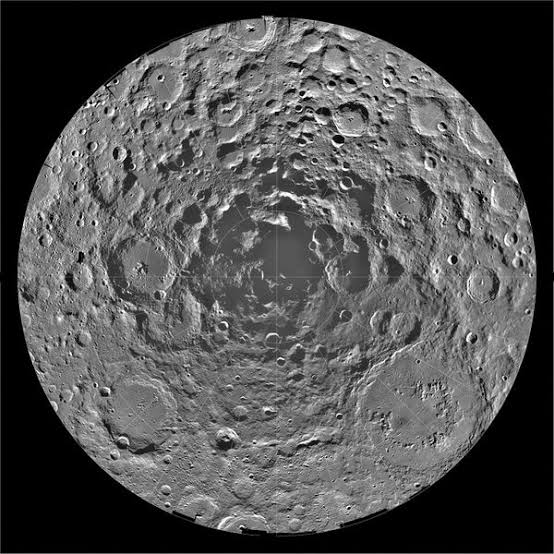
    Imagine a place where the sun never rises, where temperatures plunge to -230°C, and where ice has sat untouched for billions of years. That place is real: it’s the floor of craters at the Moon’s south pole. Scientists call these regions ‘permanently shadowed’ because the Moon’s tilt is so slight that sunlight never reaches the bottom of these deep, ancient impact sites.

    For decades, the Moon was thought to be a dry, barren world. But missions like LCROSS and Lunar Prospector have revealed a different story: hidden reservoirs of water ice, perhaps amounting to billions of metric tons. This isn’t a liquid ocean — it’s a frozen one, locked in the lunar soil. And it’s precisely this ice that makes the south pole the most coveted real estate in the solar system.

    Why does this matter? Because water is the key to sustainable human presence on the Moon. Split it into hydrogen and oxygen, and you have rocket fuel. Drink it, and you have life support. The south pole offers both the ice and near-constant sunlight on nearby ridges for solar power — a combination that could turn the Moon from a destination into a launchpad for Mars. This is why every major space agency is racing to the south pole, and why the next footprints on the Moon will be there, not at the equator.

    The Coldest Shadows in the Solar System

    The Moon’s axis is tilted by only about 1.5 degrees, almost upright. As a result, sunlight grazes the poles at a low angle, leaving the floors of deep craters like Shackleton, Cabeus, and Shoemaker in permanent darkness. These are the Permanently Shadowed Regions, or PSRs. Within them, temperatures never rise above -230°C, cold enough to trap water molecules and other volatile compounds like a deep freeze.

    This isn’t just cold for cold’s sake. That extreme chill acts like a vault, preserving ice that may have arrived via comet impacts or volcanic outgassing billions of years ago. The ice is a time capsule, holding clues to the early solar system and the origin of Earth’s water.

    The Evidence: From Hydrogen Signals to a Deliberate Crash

    Scientists first suspected ice at the poles in 1998, when NASA’s Lunar Prospector detected elevated hydrogen levels. But the smoking gun came in 2009. NASA’s LCROSS mission sent a rocket stage crashing into Cabeus Crater, kicking up a plume of debris. Spectroscopic analysis of that plume found water ice at about 5.6% by mass, along with carbon monoxide, methane, and ammonia. It was a direct, undeniable measurement.

    Later missions confirmed and expanded the picture. In 2018, data from NASA’s Lunar Reconnaissance Orbiter (LRO) showed surface water ice in PSRs. Then, in 2020, SOFIA (a flying infrared observatory) detected molecular water on sunlit lunar surface — though in much smaller amounts than in the shadows. And India’s Chandrayaan-3 lander, which touched down near the south pole in 2023, measured temperatures and found sulfur, adding to the chemical inventory.

    Why ‘Ocean’ Is a Metaphor

    Calling it a hidden ocean might conjure images of liquid water, but the reality is more like a frosty desert. The water exists as ice grains, frost, or possibly buried layers mixed with regolith — the Moon’s dusty soil. Estimates of total ice range from hundreds of millions to billions of metric tons, but no one knows exactly how much is there. Some scientists hypothesize that deeper deposits, meters to tens of meters thick, could be preserved from ancient impacts.

    That uncertainty is part of the excitement. The ice could be patchy and shallow, or it could be a substantial resource. We won’t know until we actually go and dig.

    The Race to the South Pole

    The south pole is not just a scientific curiosity; it’s strategic. NASA’s Artemis III mission, planned for 2026–2027, will land humans near the pole, targeting a site adjacent to a PSR. Meanwhile, robotic missions are paving the way. India’s Chandrayaan-3 made the southernmost landing in 2023. Japan’s SLIM lander demonstrated precision landing in 2024. Russia’s Luna-25 tried and failed in 2023. And commercial missions like Intuitive Machines’ IM-2 are planning to drill for ice as soon as 2025.

    But it’s not just about landing. The south pole offers something unique: peaks of eternal light. These are ridges that catch near-constant sunlight, ideal for solar power generation. So you have shadowed craters holding ice and sunlit peaks generating energy — a perfect pairing for a sustainable base.

    The Scientific Stakes: A Time Capsule

    Why study this ice? Because it’s a record of the past. The isotopic signatures in the ice can tell us whether Earth’s water came from comets, asteroids, or solar wind interactions. By understanding the distribution of ice on the Moon, we can also model how volatiles migrate on airless bodies like Mercury and Ceres. And from an astrobiology perspective, PSRs are among the most extreme environments in the solar system — studying them helps us understand the limits of life and how it might survive on other worlds.

    The Resource Stakes: Fuel for Mars

    Practically, water ice is the key to in-situ resource utilization, or ISRU. Split water into hydrogen and oxygen via electrolysis: oxygen for astronauts to breathe, hydrogen for rocket fuel. That turns the Moon into a refueling station. Instead of hauling fuel from Earth, we could manufacture it on the lunar surface. This is considered essential for a sustainable lunar base and for missions to Mars.

    The Geopolitical and Legal Dimension

    The south pole is also a geopolitical flashpoint. The Outer Space Treaty of 1967 prohibits national appropriation of celestial bodies, but it’s vague on resource extraction. The Artemis Accords, signed by over 40 nations, provide a framework for lunar resource use, but China and Russia have not signed. China’s Chang’e-7 and Chang’e-8 missions, planned for 2026–2029, also target the south pole. The race isn’t just scientific; it’s about who gets to establish norms and presence first.

    The Road Ahead: What’s Next?

    The future of lunar exploration will be defined by the south pole. NASA’s VIPER rover, designed to map ice, faced cancellation in 2024, but there’s political pressure to revive it. Other missions are in the pipeline. The challenges are immense: extreme cold, rough terrain, and communication blackouts in the shadows. But the potential rewards — scientific, economic, and strategic — are equally immense.

    In the coming years, we’ll see landers, rovers, and eventually humans working in these frozen shadows. The ‘hidden ocean’ won’t stay hidden for long.

    The permanently shadowed craters at the lunar south pole are more than just cold, dark holes. They are a treasure trove of water ice that could sustain human exploration and reshape our understanding of the solar system. As missions like Artemis and Chandrayaan-3 push the boundaries, the Moon’s hidden ocean is set to become the next great frontier. The ice is there, waiting. All we have to do is go get it.

    Summary

    • Permanently Shadowed Regions (PSRs) are areas near the lunar south pole where sunlight never reaches, with temperatures below -230°C.
    • Evidence for water ice includes 1998 hydrogen detections, the 2009 LCROSS impact plume (5.6% water), and 2018 LRO surface ice observations.
    • The water is not a liquid ocean but ice grains, frost, or buried layers mixed with regolith, totaling hundreds of millions to billions of metric tons.
    • The south pole also has ‘peaks of eternal light’ for solar power, making it ideal for a sustainable lunar base and resource extraction.
    • Multiple missions are racing to the south pole: Artemis III (2026–2027), Chandrayaan-3 (2023), SLIM (2024), and commercial efforts like IM-2 (2025).

    FAQ

    Q: What exactly is a permanently shadowed region (PSR)?
    A: A PSR is an area on the Moon where sunlight never directly reaches because of the Moon’s very low axial tilt. The floors of deep craters near the poles are permanently in shadow, making them extremely cold and capable of trapping water ice and other volatile compounds.

    Q: How do we know there’s water ice in these craters?
    A: We have direct evidence from several missions. In 1998, Lunar Prospector detected elevated hydrogen. In 2009, the LCROSS mission crashed a rocket into Cabeus Crater and analyzed the plume, finding water ice at about 5.6% by mass. Later, LRO in 2018 confirmed surface water ice, and SOFIA in 2020 found molecular water on sunlit areas, though in smaller amounts.

    Q: Is the ‘hidden ocean’ actually a liquid ocean?
    A: No. It’s a metaphor. The water exists as ice grains, frost, or possibly buried ice layers mixed with lunar soil. There’s no liquid water on the Moon’s surface because the vacuum and extreme cold make it impossible.

    Q: Why is the south pole more important than the equator?
    A: The equator, where Apollo landed, is dry and geologically simple. The south pole has two unique resources: water ice in permanently shadowed craters and nearly constant sunlight on high ridges for solar power. This combination is ideal for a sustainable base and for producing rocket fuel via water electrolysis.

    Q: What missions are heading to the south pole?
    A: NASA’s Artemis III (2026–2027) will land humans near the pole. Robotic missions include India’s Chandrayaan-3 (landed 2023), Japan’s SLIM (2024), and commercial missions like Intuitive Machines’ IM-2 (planned 2025). China’s Chang’e-7 and Chang’e-8 are also targeting the south pole in the late 2020s.

  • NASA’s New 34-Meter Dish: A Quiet Upgrade with Big Implications for Deep Space Exploration

    NASA’s New 34-Meter Dish: A Quiet Upgrade with Big Implications for Deep Space Exploration

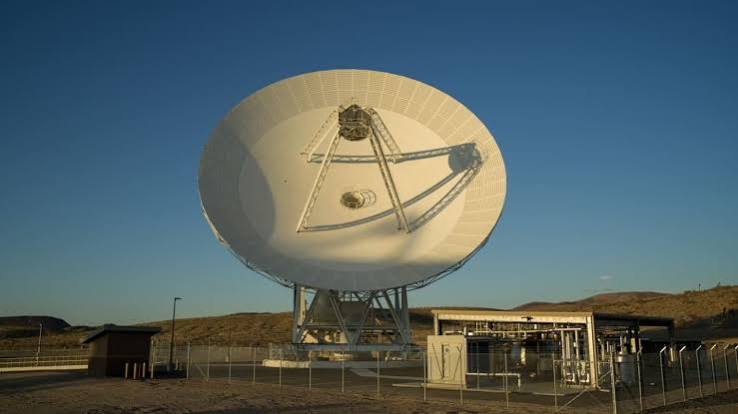
    In the high desert of California, a new 34-meter (114-foot) radio antenna has joined NASA’s Deep Space Network (DSN). It’s not the biggest dish on the block the network still relies on 70-meter giants for the most distant probes but this next-generation antenna is engineered to be more efficient and capable than its predecessors. As missions to the Moon, Mars, and beyond multiply, this dish represents a critical upgrade to the backbone of deep space communication.

    But what does a new antenna actually mean for science? It’s not just about receiving signals. This dish will transmit commands, track spacecraft positions, and help gather data that could reshape our understanding of the solar system. It’s a workhorse addition to a network that has been quietly enabling every major NASA mission for over six decades.

    The Deep Space Network: Earth’s Interplanetary Phone System

    Imagine trying to call a friend on Mars with a walkie-talkie. The signal would be impossibly weak, and the planet’s rotation would cut you off. That’s why NASA built the Deep Space Network: a trio of radio antenna facilities strategically placed around the globe—Goldstone in California, Madrid in Spain, and Canberra in Australia. Each site is roughly 120 degrees apart, so as Earth spins, at least one facility can always point its dishes toward a given spacecraft.

    This network handles far more than casual chatter. For over 40 missions—from Mars rovers to interstellar Voyagers—the DSN sends commands, receives scientific data, and performs radio science, which is a fancy way of saying it measures the spacecraft’s velocity and position to a hair’s breadth. That’s how we know the exact trajectories of orbiters and landers, and how scientists map the gravity fields of distant moons.

    The new dish at Goldstone is a 34-meter antenna, the same size as many of the network’s workhorses. But “next-gen” doesn’t mean bigger—it means smarter. The key difference is likely beam waveguide technology. In older 34-meter dishes, the sensitive receivers are mounted up at the focus, exposed to weather and needing constant maintenance. In a beam waveguide design, the signal is reflected down a tube into a stationary room below the dish. This keeps the equipment stable, reduces noise, and allows operators to switch frequencies in minutes instead of hours.

    Why a New Dish Now? The Growing Demand for Deep Space Bandwidth

    The DSN is facing a traffic jam. NASA’s Artemis program is gearing up to return humans to the Moon, Mars rovers like Perseverance are beaming back high-resolution images, and upcoming missions like Europa Clipper and Psyche will add their own demands. Meanwhile, the existing antennas are aging—some have been in service for decades. The new dish at Goldstone is part of a strategy to replace and augment the fleet to meet this surge.

    The addition is not just about capacity; it’s about capability. Newer antennas can support higher frequency bands like Ka-band, which allows for much higher data rates. Think of it like upgrading from dial-up to fiber optic. With more bandwidth, a rover can send back more detailed photos, and scientists can receive more data in a single pass. This is especially critical for missions that generate massive amounts of information, like the Perseverance rover, which sends back images and audio from the Martian surface.

    The New Dish in Action: More Than Just Listening

    One common misconception is that these dishes are only for receiving signals. In reality, the DSN is a two-way communication system. The new antenna can transmit commands to spacecraft, which is how engineers tell a rover to take a sample or a spacecraft to adjust its course. It also plays a role in radio science—by tracking a spacecraft’s Doppler shift, scientists can detect tiny variations in its velocity, which can reveal the presence of a hidden ocean under a moon’s icy crust or map the gravity field of an asteroid.

    The antenna’s location at Goldstone is steeped in history. This is where the first images from the Moon were received during the Surveyor missions, and where Voyager 1 sent its iconic “Pale Blue Dot” image. The new dish now stands alongside these legacy antennas, ready to support the next generation of exploration.

    A Network of Global Importance

    While the new dish is in California, its impact is global. The DSN is an international resource. NASA’s partners, including the European Space Agency (ESA) and the Indian Space Research Organisation (ISRO), rely on the network to communicate with their deep space missions. A new antenna at Goldstone doesn’t just help NASA—it helps the entire world’s deep space exploration efforts.

    Of course, the DSN is not unlimited. Each spacecraft must be scheduled for time, and with more missions than ever, the network is stretched thin. But every new antenna adds capacity and flexibility, easing the bottleneck and ensuring that data keeps flowing from the farthest reaches of the solar system.

    The Future: Toward Optical Communications

    The new dish is part of a broader evolution. NASA is also developing optical (laser) communications, which could dramatically increase data rates. But radio waves remain the backbone, and new dishes like this one will be essential for years to come. They are the reliable, proven technology that ensures we can still reach our spacecraft even as we push the boundaries of what’s possible.

    So the next time you see an image from Mars or hear about a new discovery from a distant asteroid, remember the quiet work of the Deep Space Network—and the new 34-meter dish in Goldstone that’s helping make it happen.

    The new 34-meter antenna at Goldstone is more than just a piece of hardware. It’s a symbol of NASA’s commitment to maintaining and upgrading its critical infrastructure in the face of growing demand. While it may not grab headlines like a Mars landing, it plays an indispensable role in every mission that relies on deep space communication. As we reach further into the cosmos, this dish will be there, helping us listen and speak to our robotic explorers.

    Summary

    • NASA added a new 34-meter radio antenna to its Deep Space Network at Goldstone, California.
    • The antenna uses next-gen technology, likely beam waveguide, for better performance and easier maintenance.
    • It supports over 40 missions, including Artemis, Mars rovers, and deep space probes.
    • The addition helps address the growing demand for DSN time from lunar, Mars, and deep space missions.
    • The DSN is a global network with sites in California, Spain, and Australia, ensuring continuous coverage.

    FAQ

    Q: Is the new antenna bigger than the existing 70-meter dishes?
    A: No, it’s 34 meters in diameter, the same size as many other DSN workhorse antennas. “Next-gen” refers to its advanced technology, not its size.

    Q: Does the DSN only receive signals from spacecraft?
    A: No, it also transmits commands and performs radio science, such as tracking spacecraft position and velocity.

    Q: Why is the network spread across three sites?
    A: The three sites are spaced about 120 degrees apart, so at least one can always see a given spacecraft as Earth rotates.

    Q: Will this new dish be used for commercial satellites?
    A: The DSN primarily supports NASA and its partners’ deep space missions, not commercial Earth-orbiting satellites, which use other networks.

    Q: How does the new antenna improve data rates?
    A: It likely supports higher frequency bands like Ka-band, which allow for faster data transmission, similar to upgrading from dial-up to fiber optic internet.

  • Your Name in Deep Space: How NASA’s Roman Telescope Will Carry 1.35 Million Stories

    Your Name in Deep Space: How NASA’s Roman Telescope Will Carry 1.35 Million Stories

    Imagine writing your name on a postcard, then sending it on a journey of a million miles—not to a friend across town, but to a point in space a million and a half kilometers from Earth. That’s exactly what NASA has made possible for over 1.3 million people around the globe. On July 27, technicians at NASA’s Kennedy Space Center in Florida installed a memory card containing 1,350,144 names onto a commemorative plaque aboard the Nancy Grace Roman Space Telescope. This isn’t just a symbolic gesture; it’s a continuation of a beloved tradition that connects humanity’s deepest curiosity with the vastness of the cosmos.

    But why do we do this? Why send names into the void? The answer lies in our shared desire to be part of something bigger than ourselves. From the Voyager Golden Records to the millions of names on Mars rovers, NASA has long invited the public to hitch a ride on its missions. The Roman Telescope—a next-generation observatory that will study dark energy, exoplanets, and more—now carries our collective identity into deep space. It’s a reminder that science isn’t just for scientists; it’s for everyone who looks up at the stars and wonders.

    The Roman Telescope: A Giant Eye on the Universe

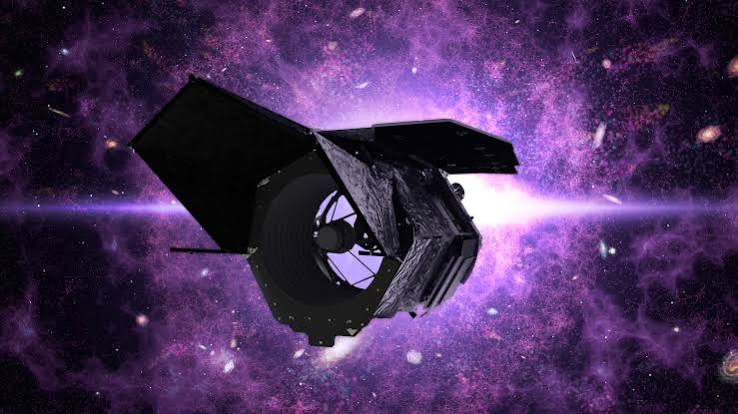
    The Nancy Grace Roman Space Telescope, named after NASA’s first Chief of Astronomy, is often described as the ‘successor’ to Hubble—but that’s not quite right. While Hubble gives us stunning close-ups of distant galaxies, Roman is built for sweeping panoramas. Its 288-megapixel camera, the largest ever flown on a NASA astrophysics mission, captures a field of view 100 times larger than Hubble’s. Imagine taking a photo of a whole city block instead of a single house—that’s the difference. Roman will help scientists understand dark energy, the mysterious force accelerating the universe’s expansion, and hunt for exoplanets, worlds orbiting other stars.

    Roman’s destination is the Sun-Earth L2 Lagrange point, a gravitationally stable spot about 1.5 million kilometers from Earth. From there, it will peer into the infrared universe, seeing through dust clouds and back in time to the early cosmos. The telescope’s mirror is the same size as Hubble’s—2.4 meters—but its wide-field capabilities make it a unique tool for surveying vast swaths of sky. It’s not a replacement for Hubble or the James Webb Space Telescope; it’s a complementary eye, each with its own strengths.

    The Memory Card: A Modern Message in a Bottle

    The names are stored on a radiation-hardened memory card, a small but rugged piece of technology designed to survive the harsh environment of space. Unlike a physical engraving, which takes up space and weight, a memory card can hold millions of names in a tiny package. This is a modern twist on an old tradition. The Voyager spacecraft carried golden records with sounds and images; the Roman Telescope carries a digital roster of humanity.

    The plaque itself is a standard feature on spacecraft, often containing mission information and cultural artifacts. The memory card adds a personal touch, turning the telescope into a time capsule of human participation. When the telescope launches—currently targeted for May 2027—it will carry these names to a point far beyond the Moon, a journey that will take months. But the names aren’t just going for the ride; they’re part of the mission’s story, a story that will be told for generations.

    A Tradition of Sending Names to Space

    NASA has been inviting the public to send their names into space for decades. The Artemis I mission carried about 3 million names on the Orion spacecraft in 2022. Mars rovers have been particularly popular: Perseverance carried 10.9 million names in 2020, and Curiosity carried 1.2 million in 2011. The InSight Mars lander had 2.4 million names in 2018, and the Parker Solar Probe took 1.1 million names to the Sun’s vicinity in 2018. Even OSIRIS-REx, which visited an asteroid, carried 442,000 names in 2016.

    The Roman Telescope’s 1.35 million names fit squarely within this tradition. It’s a way for people who may never become astronauts to feel connected to space exploration. When you submit your name, you’re not just sending text; you’re sending a piece of your identity, a symbol of your curiosity. For many, it’s a deeply personal act—a way to say, ‘I was here, and I dreamed of the stars.’

    The Human Connection: Why We Participate

    Why do millions of people jump at the chance to send their names into space? It’s not because they expect to read their name on a plaque—they know it’s a symbolic gesture. But symbols matter. They connect us to something larger than ourselves. When you see your name on a memory card aboard a spacecraft, you become part of a collective human endeavor. You’re no longer just an observer of space exploration; you’re a participant.

    This campaign also has a global reach. Names came from people all over the world, reflecting a shared curiosity that transcends borders. The inclusion of astronauts from the Artemis II and Artemis III missions adds another layer—these are the people who will soon travel to the Moon, and their names are now linked with a telescope that will go even farther. It’s a bridge between human spaceflight and robotic exploration, reminding us that both are essential to our journey into the cosmos.

    The Legacy of Nancy Grace Roman

    The telescope’s namesake, Dr. Nancy Grace Roman, was a pioneer. As NASA’s first Chief of Astronomy, she played a crucial role in developing the Hubble Space Telescope, earning her the nickname ‘Mother of Hubble.’ She broke barriers for women in STEM at a time when few women held such positions. By carrying the names of 1.35 million people, the Roman Telescope honors her legacy of opening the universe to everyone. It’s fitting that a mission named after her would include the public in such a personal way.

    Roman’s work laid the foundation for modern astrophysics, and this telescope will build on that. It will study dark energy, dark matter, and exoplanets, answering questions that were unimaginable in her time. The names on board are a testament to her belief that space exploration is for all of humanity, not just a select few.

    What the Future Holds

    As the Roman Telescope prepares for its 2027 launch, the memory card is now safely installed. But the journey is just beginning. Once at L2, the telescope will begin its scientific mission, sending back data that could reshape our understanding of the universe. And somewhere in that data, in the spacecraft’s memory, will be the names of 1.35 million people—a silent but powerful reminder that we are all part of this cosmic adventure.

    For those who submitted their names, the wait is part of the excitement. When the telescope launches, they’ll know that their name is on board, traveling to a destination far beyond our Moon. It’s a thought that can inspire awe, a connection to the infinite that few of us will ever experience firsthand. But through this campaign, we all get a taste of that wonder.

    The Roman Telescope’s memory card is more than just a storage device; it’s a symbol of human unity and curiosity. By carrying 1.35 million names to deep space, NASA continues a tradition that brings the cosmos a little closer to home. Whether you’re a scientist, a student, or someone who simply looked up at the stars one night and wondered, this mission carries a piece of all of us.

    Summary

    • NASA installed a memory card with 1,350,144 names on the Roman Space Telescope on July 27 at Kennedy Space Center.
    • The telescope, named after Nancy Grace Roman, will study dark energy, exoplanets, and more from the L2 point, 1.5 million km from Earth.
    • This is part of a long NASA tradition of public name campaigns, following missions like Artemis I and Mars rovers.
    • The names are stored digitally on a radiation-hardened card, not engraved, and will travel with the telescope to deep space.
    • The campaign connects people globally, including Artemis II and III astronauts, to the mission’s scientific goals.

    FAQ

    Q: Will the Roman Telescope carry the names to the Moon?
    A: No. The telescope is headed to the Sun-Earth L2 Lagrange point, about 1.5 million kilometers from Earth, not the Moon. The Artemis astronauts’ names are on the card, but the telescope itself is not lunar-bound.

    Q: Are the names engraved on the telescope?
    A: No. The names are stored digitally on a radiation-hardened memory card attached to a commemorative plaque. The plaque may have engravings, but the names themselves are digital data.

    Q: Is this the first time NASA has sent names into space?
    A: No. NASA has a long tradition of such campaigns, including Artemis I (3 million names), Mars rovers (Perseverance carried 10.9 million), and many others. This is one of many.

    Q: How does the memory card survive the harsh space environment?
    A: The memory card is radiation-hardened, meaning it’s designed to withstand high levels of radiation and extreme temperatures. It’s a rugged piece of technology built for space.

    Q: When will the Roman Telescope launch?
    A: The launch is currently targeted for May 2027, though dates can shift. The telescope will take months to reach its destination at L2.