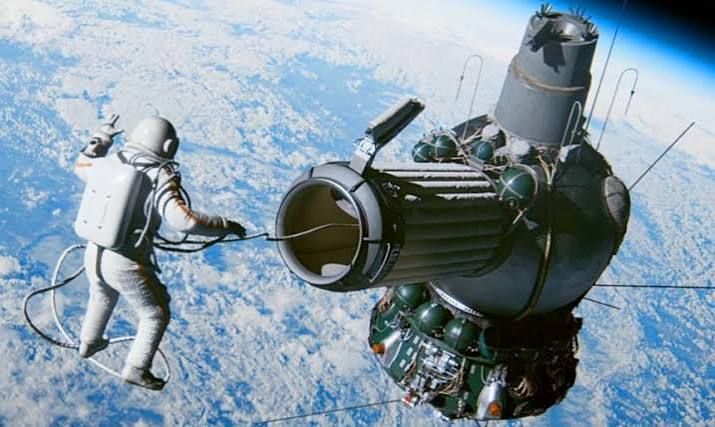
On March 18, 1965, Alexei Leonov became the first human to float freely in space. The achievement lasted just over 12 minutes, but it nearly killed him. His spacesuit ballooned out of control, he couldn’t get back into the spacecraft, and he had to make a life-or-death decision without any guidance from Earth.
This is the story of how a triumph of human ingenuity almost became a tragedy — and how Leonov’s quick thinking saved his own life and changed the course of space exploration forever.
The Mission That Almost Didn’t Happen
In the 1960s, the United States and the Soviet Union were locked in a fierce competition to dominate space. The Soviets had already launched the first satellite, Sputnik, and the first human, Yuri Gagarin. But the Americans were closing the gap with their Gemini program, which was designed to practice the techniques needed for a Moon landing — including walking in space.
The Soviet leadership wanted to stay ahead. So they rushed a mission called Voskhod 2, using a spacecraft that was never designed for spacewalking. The original Vostok capsule held only one cosmonaut and had no airlock. To let Leonov out, engineers attached an inflatable fabric tube called the Volga to the hull. It folded up like an accordion for launch and expanded in orbit to create a small room that could be depressurized.
Leonov and his commander, Pavel Belyayev, launched from Baikonur Cosmodrome on March 18, 1965. The spacecraft climbed to an altitude of about 500 kilometers — higher than any human had ever flown. The International Space Station orbits at roughly 400 kilometers, so Leonov was flying above even that.
The Spacewalk: 12 Minutes of Triumph and Terror
At 11:34 AM Moscow time, Leonov opened the outer hatch of the airlock and stepped into the void. He was tethered to the spacecraft by a 5.35-meter line. For about 10 minutes, he floated in silence, looking down at Earth from a height of 500 kilometers. He later described the view as “indescribably beautiful.”
But almost immediately, something went wrong.
In the vacuum of space, the pressure inside his Berkut suit caused it to balloon like a beach ball. The suit was designed to be flexible, but at 0.4 atmospheres of pressure — higher than planned because engineers worried about suit stiffness — it expanded far beyond its intended size. Leonov’s arms pulled away from his body, his legs stiffened, and his boots no longer touched the lower part of the suit. He couldn’t bend his elbows or knees enough to operate the camera mounted on his chest or to control his movements.
He was, in effect, trapped inside a rigid, inflated balloon.
The Desperate Decision
Leonov knew he had to get back inside the airlock, but he couldn’t fit through the 1.2-meter opening feet-first. He tried entering head-first, which was against protocol, but he still couldn’t squeeze through. His heart rate climbed to 143 beats per minute — some reports say it spiked to 190. He was sweating so profusely that his boots filled with perspiration.
With no way to communicate with ground control — the Soviets had limited satellite coverage, and Leonov was out of contact during the spacewalk — he made a unilateral decision that would have been unthinkable under normal circumstances: he opened a valve in his suit to bleed off oxygen, reducing the pressure from 0.4 to about 0.27 atmospheres.
This was a gamble. Lowering suit pressure too quickly could cause decompression sickness, or “the bends,” where nitrogen bubbles form in the blood and tissues, leading to joint pain, paralysis, or even death. It also meant his suit would provide less protection against the vacuum of space. But Leonov had no choice. He later said, “I knew I was risking my life, but I had to get back inside.”
The pressure drop made the suit slightly more pliable. Leonov managed to squeeze through the airlock head-first, then had to turn around inside the narrow tube to close the outer hatch behind him — a maneuver that required him to twist his body in a space barely wider than his shoulders. He was exhausted, drenched in sweat, and his heart was pounding.
The Ordeal Continues: Re-entry and Landing Problems
Once inside the airlock, Leonov had to close the outer hatch and then open the inner hatch to re-enter the capsule. But the inner hatch jammed. He had to struggle to force it open, and when he finally tumbled back into the cabin, he was gasping for air.
But the danger wasn’t over. The automatic system that was supposed to repressurize the cabin malfunctioned, flooding it with pure oxygen at dangerously high pressure — about 920 mm Hg, far above normal. In the pure oxygen environment, a single spark could have caused a fire that would have incinerated the crew. Belyayev quickly manually adjusted the pressure to safe levels.
Later, the spacecraft’s automatic orientation system failed. The retrorockets that were supposed to slow the craft for re-entry fired at the wrong angle, sending the capsule tumbling. Belyayev had to perform the first-ever manual re-entry burn, using a backup system. Then, the service module failed to detach cleanly from the descent module, causing violent spinning during re-entry.
The capsule eventually landed 386 kilometers off course, deep in the Ural Mountains, in a snow-covered forest. The crew had to wait two nights in freezing temperatures, surrounded by wolves, before rescuers on skis reached them. They were finally extracted by helicopter after a third day.
Aftermath and Legacy
Despite the near-disasters, Leonov and Belyayev survived. Leonov’s spacewalk lasted just 12 minutes and 9 seconds, but it proved that humans could survive and work outside a spacecraft — a critical step for future Moon landings and space stations.
Leonov’s quick thinking and courage under pressure became legendary. He later wrote, “I could have died, but I didn’t. I knew that if I died, the Americans would say that the Soviets had faked the whole thing.” He went on to command the Soyuz 19 mission in 1975, which docked with an American Apollo spacecraft in the Apollo-Soyuz Test Project, symbolizing the end of the Space Race.
The Voskhod 2 mission was a stark reminder of how dangerous early spaceflight was. The spacecraft was hastily modified, the suit was under-tested, and the margin for error was razor-thin. But it also showed the incredible resilience of the human spirit. Leonov faced impossible odds and made a split-second decision that saved his life — and in doing so, paved the way for every spacewalker who followed.
Alexei Leonov’s 12-minute spacewalk was a triumph of courage over chaos. He faced a ballooning suit, a jammed hatch, and a malfunctioning spacecraft — yet he survived to tell the tale. His story reminds us that the greatest achievements in space exploration often come at the edge of disaster, and that human ingenuity and determination can overcome even the most terrifying obstacles.
Summary
- On March 18, 1965, Alexei Leonov made the first spacewalk, lasting just 12 minutes and 9 seconds.
- His Berkut suit ballooned in the vacuum of space, making it impossible to move or re-enter the airlock.
- Leonov risked decompression sickness by bleeding oxygen from his suit to reduce pressure.
- The mission faced multiple failures after the spacewalk, including a pressurization malfunction, manual re-entry, and a landing 386 km off course.
- Leonov’s quick thinking saved his life and proved that humans could survive outside a spacecraft.
FAQ
Q: How long was Alexei Leonov’s first spacewalk?
A: The spacewalk lasted 12 minutes and 9 seconds, from hatch opening to closing.
Q: Why did Leonov’s spacesuit balloon in space?
A: The Berkut suit was pressurized to 0.4 atmospheres, and in the vacuum of space, the pressure inside caused the suit to expand far beyond its designed size, making it rigid and difficult to move.
Q: What did Leonov do to get back into the spacecraft?
A: He opened a valve to bleed oxygen from his suit, reducing the pressure to about 0.27 atmospheres, which allowed him to bend his limbs and squeeze through the airlock.
Q: What other problems did the Voskhod 2 mission encounter?
A: After the spacewalk, the cabin pressurization system malfunctioned, the automatic orientation failed, the service module didn’t detach cleanly, and the capsule landed far off course in the Ural Mountains.
Q: Did Leonov survive the mission?
A: Yes, Leonov and his commander Pavel Belyayev survived, despite spending two nights in freezing conditions before being rescued.