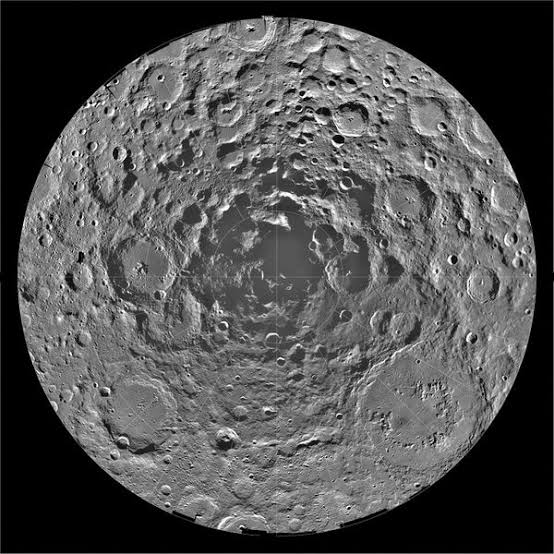
Imagine a place where the sun never rises, where temperatures plunge to -230°C, and where ice has sat untouched for billions of years. That place is real: it’s the floor of craters at the Moon’s south pole. Scientists call these regions ‘permanently shadowed’ because the Moon’s tilt is so slight that sunlight never reaches the bottom of these deep, ancient impact sites.
For decades, the Moon was thought to be a dry, barren world. But missions like LCROSS and Lunar Prospector have revealed a different story: hidden reservoirs of water ice, perhaps amounting to billions of metric tons. This isn’t a liquid ocean — it’s a frozen one, locked in the lunar soil. And it’s precisely this ice that makes the south pole the most coveted real estate in the solar system.
Why does this matter? Because water is the key to sustainable human presence on the Moon. Split it into hydrogen and oxygen, and you have rocket fuel. Drink it, and you have life support. The south pole offers both the ice and near-constant sunlight on nearby ridges for solar power — a combination that could turn the Moon from a destination into a launchpad for Mars. This is why every major space agency is racing to the south pole, and why the next footprints on the Moon will be there, not at the equator.
The Coldest Shadows in the Solar System
The Moon’s axis is tilted by only about 1.5 degrees, almost upright. As a result, sunlight grazes the poles at a low angle, leaving the floors of deep craters like Shackleton, Cabeus, and Shoemaker in permanent darkness. These are the Permanently Shadowed Regions, or PSRs. Within them, temperatures never rise above -230°C, cold enough to trap water molecules and other volatile compounds like a deep freeze.
This isn’t just cold for cold’s sake. That extreme chill acts like a vault, preserving ice that may have arrived via comet impacts or volcanic outgassing billions of years ago. The ice is a time capsule, holding clues to the early solar system and the origin of Earth’s water.
The Evidence: From Hydrogen Signals to a Deliberate Crash
Scientists first suspected ice at the poles in 1998, when NASA’s Lunar Prospector detected elevated hydrogen levels. But the smoking gun came in 2009. NASA’s LCROSS mission sent a rocket stage crashing into Cabeus Crater, kicking up a plume of debris. Spectroscopic analysis of that plume found water ice at about 5.6% by mass, along with carbon monoxide, methane, and ammonia. It was a direct, undeniable measurement.
Later missions confirmed and expanded the picture. In 2018, data from NASA’s Lunar Reconnaissance Orbiter (LRO) showed surface water ice in PSRs. Then, in 2020, SOFIA (a flying infrared observatory) detected molecular water on sunlit lunar surface — though in much smaller amounts than in the shadows. And India’s Chandrayaan-3 lander, which touched down near the south pole in 2023, measured temperatures and found sulfur, adding to the chemical inventory.
Why ‘Ocean’ Is a Metaphor
Calling it a hidden ocean might conjure images of liquid water, but the reality is more like a frosty desert. The water exists as ice grains, frost, or possibly buried layers mixed with regolith — the Moon’s dusty soil. Estimates of total ice range from hundreds of millions to billions of metric tons, but no one knows exactly how much is there. Some scientists hypothesize that deeper deposits, meters to tens of meters thick, could be preserved from ancient impacts.
That uncertainty is part of the excitement. The ice could be patchy and shallow, or it could be a substantial resource. We won’t know until we actually go and dig.
The Race to the South Pole
The south pole is not just a scientific curiosity; it’s strategic. NASA’s Artemis III mission, planned for 2026–2027, will land humans near the pole, targeting a site adjacent to a PSR. Meanwhile, robotic missions are paving the way. India’s Chandrayaan-3 made the southernmost landing in 2023. Japan’s SLIM lander demonstrated precision landing in 2024. Russia’s Luna-25 tried and failed in 2023. And commercial missions like Intuitive Machines’ IM-2 are planning to drill for ice as soon as 2025.
But it’s not just about landing. The south pole offers something unique: peaks of eternal light. These are ridges that catch near-constant sunlight, ideal for solar power generation. So you have shadowed craters holding ice and sunlit peaks generating energy — a perfect pairing for a sustainable base.
The Scientific Stakes: A Time Capsule
Why study this ice? Because it’s a record of the past. The isotopic signatures in the ice can tell us whether Earth’s water came from comets, asteroids, or solar wind interactions. By understanding the distribution of ice on the Moon, we can also model how volatiles migrate on airless bodies like Mercury and Ceres. And from an astrobiology perspective, PSRs are among the most extreme environments in the solar system — studying them helps us understand the limits of life and how it might survive on other worlds.
The Resource Stakes: Fuel for Mars
Practically, water ice is the key to in-situ resource utilization, or ISRU. Split water into hydrogen and oxygen via electrolysis: oxygen for astronauts to breathe, hydrogen for rocket fuel. That turns the Moon into a refueling station. Instead of hauling fuel from Earth, we could manufacture it on the lunar surface. This is considered essential for a sustainable lunar base and for missions to Mars.
The Geopolitical and Legal Dimension
The south pole is also a geopolitical flashpoint. The Outer Space Treaty of 1967 prohibits national appropriation of celestial bodies, but it’s vague on resource extraction. The Artemis Accords, signed by over 40 nations, provide a framework for lunar resource use, but China and Russia have not signed. China’s Chang’e-7 and Chang’e-8 missions, planned for 2026–2029, also target the south pole. The race isn’t just scientific; it’s about who gets to establish norms and presence first.
The Road Ahead: What’s Next?
The future of lunar exploration will be defined by the south pole. NASA’s VIPER rover, designed to map ice, faced cancellation in 2024, but there’s political pressure to revive it. Other missions are in the pipeline. The challenges are immense: extreme cold, rough terrain, and communication blackouts in the shadows. But the potential rewards — scientific, economic, and strategic — are equally immense.
In the coming years, we’ll see landers, rovers, and eventually humans working in these frozen shadows. The ‘hidden ocean’ won’t stay hidden for long.
The permanently shadowed craters at the lunar south pole are more than just cold, dark holes. They are a treasure trove of water ice that could sustain human exploration and reshape our understanding of the solar system. As missions like Artemis and Chandrayaan-3 push the boundaries, the Moon’s hidden ocean is set to become the next great frontier. The ice is there, waiting. All we have to do is go get it.
Summary
- Permanently Shadowed Regions (PSRs) are areas near the lunar south pole where sunlight never reaches, with temperatures below -230°C.
- Evidence for water ice includes 1998 hydrogen detections, the 2009 LCROSS impact plume (5.6% water), and 2018 LRO surface ice observations.
- The water is not a liquid ocean but ice grains, frost, or buried layers mixed with regolith, totaling hundreds of millions to billions of metric tons.
- The south pole also has ‘peaks of eternal light’ for solar power, making it ideal for a sustainable lunar base and resource extraction.
- Multiple missions are racing to the south pole: Artemis III (2026–2027), Chandrayaan-3 (2023), SLIM (2024), and commercial efforts like IM-2 (2025).
FAQ
Q: What exactly is a permanently shadowed region (PSR)?
A: A PSR is an area on the Moon where sunlight never directly reaches because of the Moon’s very low axial tilt. The floors of deep craters near the poles are permanently in shadow, making them extremely cold and capable of trapping water ice and other volatile compounds.
Q: How do we know there’s water ice in these craters?
A: We have direct evidence from several missions. In 1998, Lunar Prospector detected elevated hydrogen. In 2009, the LCROSS mission crashed a rocket into Cabeus Crater and analyzed the plume, finding water ice at about 5.6% by mass. Later, LRO in 2018 confirmed surface water ice, and SOFIA in 2020 found molecular water on sunlit areas, though in smaller amounts.
Q: Is the ‘hidden ocean’ actually a liquid ocean?
A: No. It’s a metaphor. The water exists as ice grains, frost, or possibly buried ice layers mixed with lunar soil. There’s no liquid water on the Moon’s surface because the vacuum and extreme cold make it impossible.
Q: Why is the south pole more important than the equator?
A: The equator, where Apollo landed, is dry and geologically simple. The south pole has two unique resources: water ice in permanently shadowed craters and nearly constant sunlight on high ridges for solar power. This combination is ideal for a sustainable base and for producing rocket fuel via water electrolysis.
Q: What missions are heading to the south pole?
A: NASA’s Artemis III (2026–2027) will land humans near the pole. Robotic missions include India’s Chandrayaan-3 (landed 2023), Japan’s SLIM (2024), and commercial missions like Intuitive Machines’ IM-2 (planned 2025). China’s Chang’e-7 and Chang’e-8 are also targeting the south pole in the late 2020s.