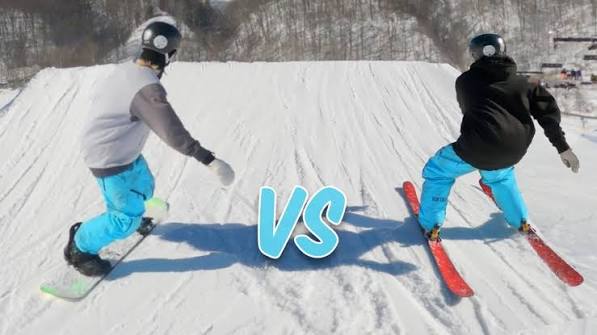
Tag: skiing

  • Skiing vs. Snowboarding: Which Winter Sport Is Easier to Learn?

    Skiing vs. Snowboarding: Which Winter Sport Is Easier to Learn?

    You’re standing at the rental shop, skis in one hand, snowboard in the other. The decision feels big, and it is—not because one is inherently better, but because your first few days on the mountain will be radically different depending on which you choose. The question isn’t just ‘which is easier?’ but ‘which is easier for you?’

    The short answer, according to ski instructors and industry data: skiing is easier to start but harder to master; snowboarding is brutal at first but clicks faster once you’re past the beginner phase. But that’s a simplification. The real difference lies in biomechanics, equipment, and your own physical and psychological makeup.

    Why Skiing Feels More Natural at First

    Skiing uses a stance that mirrors how you walk: feet forward, body facing downhill, legs moving independently. That’s why most beginners can make controlled turns within a day or two of lessons. The famous ‘pizza’ wedge (where you point your ski tips together) gives you immediate speed control—a psychological safety net that lets you focus on balance rather than panic.

    You can also ride the chairlift on your first day without learning a special skill. Skiers just shuffle off and slide. Snowboarders, by contrast, must unstrap one foot and ‘skate’—a wobbly, awkward motion that causes many a first-timer to eat snow at the unload ramp.

    Falls also feel different. Skiers slide when they fall; snowboarders catch an edge and slam. That’s part of why beginner snowboarders fall 2–3 times more often in the first 48 hours than skiers, according to instructor reports. More falls mean more soreness—in the wrists, butt, and core—and more frustration.

    The Snowboard’s Steep Start

    Snowboarding forces you into a sideways stance, like a skateboard or surfboard. Your body faces across the hill, not down it. For most people, that’s a complete retraining of balance and visual perception. There’s no ‘pizza’ equivalent—you have to commit to either your heel edge or toe edge, with no halfway safety position.

    Getting up from a seated position is a major hurdle. With both feet strapped to one board, you have to roll over, push up with your arms, and swing your board around—all while on a slope. It’s exhausting, especially on Day 1.

    But here’s the flip side: once you survive the first 2–3 days, the learning curve flattens dramatically. Many riders report a ‘breakthrough’ moment where everything clicks. After that, progression to carving and advanced terrain often happens faster than on skis. Because you only have one edge to manage, there’s less to think about at speed. The sideways stance becomes second nature, and some riders say it feels more natural at high speeds than skiing.

    The Numbers Behind the Learning Curves

    Industry data paints a clear picture of the trade-off. With professional instruction, most skiers achieve their first controlled stop in 1–2 hours; snowboarders need 2–4. Skiers link turns in 2–3 days; snowboarders take 3–5. But by the time you’re aiming for black diamond runs, snowboarders have closed the gap—and even pulled ahead. Skiers typically need 20–40 days to feel confident on advanced terrain; snowboarders often do it in 15–30.

    Retention stats tell a similar story. Ski schools report that 70–80% of first-time skiers return for a second lesson, versus 50–60% for snowboarders. The drop-off isn’t because snowboarding is worse—it’s because the first two days are so punishing that many people quit before the breakthrough.

    Injury patterns also differ. Skiing has a higher rate of knee injuries, especially ACL tears, which often happen at higher speeds. Snowboarding has more wrist and ankle injuries, mostly from falling on outstretched hands. Overall injury rates are similar, but the mechanism and prevention strategies differ.

    How Your Body and Mind Affect the Choice

    Your age, fitness, and athletic background matter more than you’d think. Children under 10 often learn snowboarding faster than adults because of their lower center of gravity and less fear. But for very young kids (ages 3–5), skiing’s simpler equipment still wins.

    Adults over 40 generally find skiing easier on the body initially. The fall-heavy learning curve of snowboarding is harder on joints and recovery. Skiing, however, is a constant quad workout—your thighs will scream after a day of pizza-ing.

    If you’re a skateboarder, surfer, or wakeboarder, you’ll likely pick up snowboarding much faster than the average person—your balance and edge control instincts already exist. Ice skaters and rollerbladers often have a head start on skis.

    Fear also plays a role. If you’re anxious about speed or falling, skiing’s wedge gives you a sense of control that can help you relax and learn. Snowboarding’s early falls can amplify fear. But if you’re the type who gets bored with cautious progress and wants a challenge, the snowboard’s steep start might be exactly what you need.

    The Verdict: Which Should You Choose?

    There’s no universal winner. If you want the fastest path to cruising down a green run with minimal pain, choose skiing. You’ll be making turns by day two and feeling like a skier on day three.

    If you’re willing to suffer through two days of falling and frustration for a smoother intermediate progression, choose snowboarding. The ‘aha’ moment is one of the most satisfying in sports—and once it hits, you’ll likely progress faster than your ski friends.

    Your physical condition matters too. If you have bad knees, skiing’s ACL risk and quad burn might be a concern. If you have weak wrists or a sore back, snowboarding’s fall-heavy start could be miserable.

    Talk to a local instructor, rent gear for a day, and try both if you can. The best choice is the one that keeps you coming back to the mountain—and that’s about your personality as much as your body.

    Ultimately, the ‘easier’ sport is the one that matches your tolerance for frustration and your physical strengths. Skiing offers a gentle on-ramp; snowboarding offers a steep climb with a rewarding view. Whichever you pick, take a lesson, wear a helmet, and give yourself at least three days before judging. The mountain will be there either way.

    Summary

    • Skiing is easier to start: most beginners can make turns in 1–2 days, thanks to the natural forward stance and the wedge for speed control.
    • Snowboarding is harder at first: expect 2–3 days of frequent falls (2–3x more than skiing) before things click.
    • Progress flips after the beginner phase: snowboarders often reach intermediate and advanced levels faster than skiers.
    • Injury patterns differ: skiing has more knee injuries (ACL); snowboarding has more wrist and ankle injuries.
    • Your background matters: surfers/skaters pick up snowboarding faster; skaters/ice skaters have an edge in skiing.

    FAQ

    Q: Which sport is less painful to learn?
    A: Skiing generally involves fewer falls in the first two days, so it’s less physically jarring. Snowboarding’s early falls can lead to sore wrists and tailbones.

    Q: Can I learn snowboarding if I’m over 40?
    A: Yes, but be prepared for a tougher first few days. Consider extra padding (wrist guards, crash shorts) and take lessons to minimize falls.

    Q: How long until I can go down a blue run?
    A: With lessons, most skiers feel comfortable on blues after 5–10 days; snowboarders often get there in 5–8 days, once past the initial hurdle.

    Q: Do I need to be fit to start?
    A: Basic fitness helps, but neither sport requires elite conditioning. Skiing uses quads heavily; snowboarding uses core and ankles. You’ll get sore either way—it’s part of the fun.

    Q: What’s the best way to decide?
    A: Try both if you can. Rent gear for a day, take a beginner lesson in each, and see which one you enjoy more. The ‘easier’ one is the one you’ll stick with.

  • Swiss Alps vs. Austrian Alps: A Scenic Showdown Based on the Facts

    🌍 Swiss Alps or Austrian Charm? Which one will steal your heart? 🏞️ Switzerland and Austria: Two breathtaking alpine destinations, strikingly similar yet uniquely beautiful! From Lucerne's stunning lake views to Hallstatt's

    The Swiss Alps and Austrian Alps are two of the most celebrated mountain ranges on Earth, each drawing millions of visitors with promises of breathtaking scenery. But which is truly more scenic? The answer isn’t as simple as picking a postcard favorite. It depends on what you value: the dramatic, high-altitude grandeur of Switzerland or the accessible, varied beauty of Austria.

    This comparison digs into the geological contrasts, iconic landmarks, and practical realities that shape the scenic experience in each country. From the Matterhorn’s perfect pyramid to Austria’s gentle limestone meadows, the two ranges offer distinct flavors of alpine beauty. Let’s break down the facts to help you decide which range will steal your heart.

    The Height Advantage: Grandeur vs. Accessibility

    Switzerland takes the crown for sheer vertical drama. Its Alps cover 60% of the country and include 48 peaks above 4,000 meters, with the Dufourspitze reaching 4,634 meters. The Matterhorn (4,478 m) is arguably the most recognizable mountain on Earth, a near-perfect pyramid that has become shorthand for the Alps themselves. This is a landscape of jagged granite and gneiss, carved by glaciers into deep valleys and towering cliffs.

    Austria’s highest peak, the Großglockner, stands at 3,798 meters—nearly a kilometer shorter than Switzerland’s top. But that doesn’t mean Austria lacks beauty; it offers a different kind. The Austrian Alps are dominated by limestone and dolomite, which erode into broad plateaus, rolling ridges, and dramatic karst formations. The Dachstein and Karwendel ranges showcase this softer, more approachable side of the Alps, with grassy slopes and extensive cave systems.

    Iconic Landmarks: A Tale of Two Postcards

    The classic Swiss landscape is defined by turquoise lakes, hanging valleys, and colossal glaciers. The Aletsch Glacier, a UNESCO World Heritage site, stretches 23 kilometers—the largest in the Alps. The Lauterbrunnen Valley, with its 72 waterfalls, inspired J.R.R. Tolkien’s Rivendell. Switzerland’s scenic train routes, like the Glacier Express and the Jungfrau Railway, have been ferrying awestruck passengers since the early 20th century.

    Austria counters with a different set of icons. The Grossglockner High Alpine Road is a masterpiece of engineering that snakes through 36 hairpin turns to offer panoramic views of the Pasterze Glacier, Austria’s largest. The Krimml Waterfalls (380 m) are the highest in Europe, and the Wolfgangsee and Zell am See lakes offer postcard-perfect reflections of the surrounding peaks. Austria’s alpine culture is deeply rooted in farming (Almwirtschaft), so you’ll encounter charming huts and grazing cattle, a pastoral beauty that Switzerland’s more rugged terrain lacks.

    Accessibility: Who Can Enjoy the View?

    Switzerland’s scenic wonders are often behind a pricey train ticket, but the experience is unmatched. The country pioneered mountain railways, with the Jungfraubahn reaching Europe’s highest station at 3,454 meters. Public transport is efficient, punctual, and integrated, but it comes at a cost. A single scenic rail journey can set you back over $100.

    Austria is the more budget-friendly option. Lift tickets, accommodation, and dining are significantly cheaper, and the lower peaks mean more accessible hiking trails. Austria has ~800 cable cars and lifts (vs. ~500 in Switzerland), making it easier to get up high without breaking the bank. The country also receives ~45 million overnight stays in alpine areas annually, compared to ~12 million in Switzerland, indicating a larger tourism volume that’s driven by winter sports and a robust après-ski culture.

    Winter Sports: The Skiing Verdict

    If skiing is your measure of scenic beauty, Austria wins decisively. It’s widely considered the skiing capital of Europe, with world-class resorts like St. Anton, Ischgl, and Sölden. The infrastructure is dense, the villages are lively, and the après-ski scene is legendary. Innsbruck, the capital of the Tyrol, hosted the Winter Olympics twice (1964 and 1976), cementing Austria’s alpine sporting pedigree.

    Switzerland offers higher-altitude skiing with more reliable snow, but at a premium price. Resorts like Zermatt and St. Moritz are synonymous with luxury and exclusivity, but they’re also more expensive and less accessible than their Austrian counterparts. For the average skier who wants great slopes without the sticker shock, Austria is the clear choice.

    The Verdict: It Depends on Your Definition of Scenic

    So, which is more scenic? The answer lies in what you seek. If you want awe-inspiring, high-altitude grandeur that feels like a postcard come to life, Switzerland delivers. The Matterhorn, the Aletsch Glacier, and the sheer verticality of the landscape are unforgettable.

    If you prefer scenery that’s more accessible, varied, and kind to your wallet, Austria is your destination. The limestone plateaus, alpine meadows, and gentle valleys offer a different but equally valid form of beauty, one that invites you to wander through it rather than merely gaze at it from a train window.

    Ultimately, the Swiss Alps and Austrian Alps are both spectacular, but they speak to different sensibilities. Switzerland is the dramatic overachiever, while Austria is the accessible charmer. Choose Switzerland for an epic, once-in-a-lifetime alpine spectacle. Choose Austria for a scenic vacation that’s easier on the legs and the budget. Either way, you’ll be surrounded by some of the most beautiful mountains on the planet.

    Summary

    • Swiss Alps: Higher peaks (48 over 4,000 m), iconic Matterhorn, largest glacier (Aletsch), dramatic granite peaks, but pricier and less accessible.
    • Austrian Alps: Lower peaks (highest: Großglockner at 3,798 m), limestone plateaus, more accessible hiking, cheaper infrastructure, and better for winter sports.
    • Scenic variety: Switzerland offers postcard-perfect, vertical drama; Austria offers diverse landscapes including karst, meadows, and waterfalls.
    • Tourism stats: Austria gets ~45 million alpine overnight stays vs. ~12 million in Switzerland, reflecting its larger winter tourism draw.
    • Practical tip: Choose Switzerland for grandeur and iconic views; choose Austria for budget-friendly, accessible beauty.

    FAQ

    Q: Which country has the highest peak in the Alps?
    A: Switzerland. The Dufourspitze in the Monte Rosa massif reaches 4,634 meters, while Austria’s highest, the Großglockner, is 3,798 meters.

    Q: Are the Austrian Alps less scenic than the Swiss Alps?
    A: Not necessarily. They offer a different kind of scenery—gentler limestone formations, grassy plateaus, and more accessible trails—while Switzerland is known for dramatic, high-altitude peaks and glaciers.

    Q: Which is better for skiing, Switzerland or Austria?
    A: Austria is generally considered better for skiing due to its larger number of resorts (~800 lifts), more developed après-ski culture, and lower costs. Switzerland has higher-altitude skiing but is more expensive.

    Q: Which country has more hiking trails?
    A: Switzerland has about 65,000 km of marked trails, compared to Austria’s ~50,000 km. However, Austrian trails are often easier and more suitable for casual hikers.

    Q: What are the most iconic scenic landmarks in each country?
    A: Switzerland’s icons include the Matterhorn, the Aletsch Glacier, and the Lauterbrunnen Valley. Austria’s icons include the Großglockner High Alpine Road, the Krimml Waterfalls, and the Zell am See lake.

  • Canadian Rockies vs. US Rockies: Which Mountain Range Reigns Supreme?

    Canadian Rockies or American Rockies: Which Should You Visit?

    North America’s Rocky Mountains stretch from British Columbia down to New Mexico, but the experience on each side of the border is wildly different. Canadian peaks are dramatic, glaciated, and cloaked in emerald forests, while their US counterparts are higher, drier, and geologically older.

    This isn’t just a matter of national pride. The differences shape everything from the color of the lakes to the type of rock under your boots. Whether you’re planning a bucket-list road trip or simply curious about what makes each range unique, understanding these distinctions will change how you see the mountains.

    The Tale of Two Ranges: Same Family, Different Personalities

    Both the Canadian and US Rockies were born from the same tectonic collision—the Laramide Orogeny, which began around 80 million years ago. But time and geology have treated them differently.

    The Canadian Rockies are younger in terms of erosion. Composed primarily of sedimentary rock—limestone, shale, and quartzite—they were thrust upward along faults, creating sharp, jagged peaks with dramatic vertical relief. Glaciers, like the massive Columbia Icefield, still carve these mountains, giving them a raw, alpine feel.

    In contrast, the US Rockies are geologically older and more eroded. The Southern Rockies, especially in Colorado, are largely igneous and metamorphic—granite and gneiss—with broad, rounded summits that have been weathered over millions of years. The Northern Rockies, stretching through Montana and Idaho, mix sedimentary and volcanic rock, offering a different kind of ruggedness.

    This geological contrast is visible at a glance. Canadian peaks often look like cathedral spires, while Colorado’s fourteeners—peaks above 14,000 feet—resemble giant, ancient humps.

    Elevation: The US Takes the Crown

    If you’re chasing altitude, the US Rockies win outright. Mount Elbert in Colorado stands at 14,440 feet (4,401 meters), the highest point in the entire range. Colorado alone boasts 58 fourteeners, a playground for peak baggers.

    The Canadian Rockies’ highest peak, Mount Robson, reaches only 12,972 feet (3,954 meters). But don’t let the lower numbers fool you. The Canadian Rockies are more rugged and heavily glaciated, meaning the vertical relief—the difference between valley floor and summit—can be just as staggering. A 10,000-foot climb on a Canadian peak can feel more intimidating than a 14,000-foot summit in Colorado.

    National Parks: The Crown Jewels

    Both sides have world-renowned protected areas, but they offer different experiences.

    Canadian Rockies: Banff, established in 1885, is Canada’s first national park and the anchor of a contiguous string of parks: Jasper, Yoho, Kootenay, and Waterton Lakes. Together with Montana’s Glacier National Park, they form the Waterton-Glacier International Peace Park. The iconic Icefields Parkway, connecting Banff and Jasper, is consistently ranked among the world’s most scenic drives. Turquoise glacial lakes like Lake Louise and Moraine Lake are so vivid they look Photoshopped.

    US Rockies: Rocky Mountain National Park in Colorado draws around 4.5 million visitors annually, slightly more than Banff’s 4 million. But the US side offers more variety: the geothermal wonders of Yellowstone, the jagged spires of Grand Teton, and the rugged wilderness of Glacier. If you want to see grizzly bears and glaciers, Glacier is your spot; if you want hydrothermal features and bison, Yellowstone delivers.

    Recreation: Skiing vs. Hiking

    When it comes to skiing, the US Rockies are the undisputed champion. Colorado alone has about 30 ski resorts, including Vail, Aspen, and Breckenridge. The combination of high altitude, abundant sunshine, and reliable snow makes it a global skiing destination. Wyoming’s Jackson Hole and Montana’s Big Sky add to the roster.

    The Canadian Rockies have fewer resorts, but they’re world-class. Banff’s Sunshine Village and Lake Louise offer stunning scenery, while Kicking Horse in British Columbia is known for its challenging terrain. The trade-off: Canadian ski resorts often have longer seasons and lighter crowds, though the weather can be harsher.

    For hiking and backpacking, both ranges excel. The Canadian Rockies offer incredible trail networks, but the US side has more miles of trail and greater diversity—from desert-like foothills in New Mexico to alpine tundra in Colorado. The Continental Divide Trail runs through both countries, offering a continuous wilderness experience.

    Wildlife and Ecology: Cool and Wet vs. Warm and Dry

    The Canadian Rockies are cooler and wetter, with more precipitation falling as snow. This creates lush subalpine forests of Engelmann spruce and lodgepole pine, plus alpine tundra. You’ll find grizzly bears, caribou, mountain goats, and wolverines here.

    The US Rockies are drier and sunnier, especially in the south. Lower elevations feature piñon-juniper woodlands and ponderosa pine. Wildlife includes elk, bighorn sheep, black bears, and, in the northern reaches, grizzly bears. The Greater Yellowstone Ecosystem is one of the last places in the lower 48 where you can see wolves, bears, and bison in their natural habitat.

    The Cultural and Economic Angle

    Indigenous peoples have called these mountains home for millennia—the Stoney-Nakoda and Ktunaxa in Canada, the Ute and Shoshone in the US. The arrival of the Canadian Pacific Railway in the 1880s turned Banff into a resort town, while the Colorado Gold Rush and later silver booms drove settlement in the US.

    Today, tourism dominates both economies. But the US side has also become a hub for tech and remote work, with Boulder and Bozeman attracting a new wave of residents. Ski towns like Aspen and Vail are synonymous with luxury, while Canadian towns like Jasper and Canmore maintain a more understated vibe.

    Which Range Should You Visit?

    If you want dramatic, glacier-carved peaks and iconic turquoise lakes, head to Canada. If you prefer high-altitude summits, varied landscapes, and world-class skiing, the US side won’t disappoint. Many travelers do both—the ranges are connected by the Continental Divide, and you can drive from Banff to Denver in about 20 hours, taking in the best of both worlds.

    Ultimately, there’s no loser here. Both ranges are magnificent expressions of the same mountain-building forces, each with its own character. The real question is what kind of mountain experience you’re after.

    Whether you’re standing on a Colorado fourteeners or gazing at Lake Louise, you’re witnessing the same ancient mountain system. The Canadian Rockies offer dramatic, glaciated scenery; the US Rockies counter with higher peaks and greater variety. Choose based on your taste, but either way, you’re in for a king’s view.

    Summary

    • The Canadian Rockies are generally lower but more rugged and glaciated, with peaks like Mount Robson (12,972 ft).
    • The US Rockies are higher, with Mount Elbert (14,440 ft) as the highest point in the entire range and 58 fourteeners in Colorado alone.
    • Geologically, Canadian peaks are younger sedimentary rock, while US Southern Rockies are older igneous/metamorphic rock.
    • Banff and Jasper in Canada offer iconic turquoise lakes and the Icefields Parkway; US parks like Yellowstone, Grand Teton, and Rocky Mountain National Park provide more variety.
    • For skiing, the US (especially Colorado) dominates, but Canada has fewer, equally impressive resorts with lighter crowds.

    FAQ

    Q: Which is higher, the Canadian Rockies or the US Rockies?
    A: The US Rockies are higher overall. The highest peak in the entire range is Mount Elbert in Colorado at 14,440 feet, while the highest Canadian peak, Mount Robson, is 12,972 feet.

    Q: What is the most scenic drive in the Canadian Rockies?
    A: The Icefields Parkway, connecting Banff and Jasper, is widely considered one of the most scenic drives in the world, passing by glaciers, turquoise lakes, and towering peaks.

    Q: Are there grizzly bears in both ranges?
    A: Yes, grizzly bears are found in both the Canadian Rockies and the northern US Rockies, particularly in Glacier National Park and the Greater Yellowstone Ecosystem.

    Q: Which range has better skiing?
    A: The US Rockies, especially Colorado, have more ski resorts (about 30 in Colorado alone) and are renowned for their high-altitude, sunny conditions. Canada has fewer but still world-class resorts like Lake Louise and Sunshine Village.

    Q: Can I visit both ranges in one trip?
    A: Absolutely. You can drive from Banff, Canada, to Denver, Colorado, in about 20 hours, taking in the Canadian Rockies, Glacier National Park, Yellowstone, and the Colorado Rockies along the way.